

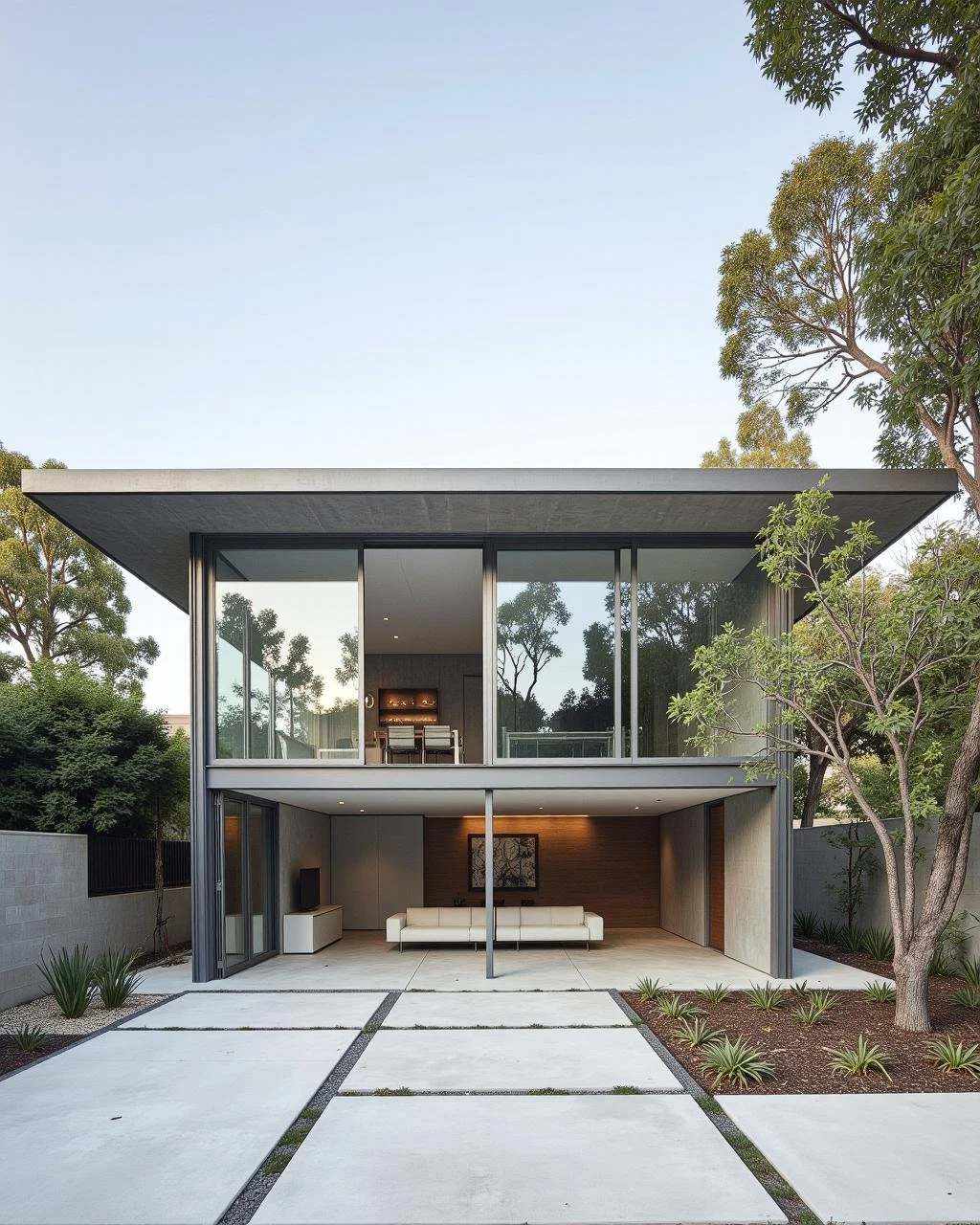
Accessory Dwelling Unit Plans & Design for Los Angeles Homeowners
Six thoughtfully designed accessory dwelling unit plans — from a 462 sq ft studio to a 1,131 sq ft two-bedroom cottage. Every layout is permit-ready and fully customizable.

6 SIGNATURE FLOOR PLANS
100% FULLY CUSTOMIZABLE
462 - 1,131 SQUARE FEET RANGE
1-2 BEDROOM OPTIONS
WHAT IS AN ADU?
An accessory dwelling unit (ADU) is a self-contained residential structure built on the same lot as a primary home. Whether you call it a backyard cottage, in-law suite, granny flat, or secondary unit — the premise is the same: a fully functional home in a compact, efficient footprint.
Modern ADU design has evolved far beyond converted garages. Today's accessory dwelling units are architect-designed, permit-ready structures that blend seamlessly with the main property while delivering every comfort of a full-size home: private entrance, complete kitchen, bathroom, living space, and bedroom.
Our ADU plans are developed by experienced ADU designers who understand local zoning codes, setback requirements, and construction realities. Each floor plan in our collection has been refined through real builds — so what you see is what you get, down to the last square foot.
Whether you need a rental income unit, a space for aging parents, a home office with a guest suite, or a long-term investment in your property value, there is an ADU building plan in our collection designed precisely for that need.
SMART HOMES FOR EVERY PROPERTY
Why Build an ADU?
-Generate rental income of $1,200–$3,500/month
-Add 20–30% to your overall property value
-House family members with full independence
-Create a dedicated home office or studio
-Faster to permit & build than a full addition
-Lower cost per sq ft than primary home construction
-Flexible - use changes as your life does
OUR ADU HOUSE PLANS
Every plan below is a fully realized accessory dwelling unit design — complete with room dimensions, fixture layouts, and material specifications. All are permit-ready and customizable to your lot and style preferences.
6 Signature ADU Floor Plans
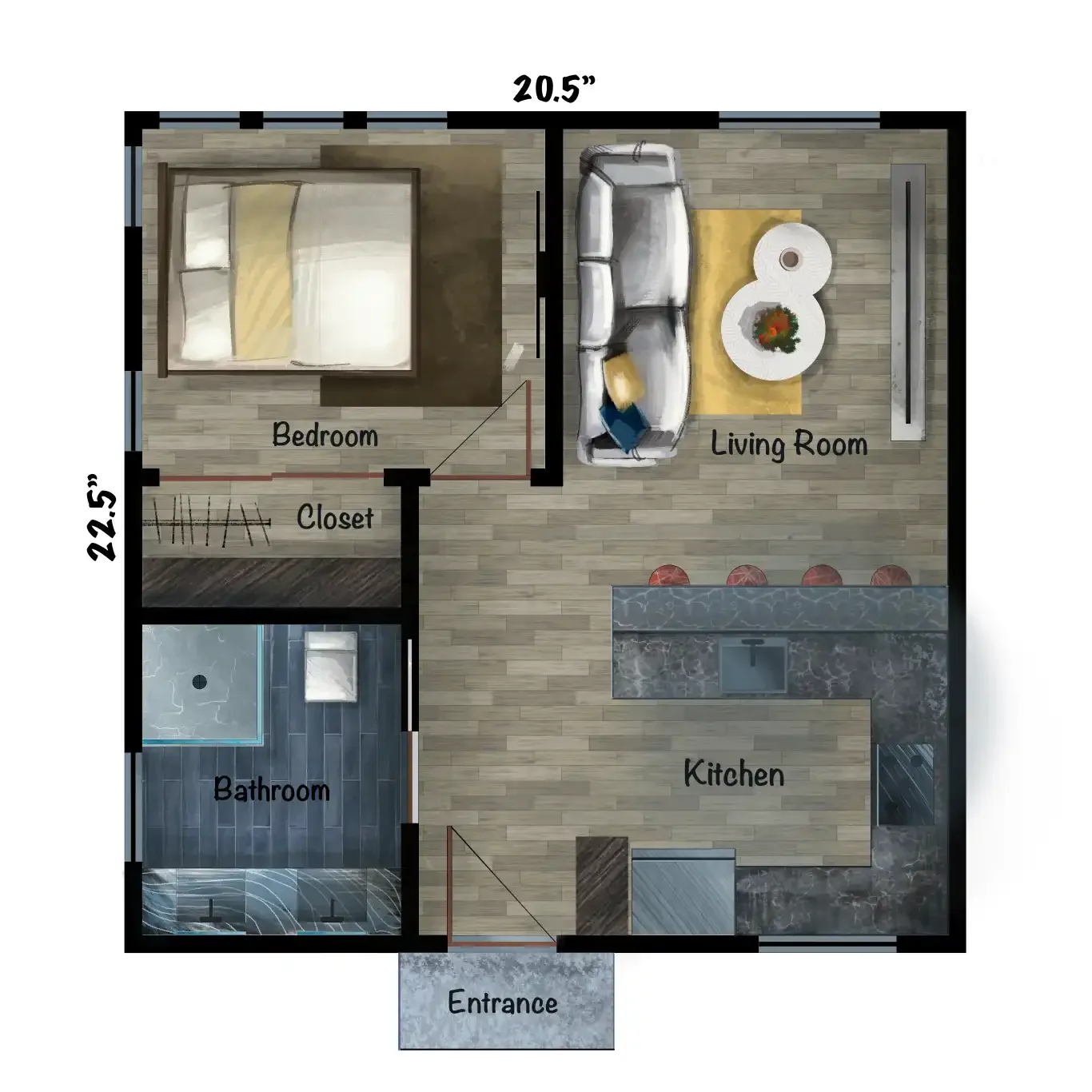
The Sage proves that a small ADU doesn't mean a compromised one. At just 462 square feet, this compact accessory dwelling unit design delivers everything a full-size apartment offers — just without the wasted space that most renters never use anyway.
The floor plan is deceptively efficient. A square footprint eliminates the long corridors and awkward transitions that plague so many small ADU house plans, putting every square foot to work. The result is a unit that feels complete and considered, not squeezed.
The bedroom is a proper room with a real door and a walk-in closet — not a sleeping alcove carved out of a studio layout or a Murphy bed tucked behind a partition. Privacy and storage are built in from the start, which matters enormously to long-term tenants who are choosing between your ADU and a one-bedroom apartment down the street.
The bathroom features a full shower enclosure — not a tub-shower combo added as an afterthought — with enough floor space to feel like a bathroom, not a closet with plumbing. And the kitchen is a genuine full kitchen, not a kitchenette. That distinction is significant: a real kitchen with full-size appliances, counter space, and proper storage is one of the single biggest factors in what renters will pay and how long they'll stay.
The living room is bright and open, positioned to maximize natural light and create a genuine sense of arrival when you walk through the front door.
For homeowners building their first ADU, or anyone working with a tight lot and a defined budget, The Sage delivers apartment-quality living in the smallest possible footprint — and commands rents that reflect it.
1 BED - 1 BATH = 462 sq. ft
THE SAGE ADU
1 BED - 1 BATH = 756 sq. ft
The Birchwood is our most popular one-bedroom ADU plan — and once you see the layout, it's easy to understand why.
Most one-bedroom ADU designs fall into a familiar trap: they're essentially studios with a door added to one end. The bedroom feels tacked on, the living space feels compressed, and the whole unit reads as an afterthought rather than a home. The Birchwood was designed specifically to solve that problem.
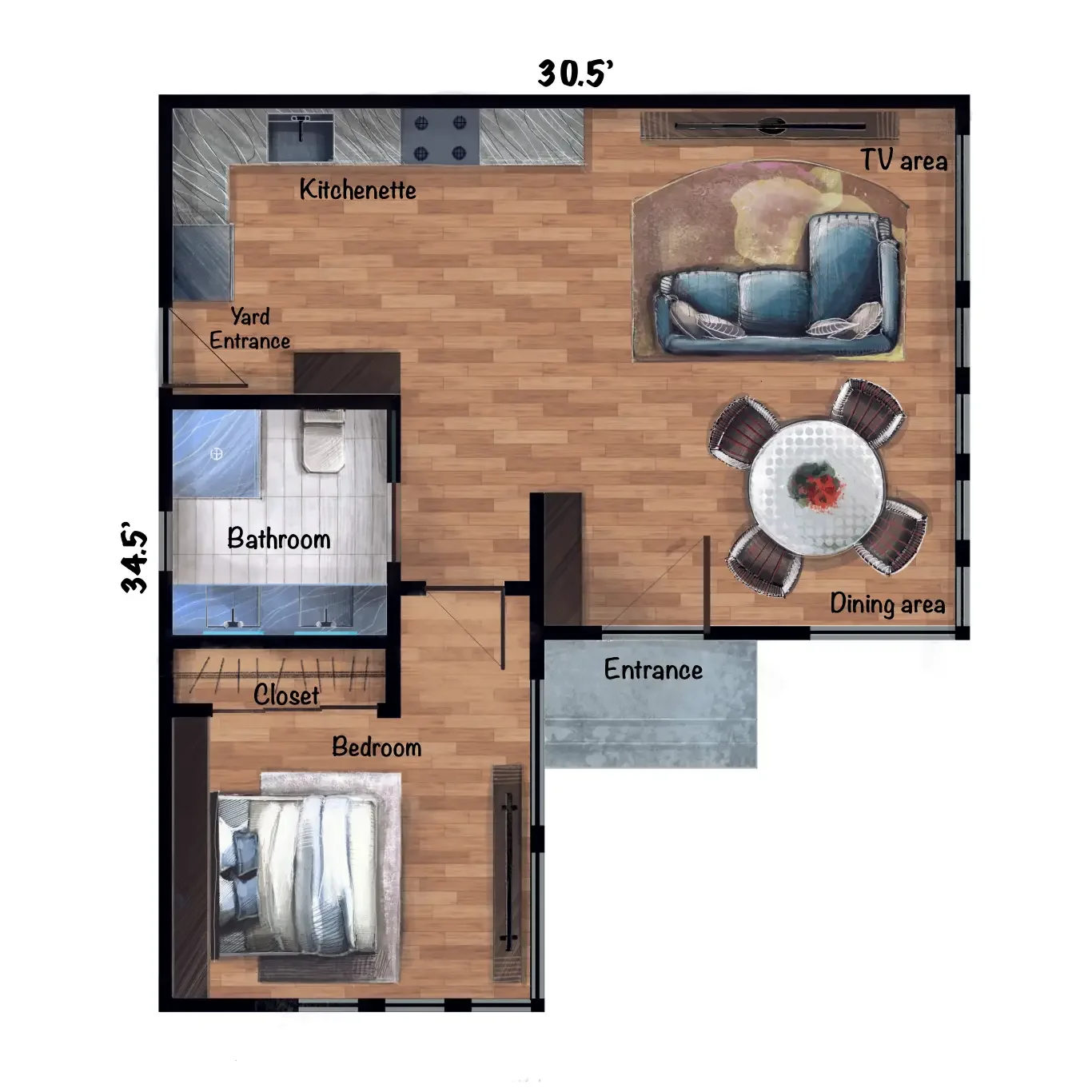
The key is the L-shaped layout. Rather than stacking rooms in a single corridor, the plan bends — placing the private bedroom wing along one axis and the open living zone along the other. The result is a genuine sense of separation between where you sleep and where you live, without burning square footage on hallways that serve no other purpose.
The bedroom wing contains everything it needs to feel complete: a properly sized room with a dedicated closet and a full bathroom directly accessible from the sleeping area. No walking through the kitchen at 6am. No sharing a bathroom that opens onto the living room. Just a private, quiet space that functions exactly the way a bedroom in a full-size home would.
On the other side of the L, the open living zone flows naturally between the kitchenette, a dedicated dining area, and a TV lounge. These three functions are distinct but connected — the kind of layout that photographs well, lives well, and rents well. Tenants can cook, eat, and relax without the spaces competing with each other.
Perhaps the most underrated feature of The Birchwood is its dual entrance design. A front entrance handles the primary access, while a yard entrance — positioned on the side of the unit — gives the occupant a private connection to outdoor space without passing through the main home's territory. For rental properties especially, that separation of access is worth its weight in gold. It gives tenants genuine independence and gives homeowners a clean boundary between the two households sharing a lot.
The Birchwood works on almost any property configuration and suits a wide range of occupants — a single professional, a couple, a remote worker who needs a defined living space, or a parent housing an adult child nearby. It is, in every sense, a proper home — just efficiently scaled.
THE BIRCHWOOD ADU
1 BATH - STUDIO = 385 sq. ft
Efficiency taken to its highest form. The Foxden Studio is a masterclass in what intelligent accessory dwelling unit design can achieve when every square foot is treated as intentional rather than incidental.
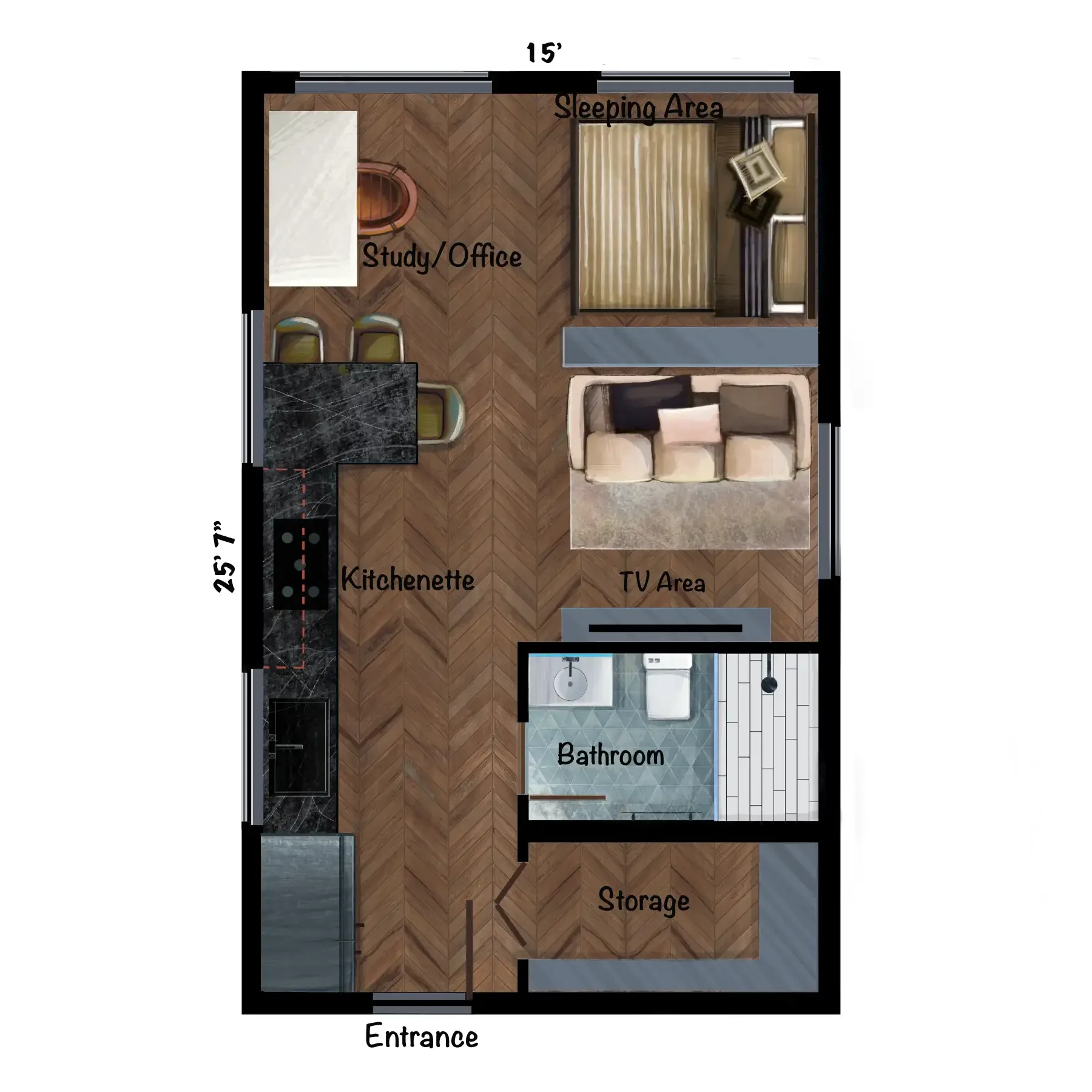
At under 390 square feet, the plan fits a kitchenette, dining nook, study/office, TV area, sleeping zone, full bathroom, and dedicated storage — and it does so without the compressed, claustrophobic feeling that haunts most studio ADU house plans of this size. The difference is in the zoning. Rather than leaving the interior as one undivided room and letting furniture define the functions, the Foxden Studio uses deliberate spatial planning to give each zone its own address within the open plan.
The sleeping zone is positioned away from the primary living and work areas, creating a psychological separation between rest and activity even without a wall between them. The study and office nook sits where natural light and sight lines support focused work — not squeezed into a leftover corner as an afterthought. The dining nook anchors the kitchenette without bleeding into the TV area, so cooking, eating, and relaxing each feel like distinct experiences rather than one blurred room with too much furniture in it.
The full bathroom punches well above its weight for a plan of this scale — a proper wet room with everything a tenant or guest needs, finished to the same standard as the rest of the unit.
Storage, the perennial weakness of small ADU building plans, is baked into the layout from the start rather than solved with freestanding furniture after the fact. That matters for livability, for how the unit photographs, and for the caliber of tenant it attracts.
The Foxden Studio is the right ADU plan for three distinct situations. For homeowners with constrained lots where a larger footprint simply isn't possible, it delivers a fully functional dwelling within a minimal land impact. For budget-conscious builds, the smaller square footage reduces construction cost significantly without sacrificing the quality of the living experience. And for short-term rental use — where guests prioritize design, functionality, and a sense of place over raw square footage — the Foxden Studio consistently outperforms larger but less considered layouts. Small, yes. But never small in ambition.
THE FOXDEN ADU
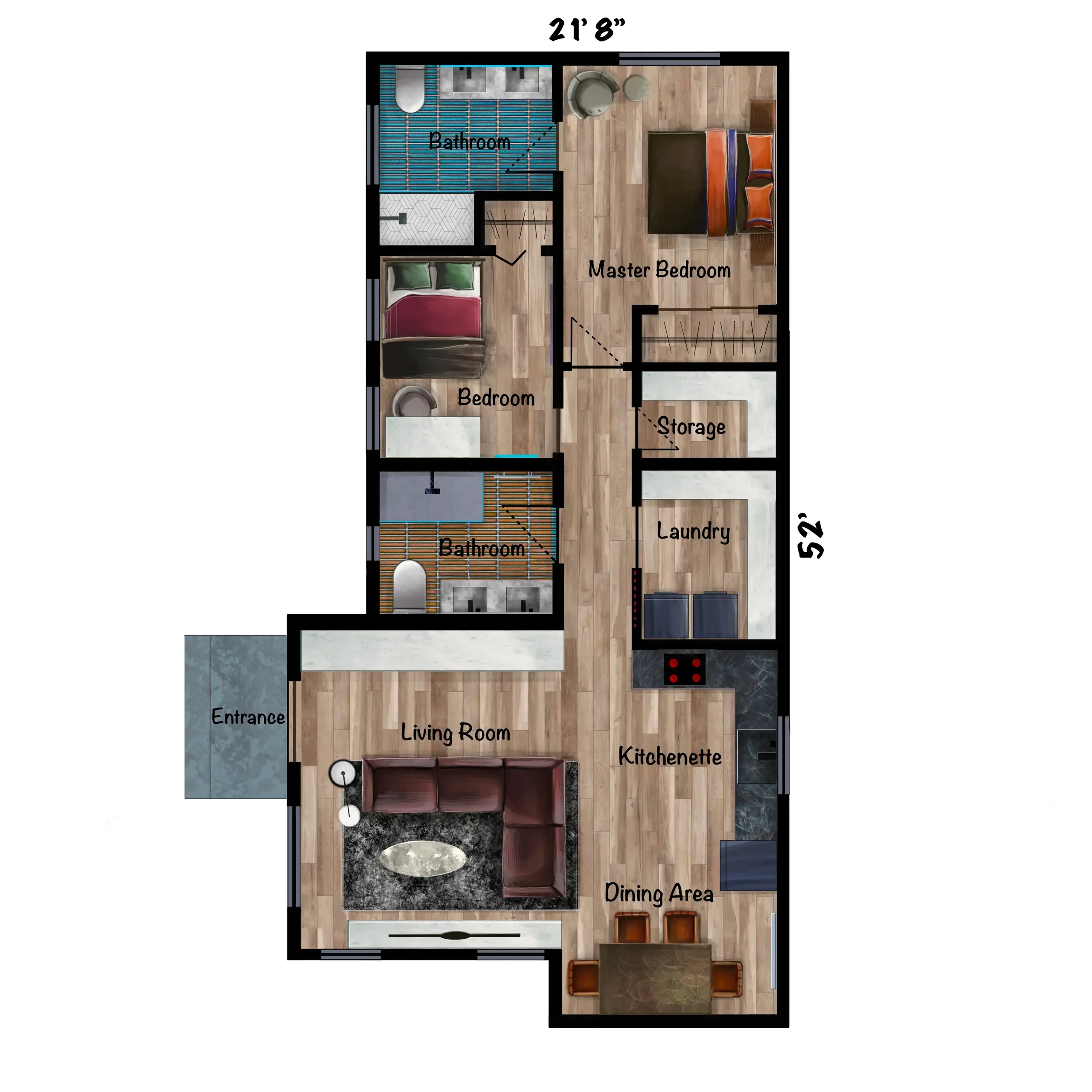
2 BATH - 2 BEDs = 1,131 sq. ft
The Meridian is our largest and most complete accessory dwelling unit design — and it was built to solve a problem that stops a lot of ADU projects before they start.
Narrow lots. Deep lots. Properties where the usable building envelope is long and thin rather than wide and open. These are the sites that most standard ADU house plans simply weren't designed for — and where homeowners are often told their options are limited. The Meridian was drawn specifically for these conditions, and at 21′8″ × 52′ covering 1,131 square feet across a vertical layout, it turns what looks like a constraint into one of the most livable ADU floor plans in our entire collection.
The logic of the plan is straightforward: stack the public and private zones cleanly, one above the other, with a clear threshold between the two. At street level, the living room and dining area occupy the full width of the footprint, open to each other but distinct in function. This is not a kitchenette tucked into a corner of a studio. The Meridian has a proper dining area — a dedicated space with room for a real table, real chairs, and the kind of meal that takes two hours to prepare and deserves somewhere worthy to be eaten. For tenants who cook, who host, who treat their home as more than a place to sleep, that distinction matters enormously. It is one of the primary reasons the Meridian commands some of the highest rental rates of any plan in our collection.
The kitchenette connects directly to the dining area, keeping the relationship between cooking and eating natural and efficient. The living room anchors the front of the plan, positioned to receive the best natural light and create a genuine sense of arrival from the entrance.
Move upstairs and the plan shifts entirely into private territory. The master bedroom occupies its own dedicated zone — properly sized, properly proportioned, with none of the compromises that come from trying to fit a primary bedroom into a plan that was never designed to hold one. The second bedroom sits adjacent, separated enough to function independently, close enough to share the bathroom that serves both rooms. Two full bathrooms across the plan means two occupants never have to negotiate morning schedules. The laundry is built into the upper level as well — positioned where it makes the most sense logistically, close to the bedrooms where laundry actually originates. Storage is integrated throughout rather than treated as an afterthought.
The Meridian is the ADU plan for homeowners who want to offer something genuinely different in their rental market — a two-bedroom, two-bathroom dwelling with a real dining room, real laundry, and real separation between living and sleeping. On a narrow lot that most builders would pass on, it delivers a home that a tenant could live in comfortably for years.
THE MERIDIAN ADU
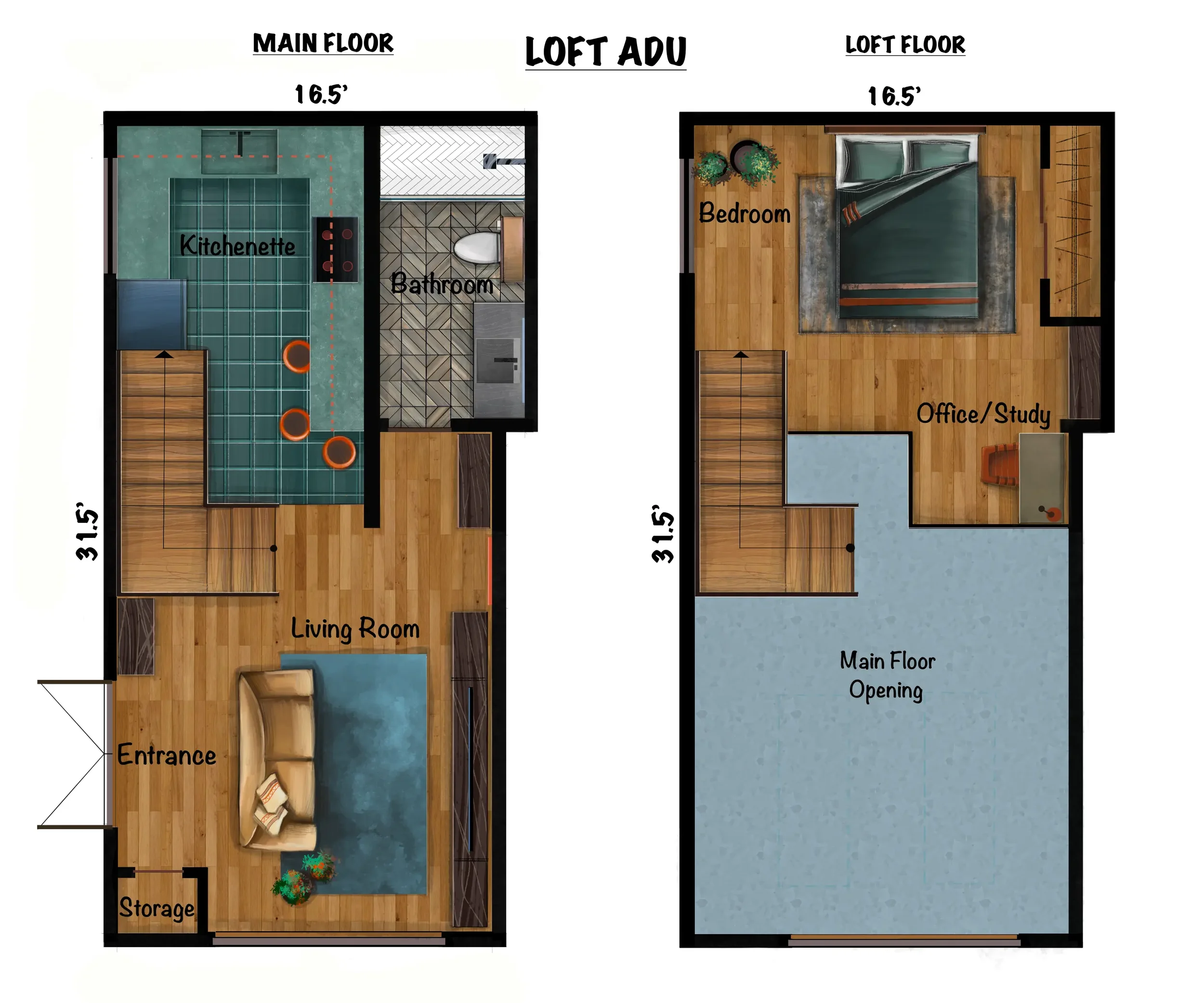
LOFT, 1 BATH - 1BEd = 767 sq. ft
The Atelier Loft does what no single-story ADU plan can — it builds upward.
At 16.5′ × 31.5′ on the main floor with a 15′ × 16.5′ loft above, this two-story accessory dwelling unit design solves one of the most common constraints homeowners face: a lot that isn't wide enough or deep enough for a larger footprint, but still needs to deliver a complete, comfortable dwelling. The answer isn't to compress the program into a cramped single level. The answer is to go vertical.
The main floor is organized around three clear functions. The kitchenette sits at the front of the plan, efficiently laid out and fully equipped for everyday cooking without occupying more floor area than it needs to. The bathroom is tucked adjacent — full, properly finished, and accessible without passing through any other room. The living room occupies the heart of the main floor, generous in feel if not in raw square footage, anchored by the dramatic double-height ceiling that opens upward to the loft above. That vertical volume is the defining feature of the Atelier Loft — the moment someone walks through the front door, the space reads as something far larger than its footprint suggests. Storage is built into the base of the staircase, keeping the living area clean and uncluttered.
The staircase itself is more than a functional connection between levels. It is the architectural spine of the unit — the element that makes the loft feel like a genuine two-story home rather than a box with a ladder attached.
Upstairs, the 15′ × 16.5′ loft level is divided between two distinct zones. The bedroom occupies the quieter end of the floor — a proper sleeping space with room for a full bed, bedside furniture, and natural light from above. It sits far enough from the stair landing to feel private, which matters in a plan where visual openness is one of the defining qualities. On the other side of the loft, the office and study area gives the occupant a dedicated workspace that is genuinely separate from both the sleeping area and the living floor below. For remote workers, this separation is not a luxury — it is the difference between a unit they'll stay in long-term and one they'll outgrow in six months. For creatives, the elevated position, natural light, and separation from the main living activity makes it an ideal studio or creative space.
The Atelier Loft is the ADU house plan for the lot that everyone else said couldn't fit a real dwelling. It can. It just needed to think in three dimensions.
THE ATELIER LOFT ADU
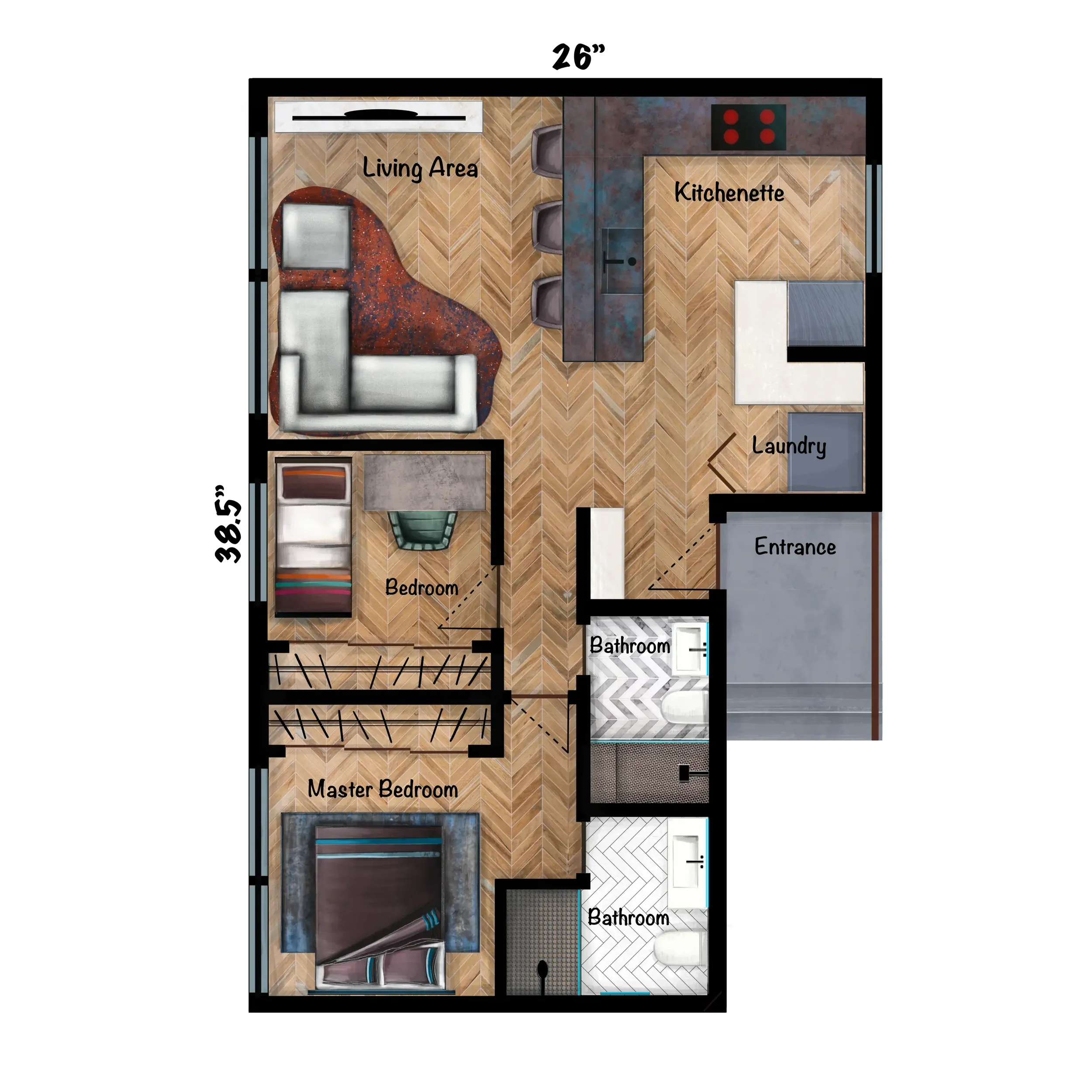
2 BEDs, 2 BATH = 1,001 sq. ft
The Hawthorn is the plan for people who are done compromising.
At 26′ × 38.5′ and just over 1,000 square feet, this is a two-bedroom accessory dwelling unit design built for full-time, long-term living — not occasional guest use, not a short-term rental experiment, not a converted garage with a bed in it. The Hawthorn is a proper home, scaled efficiently for a secondary lot position but designed with every consideration that goes into a primary residence.
The floor plan opens into a living area that sets the tone immediately. There is genuine room here — room for a real sofa, a coffee table, a rug that defines the space rather than just covering it. The kitchenette sits adjacent, connected to the living zone in a way that makes cooking feel like participation rather than isolation. A dining configuration fits naturally between the two, creating the kind of open social layout that tenants photograph when they're trying to convince a partner or roommate that yes, this is the one.
What separates the Hawthorn from every other two-bedroom ADU house plan in our collection is how it handles the private zone. A shared hallway runs between the master bedroom and the secondary bedroom, giving each room its own threshold and its own sense of arrival. This is not a small detail. In multigenerational living situations — a parent and adult child, two siblings, a homeowner and a long-term tenant sharing a lot — the difference between a hallway and a direct shared wall is the difference between a living arrangement that works and one that creates friction within months. Privacy is built into the architecture, not negotiated around it.
The master bedroom is a genuine primary suite in every practical sense: enough square footage for a king bed and furniture, proportioned correctly, and served by its own bathroom. The secondary bedroom is equally considered — not a box with a window, but a real room with real dimensions that a person could make their own. The second bathroom serves both the secondary bedroom and the common areas, keeping morning routines separate and the overall floor plan functional for two occupants living independently under one roof.
The dedicated laundry is one of the Hawthorn's most underappreciated features. In the rental market, in-unit laundry is consistently ranked among the top two or three amenities tenants are willing to pay more for. In a multigenerational context, shared laundry logistics are one of the most common sources of household friction. Having it built into the plan — not added as a closet conversion later — keeps the unit clean, the tenants happy, and the rent where it should be.
THE HAWTHORN ADU
ADU DESIGNER GUIDANCE
How To Choose the Right ADU Plan
Every ADU building plan begins with your property. Lot size, shape, and setback rules determine which footprints are possible before any design decision is made. Our ADU designers will pull your parcel data and zoning code on day one so you're never designing toward something unbuildable
I - Start with Your Lot
Every ADU building plan begins with your property. Lot size, shape, and setback rules determine which footprints are possible before any design decision is made. Our ADU designers will pull your parcel data and zoning code on day one so you're never designing toward something unbuildable
2 - Define the End Use
3 - Match Square Footage to Budget
ADU construction typically costs $250–$450 per square foot depending on finishes, site conditions, and local labor markets. Our compact plans like the Foxden Studio and The Sage deliver the highest return on investment for budget-conscious builds, while the Meridian and Hawthorn command premium rents that justify the larger construction investment.
Every ADU building plan begins with your property. Lot size, shape, and setback rules determine which footprints are possible before any design decision is made. Our ADU designers will pull your parcel data and zoning code on day one so you're never designing toward something unbuildable
4 - Choose Your Exterior Style
Every ADU building plan begins with your property. Lot size, shape, and setback rules determine which footprints are possible before any design decision is made. Our ADU designers will pull your parcel data and zoning code on day one so you're never designing toward something unbuildable
5 - Customize & Permit
Let’s Discuss Your ADU Design & Plans
FREQUENTLY ASKED QUESTIONS
ADU Plans & Designs Questions

SHARE THESE ADU PLANS WITH YOUR FRIENDS & FAMILY.
How much does it cost to build an ADU?
ADU construction costs vary by size, site conditions, finishes, and local labor markets. As a general guide, expect $250–$450 per square foot for a fully finished accessory dwelling unit. A compact studio plan like The Foxden or The Sage typically comes in between $95,000–$175,000, while a two-bedroom plan like The Hawthorn or Meridian ranges from $250,000–$450,000. We provide detailed cost estimates during your free consultation based on your specific lot and plan selection.
Absolutely. Every plan in our collection is a starting point, not a final product. Our ADU designers can modify room configurations, window placement, door swings, fixture selections, exterior cladding, rooflines, and more. Minor modifications are included in our design fee; more significant layout changes are quoted separately. Our goal is a plan that's perfectly suited to your property and your life.
Can I customize these ADU plans?
Do ADUs require separate utility connections?
This depends on your local jurisdiction and your preferences. In most cities, ADUs can be connected to the main home's existing utilities (water, electric, gas), which reduces upfront connection costs. Separate metering is optional in most cases but may make sense if you plan to rent the unit long-term, as it simplifies billing for both you and the tenant. Our team will walk you through the best utility strategy for your specific situation during the planning phase.
How long does it take to build an ADU?
From plan selection to move-in day, most ADU builds take 9–14 months. This includes 2–4 months for permitting (depending on your municipality) and 5–8 months of construction. Pre-designed ADU house plans like ours significantly reduce design time compared to custom projects built from scratch, which can add 3–6 months to the timeline.
What is the difference between an ADU and a JADU?
A Junior ADU (JADU) is a smaller unit — typically under 500 sq ft — created within the existing footprint of the main home, such as a converted bedroom or garage. A full ADU is a separate, self-contained structure with its own entrance, kitchen, and bathroom. Our plans are all full ADUs, meaning they are fully independent structures, not conversions. Both types are eligible for rental income and add value to your property.
Which ADU plan is best for rental income?
For maximum monthly rental income, the two-bedroom plans — The Hawthorn and The Meridian — command the highest rents in most markets, typically $2,200–$3,500/month depending on location. For the best return on investment (rental income relative to build cost), The Birchwood one-bedroom plan consistently performs best. Our ADU designer team can model projected rental income for any plan based on your specific zip code and market conditions.
We design and build accessory dwelling units across Los Angeles and the surrounding communities. Our team understands the specific zoning codes, setback requirements, design review processes, and permitting nuances that vary from one city to the next across greater Los Angeles — and that local knowledge is what keeps our projects moving from plan to permit to build without unnecessary delays.
We are primarily focused on Los Angeles, Santa Monica, and Pasadena, with deep experience across the Westside including Beverly Hills, Brentwood, Pacific Palisades, Malibu, and Culver City. We regularly work throughout the Beach Cities — Manhattan Beach, Hermosa Beach, and Redondo Beach — as well as the Pasadena area including Altadena, South Pasadena, and San Marino. Our wider service area extends across the San Fernando Valley.
Not sure if we cover your neighborhood? Reach out directly. Every project begins with a free site assessment — we review your lot, your zoning, and your goals before a single dollar is spent on design or permitting.