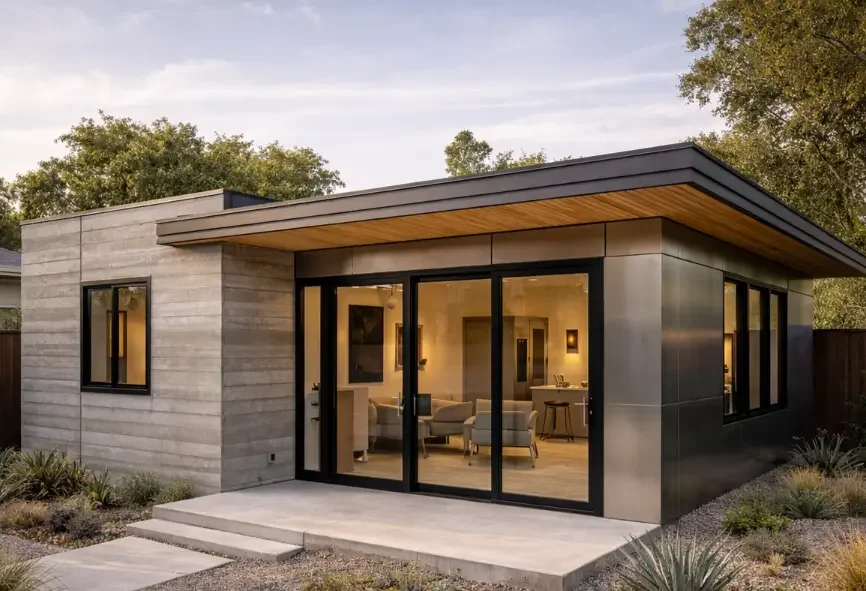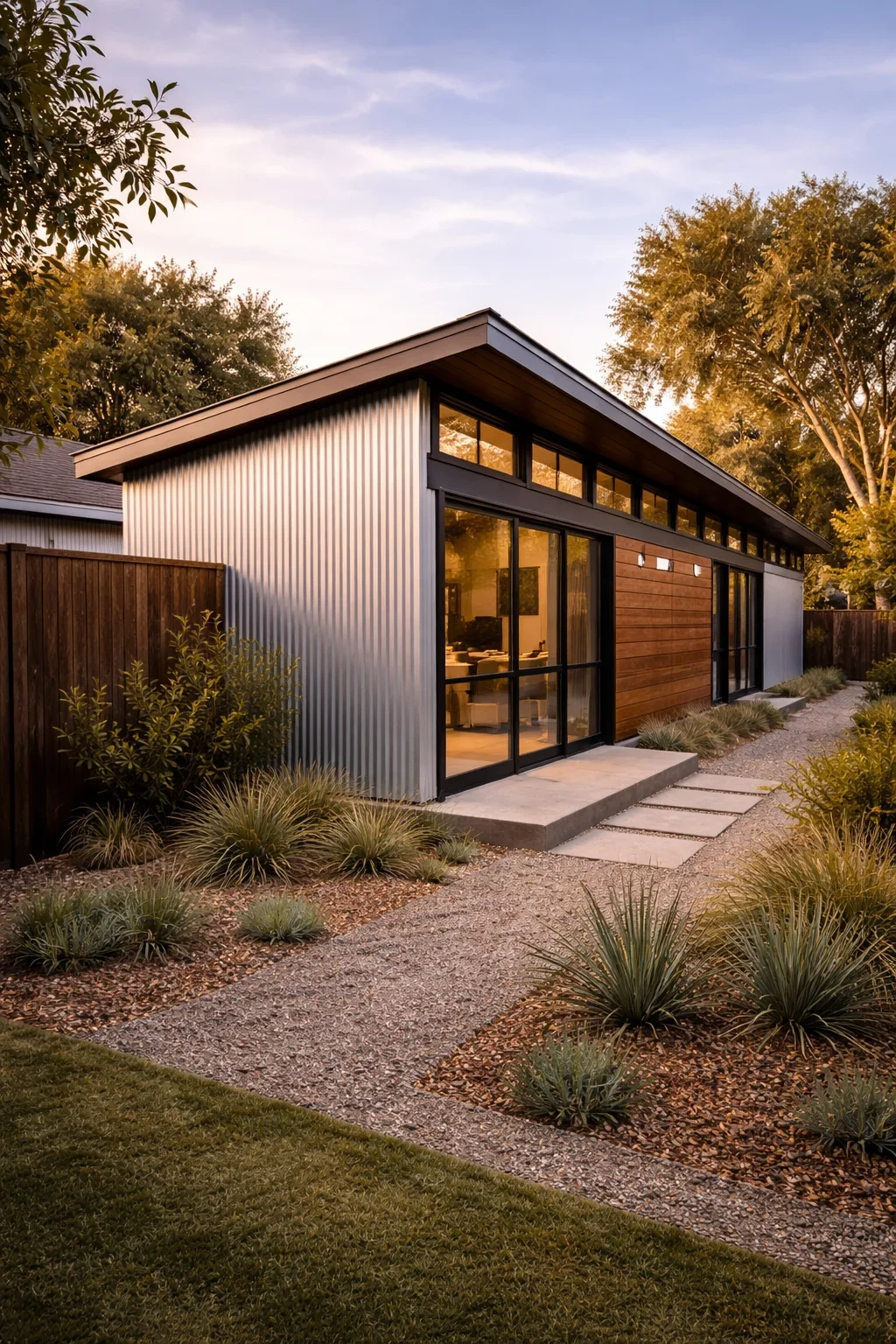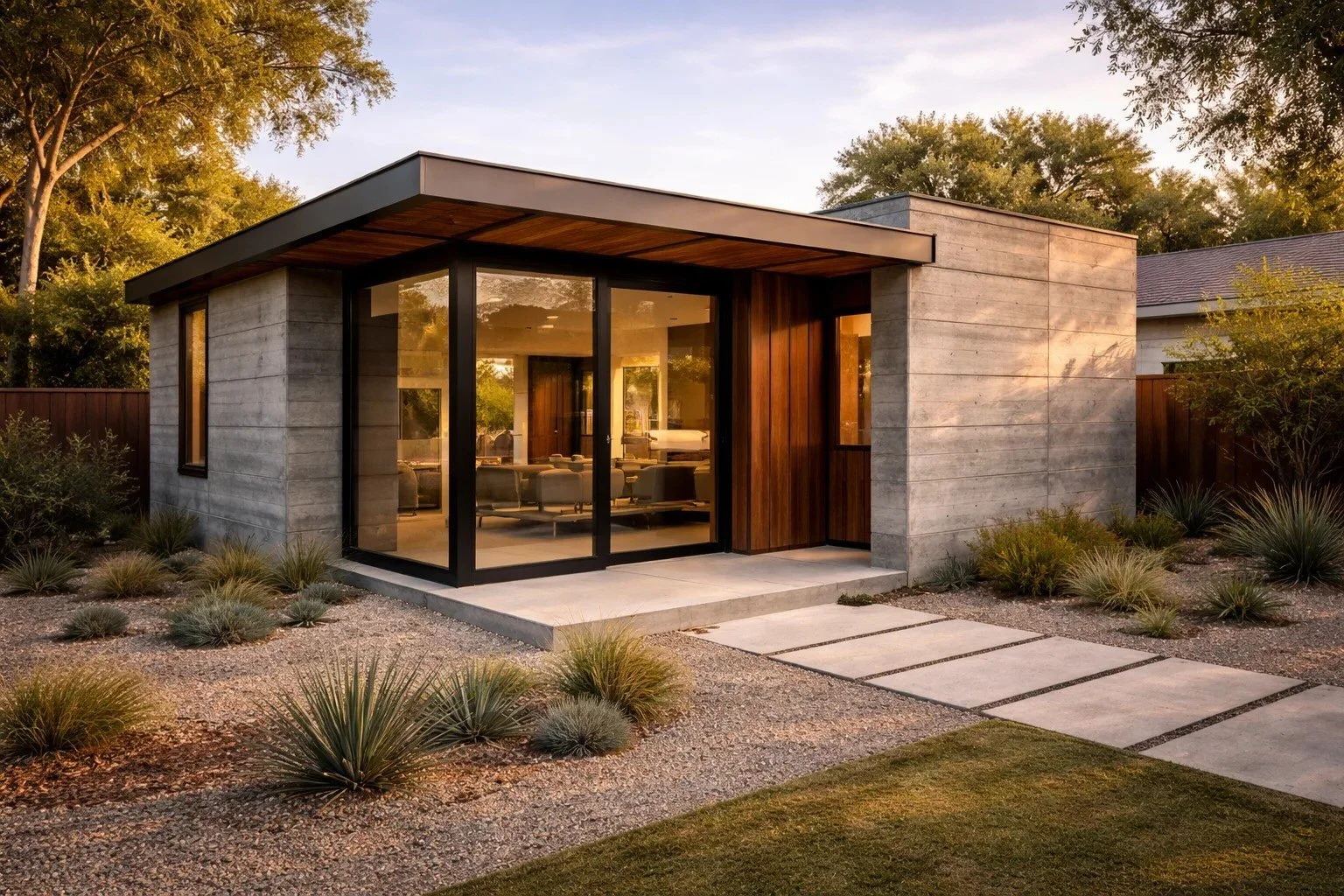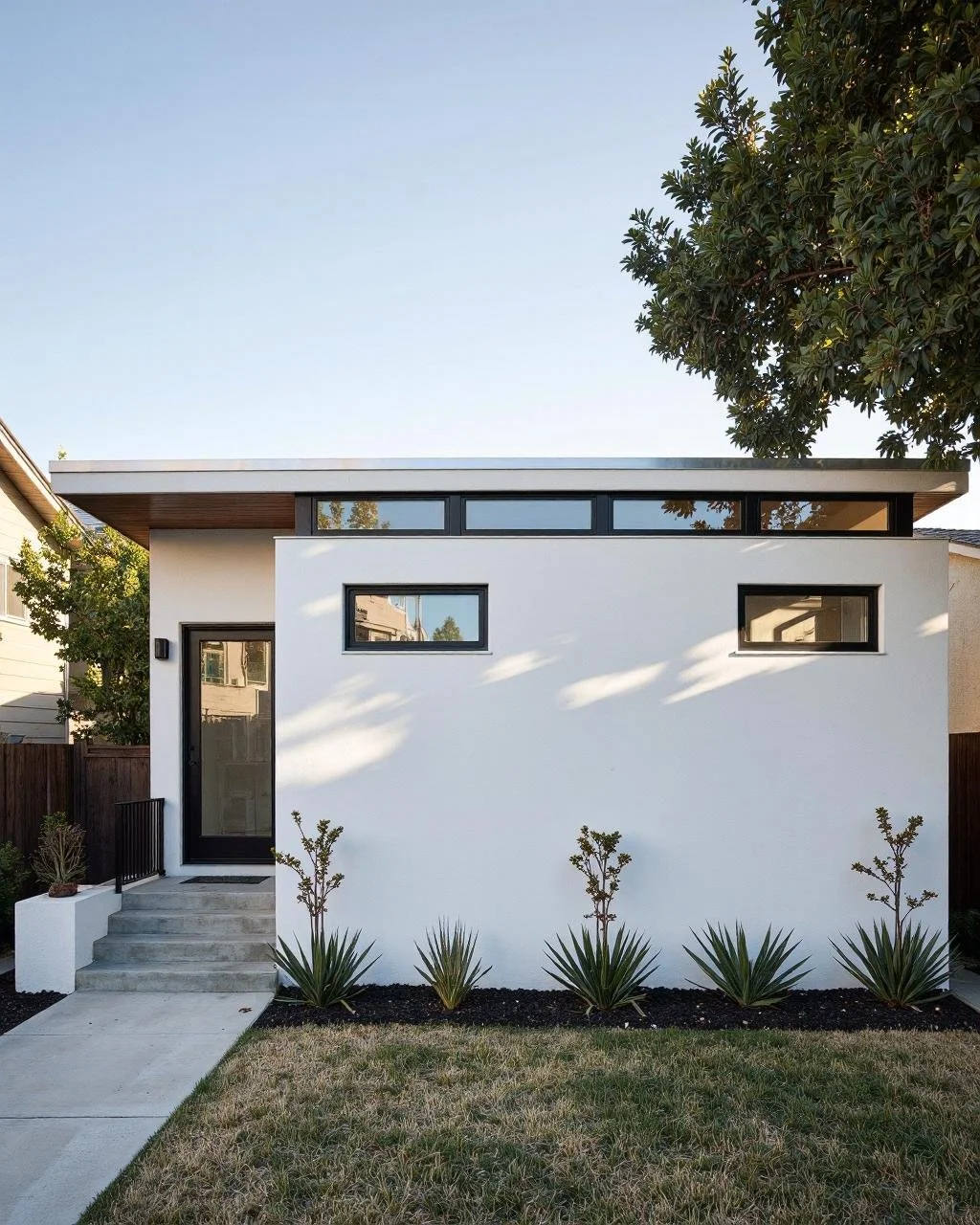
Additional dwelling unit designs in Los Angeles vary widely — from traditional forms that blend into existing homes to more modern compositions shaped by light, materials, and space. Each approach responds to the property, the neighborhood, and how the space is intended to be used. The goal is not just to add square footage, but to create a structure that feels considered, functional, and naturally integrated into the environment.
Additional Dwelling Unit Designs For Los Angeles
Explore ADU Design Styles in Los Angeles
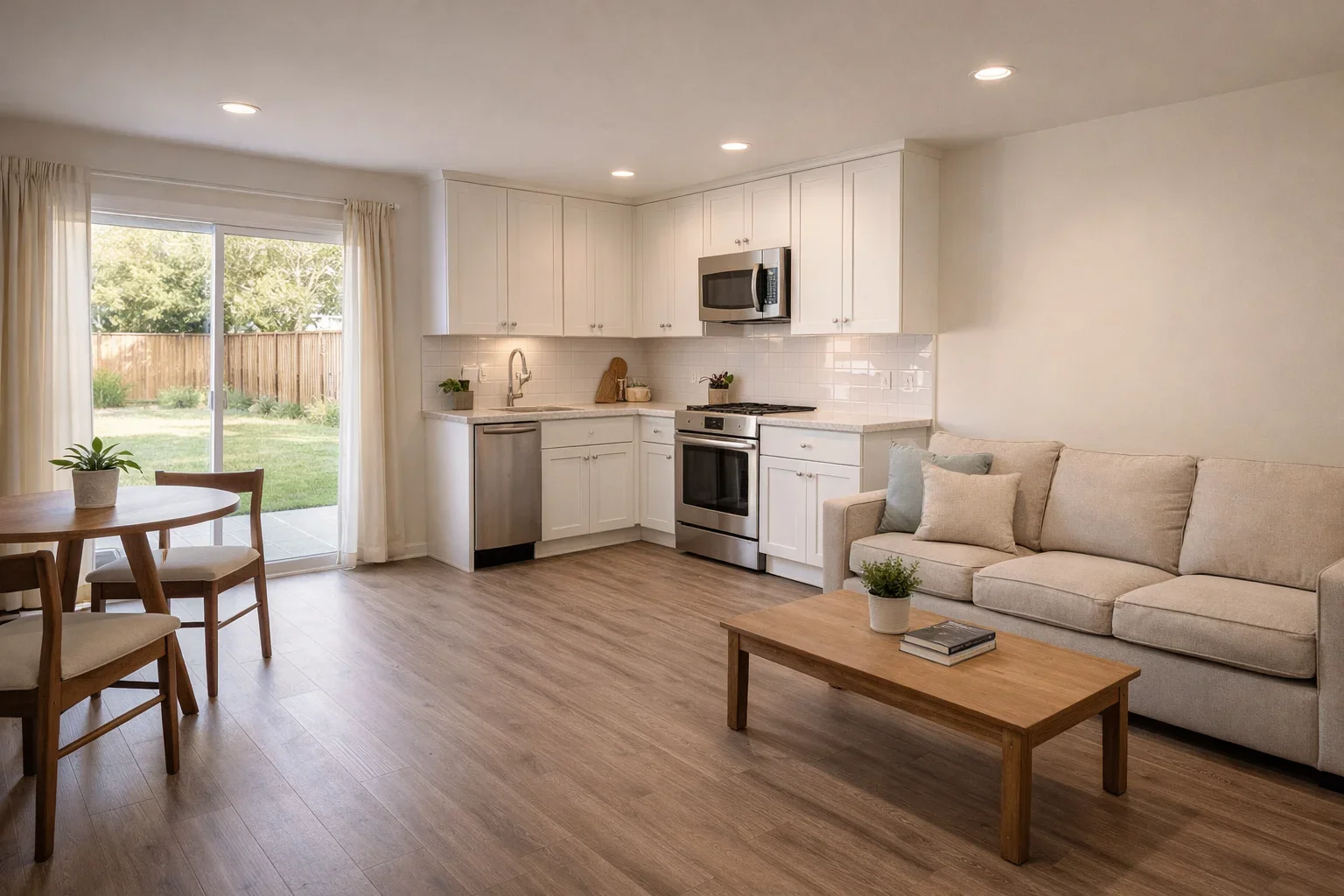
Additional dwelling unit designs for Los Angeles reflect more than just added square footage. They respond to the way homes are built, used, and adapted across the city. From hillside properties to compact suburban lots, each ADU is shaped by its context — the existing house, the available space, and the intended use.
In Los Angeles, there is no single approach to ADU design. Some projects follow the language of the main residence, continuing materials and proportions. Others introduce a more contemporary form, creating a clear distinction between old and new. Both directions can work when the design feels intentional and well integrated.
The growing demand for additional dwelling units has shifted the focus toward efficient layouts, natural light, and strong indoor-outdoor connections. Even compact spaces can feel open and comfortable when planned with clarity. The goal is not only to meet zoning requirements, but to create a space that supports daily living — whether as a rental unit, guest house, or private extension of the home.
This page explores a range of ADU design approaches commonly seen in Los Angeles, from modern and mid-century influences to more traditional and mixed styles. Each reflects a different way of working with the property while maintaining a sense of balance with its surroundings.
Understanding these design directions helps guide better decisions early in the process, before construction begins.
Table of Contents
Style No. 01 · Los Angeles Residential Guide
Spanish Revival &
Mediterranean
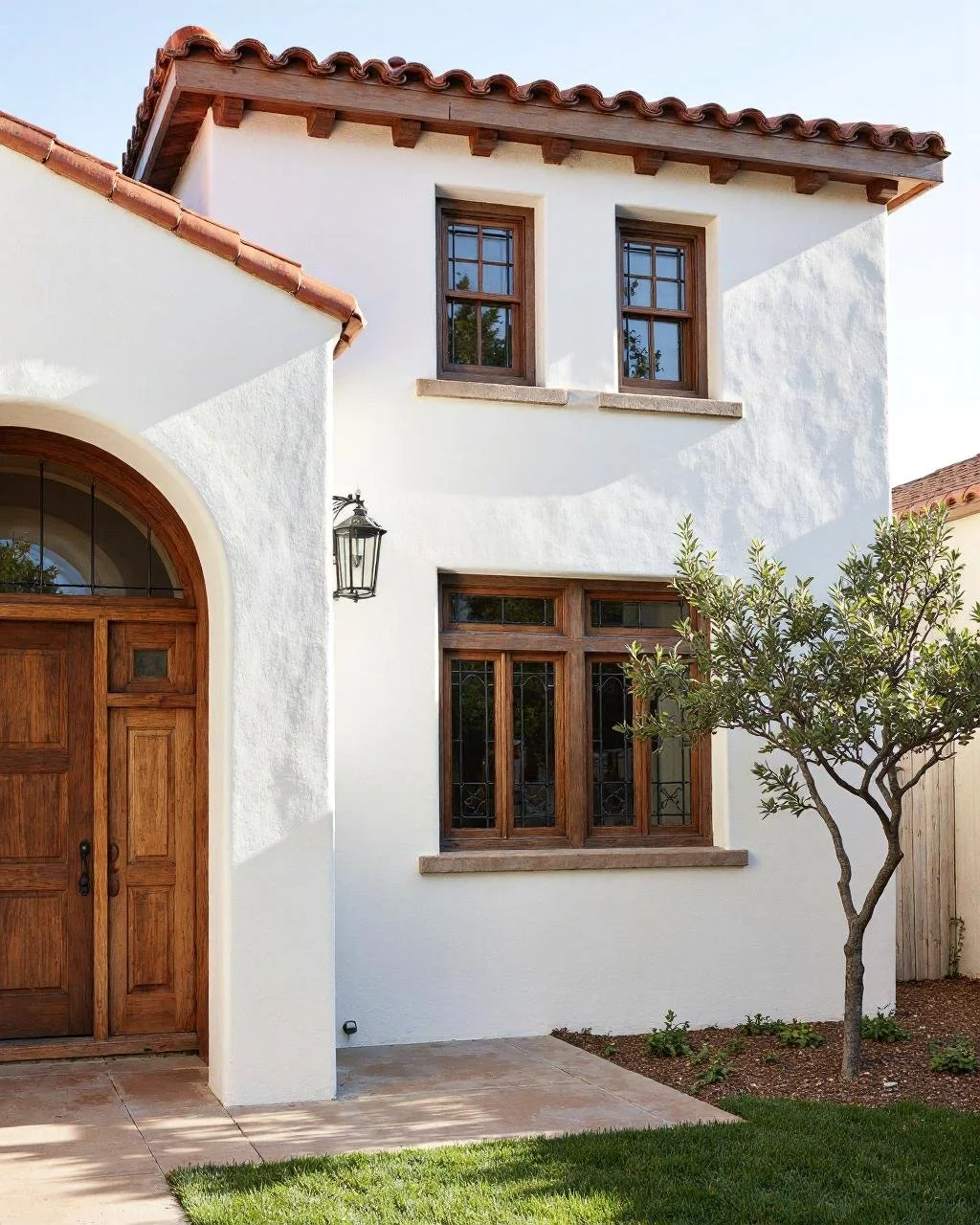
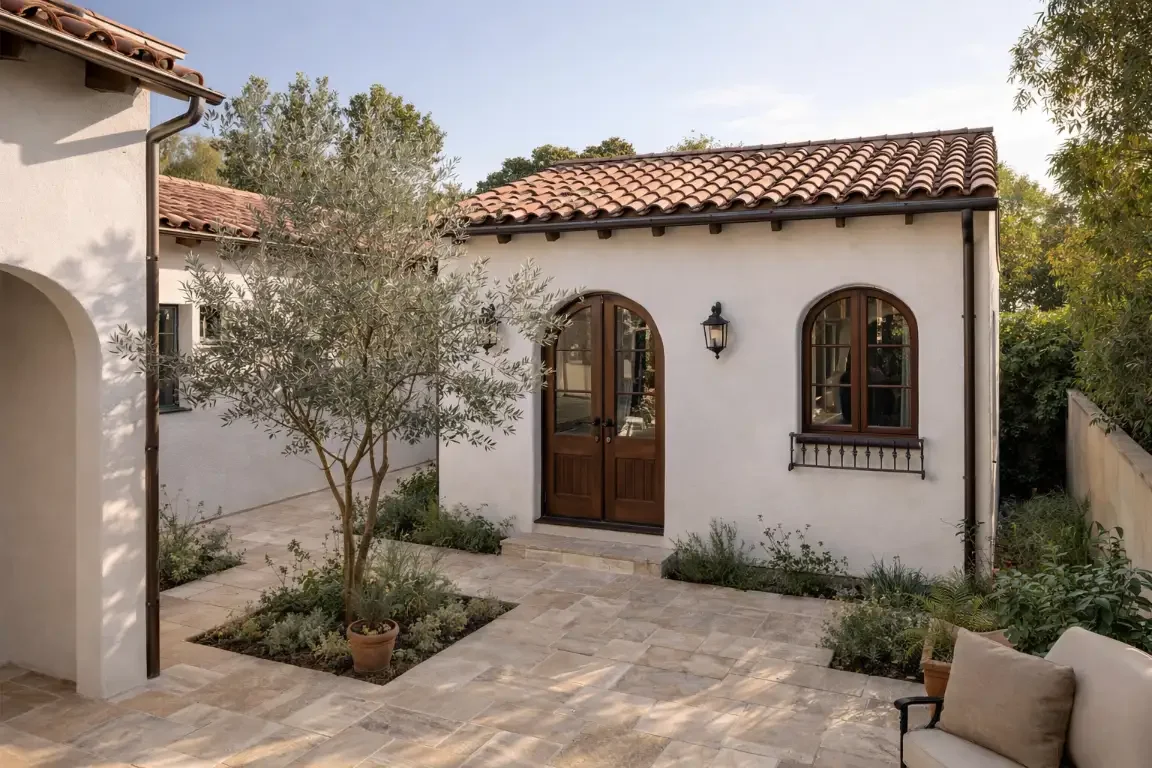
Sun-warmed stucco, the rhythm of arches, and the memory of Andalusia — translated into the California landscape.
Bertram Goodhue · Lillian Rice · George Washington Smith · Wallace Neff · Addison Mizner
History
Spanish Revival emerged in California in the early 20th century as architects looked to the missions, haciendas, and Moorish palaces of Spain and Mexico for inspiration. The style gained national attention after Bertram Goodhue's landmark Panama–California Exposition buildings in San Diego (1915), which introduced a romanticized Spanish Baroque vocabulary to American audiences. In Los Angeles, architects like Wallace Neff and Lillian Rice refined the idiom into an approachable domestic architecture: sun-baked stucco walls that breathed with the climate, shaded arcades that blurred inside and outside, and hand-painted tilework that gave each home its own character. The style flourished through the 1920s and 1930s as LA's population exploded, becoming the default language for everything from modest bungalows in Highland Park to grand Pasadena estates. It remains among the most beloved and protected residential vocabularies in Southern California today.
Defining Features
- Smooth or sand-textured white to ochre stucco exteriors
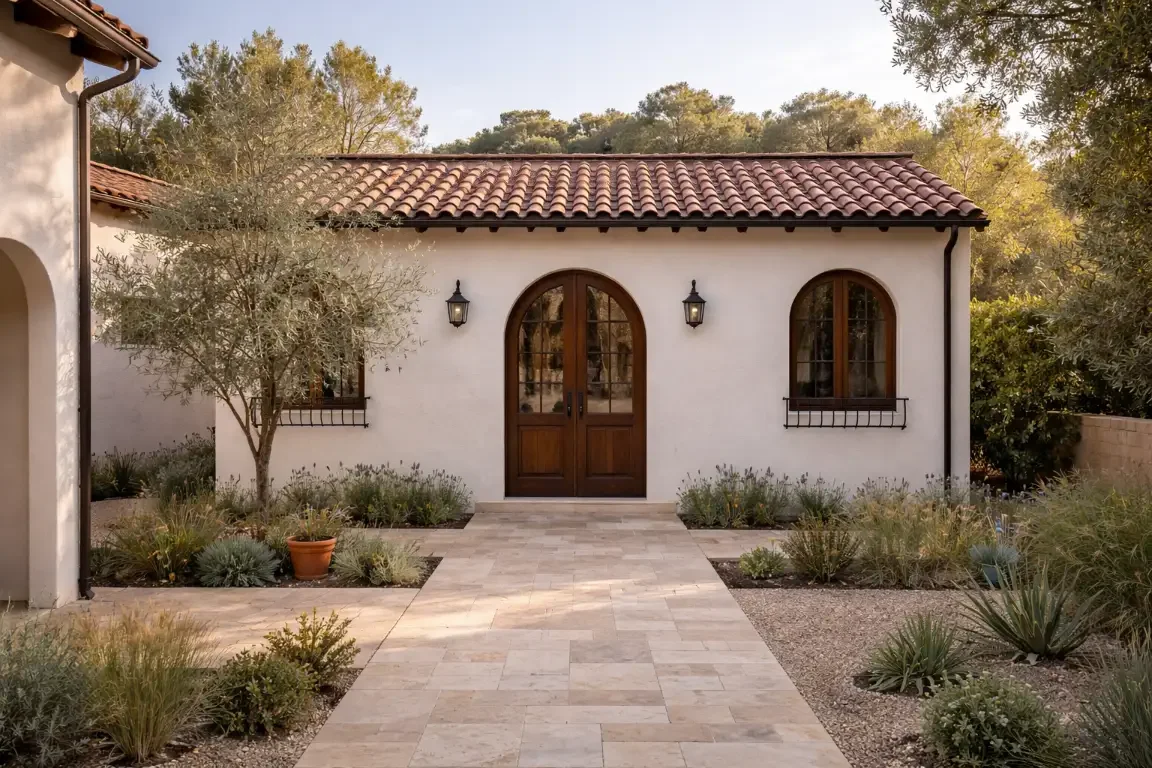
- Low-pitched red clay barrel-tile roofs with wide overhanging eaves
- Rounded and pointed arched windows, doorways, and colonnades
- Central or entry courtyards with fountains or tiled pathways
- Ornate hand-painted Talavera or Saltillo tile accents
- Wrought-iron grilles, railings, and lantern fixtures
- Carved plaster or stone decorative surrounds at entry
- Deep-set windows with painted wood shutters
- Exposed wood ceiling beams and terracotta tile floors inside
ADU Design Notes
ADUs on Spanish Revival properties benefit most from a faithful echo of the primary home's palette and material vocabulary. A detached casita positioned around a shared courtyard is the most historically resonant typology — it mirrors the original hacienda compound model. Match the stucco texture and color precisely, carry the red barrel tile to the ADU roofline, and incorporate at least one arched opening — even a garden gate — to maintain continuity. Avoid flat roofs and smooth panel materials that will read as intrusions. If budget limits full tile roofing, a single-color concrete tile in terracotta can approximate the effect without the cost premium.
ADU Compatibility
Strong fit — requires style-matching effort
Style No. 02 · Los Angeles Residential Guide
Mid-Century
Modern
Glass, steel, and optimism — an architecture that believed the future would be open to the sky.
Richard Neutra · Rudolf Schindler · Charles & Ray Eames · Pierre Koenig · John Lautner · Craig Ellwood
History
Southern California's postwar optimism found its perfect architectural expression in Mid-Century Modernism. Fueled by returning veterans, cheap land, and a faith in technology, Los Angeles became the unlikely capital of the modern house. The Case Study House Program — commissioned by Arts & Architecture magazine in 1945 — tasked architects like Richard Neutra, Charles and Ray Eames, and Pierre Koenig with designing affordable, replicable modern homes for the American family. The results were revolutionary: steel frames, floor-to-ceiling glass, flat roofs that melted into the landscape, and an almost total dissolution of the boundary between inside and outside. Rudolf Schindler had anticipated much of this even earlier with his Kings Road House (1922). John Lautner pushed the vocabulary to its most sculptural extremes throughout the 1960s and '70s. The style was deeply tied to LA's geography — the hills, the canyon light, and the mild climate that made glass walls not just possible but sensible.
Defining Features
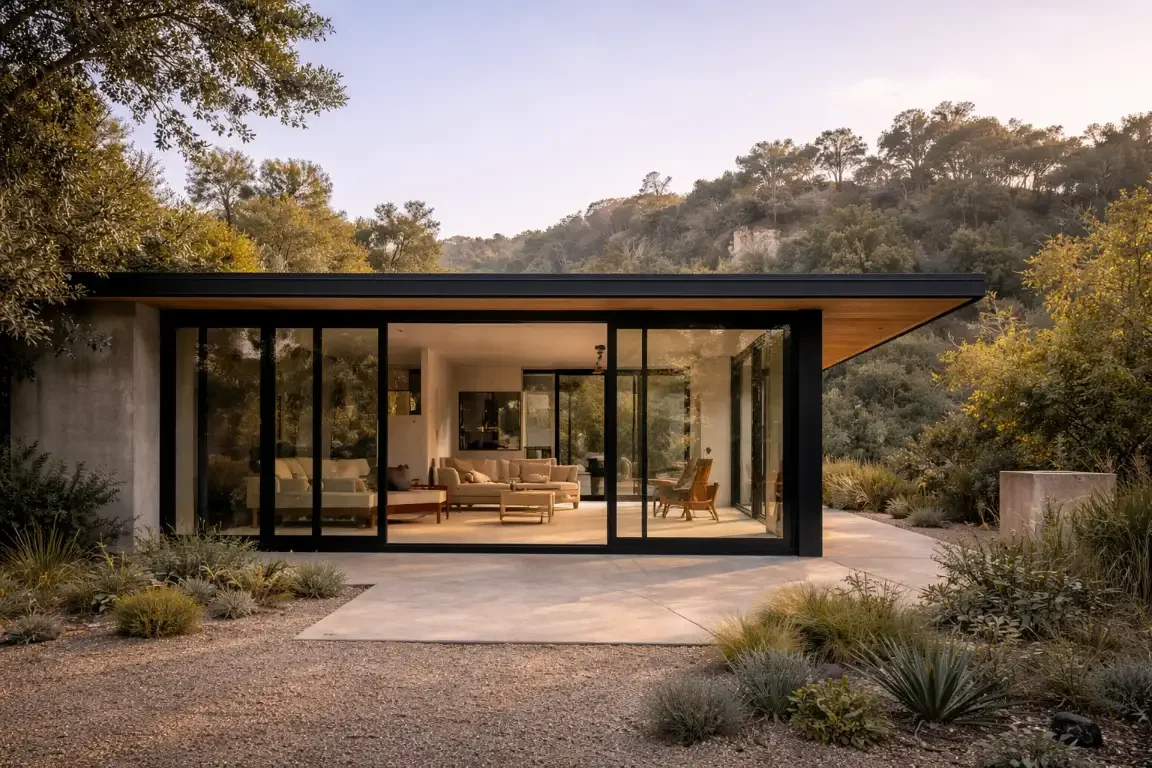
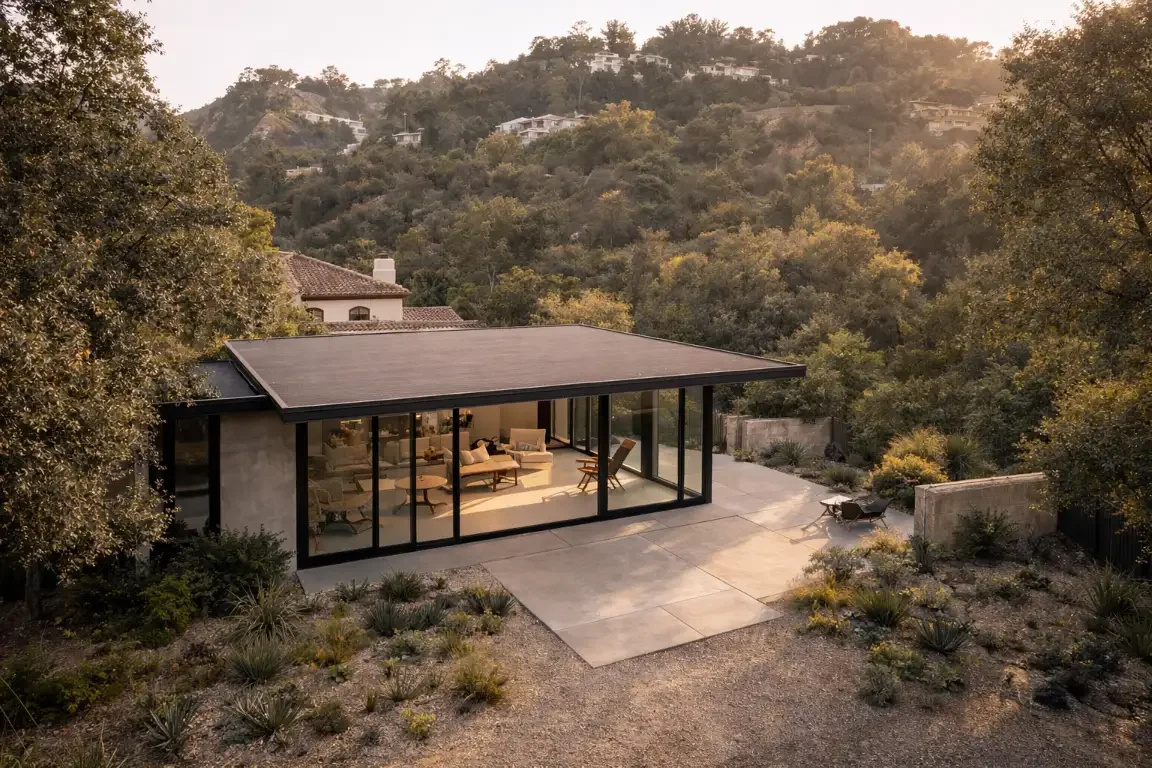
- Flat or low-pitched shed rooflines with generous overhangs
- Exposed structural post-and-beam framing
- Floor-to-ceiling glass walls and sliding glass doors
- Strong horizontal emphasis in massing and fenestration
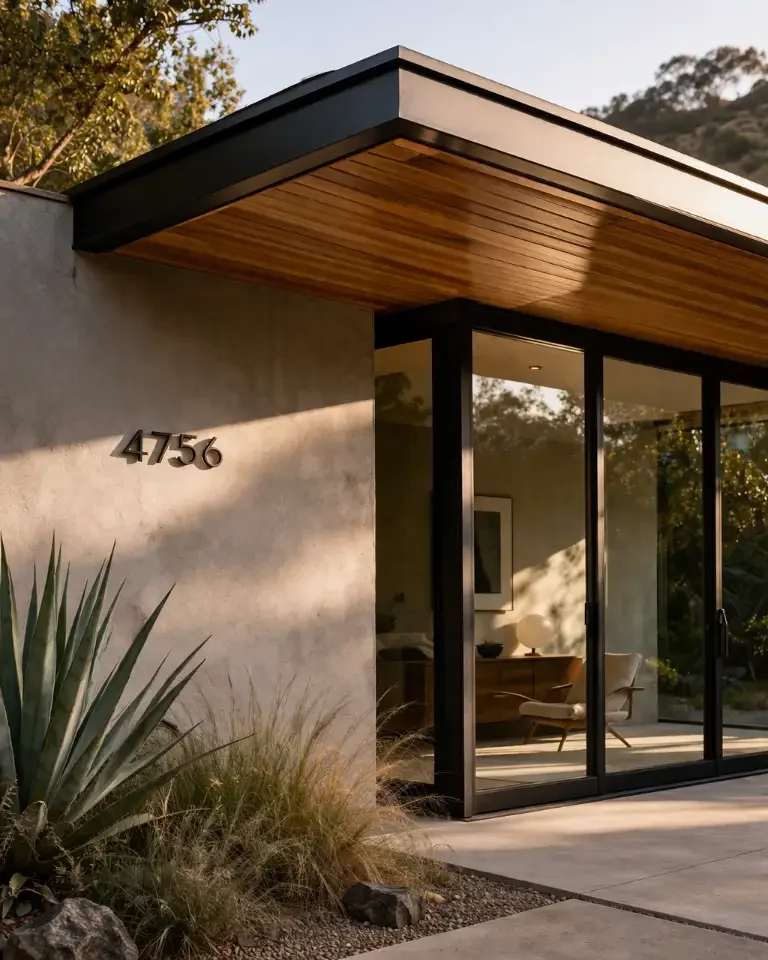
- Natural wood soffits, fascias, and interior paneling
- Polished concrete, terrazzo, or flagstone floors
- Seamless indoor-outdoor connection to patios and gardens
- Minimal interior walls — open plan living
- Integration with landscape and natural topography
ADU Design Notes
Mid-Century Modern properties offer perhaps the most natural compatibility with contemporary ADU design. The flat-roof, glass-walled studio is the ADU typology most in dialogue with this architectural heritage. Emphasize the indoor-outdoor connection — sliding glass walls opening onto a shared garden, a steel-framed canopy over the entry — and allow the ADU's structural logic to be visible and honest. Use polished concrete floors, thermally modified wood siding, and black steel window frames for material continuity. Avoid adding pitched roofs or decorative trim that would undercut the Modernist clarity. A well-designed ADU here can feel like a missing Case Study House annex.
ADU Compatibility
Exceptional fit — modern ADUs align naturally
Style No. 03 · Los Angeles Residential Guide
Contemporary
/ Modern
Geometry without ornament — the language of the city's newest neighborhoods and most common ADUs.
Thom Mayne / Morphosis · Frank Gehry (late work) · CallisonRTKL · Griffin Enright · Johnston Marklee
History
Contemporary Modern in Los Angeles is less a single movement than the cumulative default of the city's 21st-century building boom. It draws from multiple lineages — the formal experimentation of Thom Mayne and Morphosis, the deconstructivism of Frank Gehry's late work, and the minimalist rigor of European architects like Herzog & de Meuron and Tadao Ando, whose influence spread through LA's architecture schools and developer culture. What solidified into a dominant residential typology was shaped as much by economics as aesthetics: smooth stucco is inexpensive to apply, flat roofs maximize interior volume on small LA lots, and clean geometric massing reads well in listing photos. Firms like Griffin Enright and Johnston Marklee elevated the vocabulary into something genuinely sophisticated, but it was the spec-builder community that spread it to every hillside cut and teardown lot across the city. Today it is the unmarked vernacular of new residential construction in Los Angeles.
Defining Features
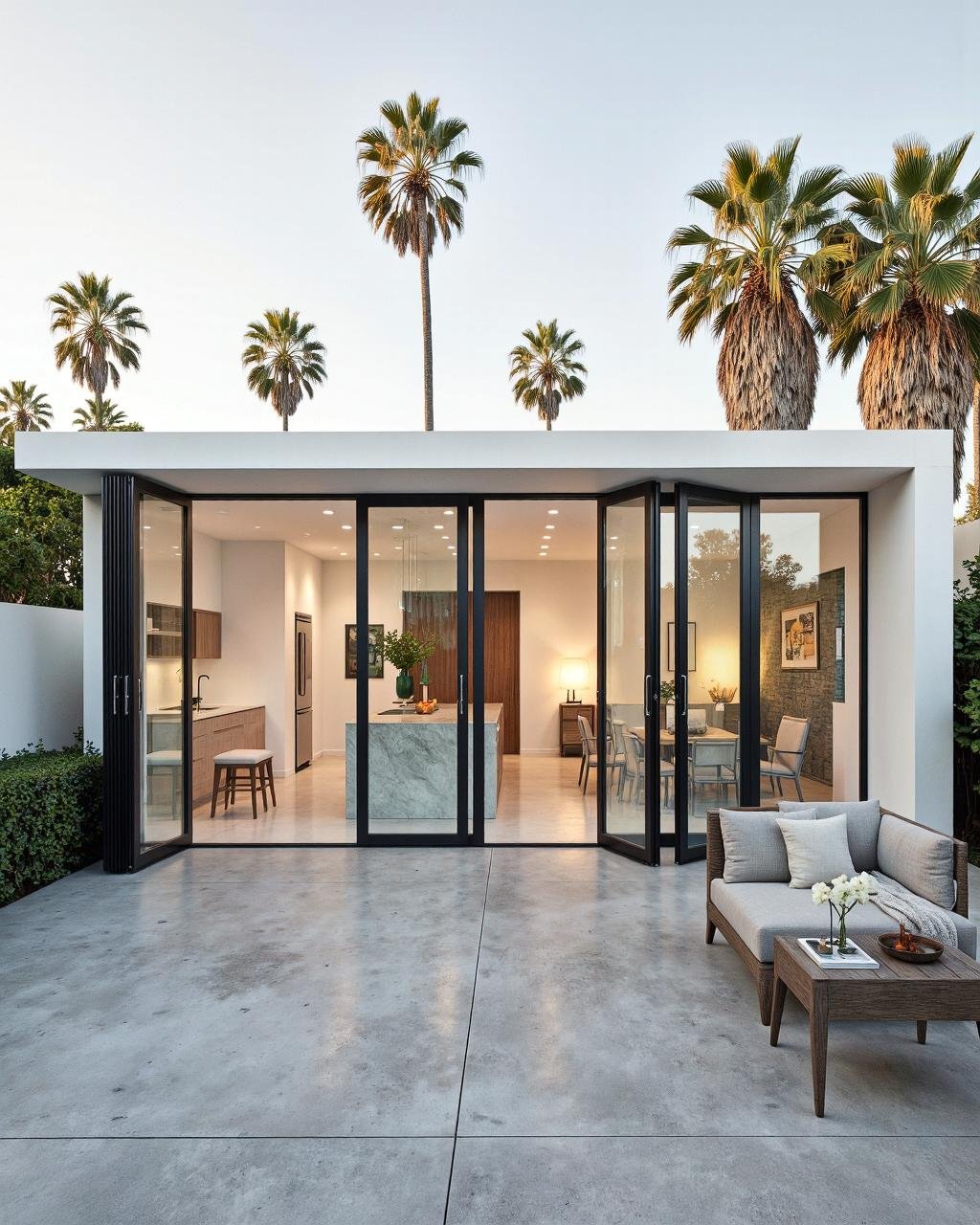
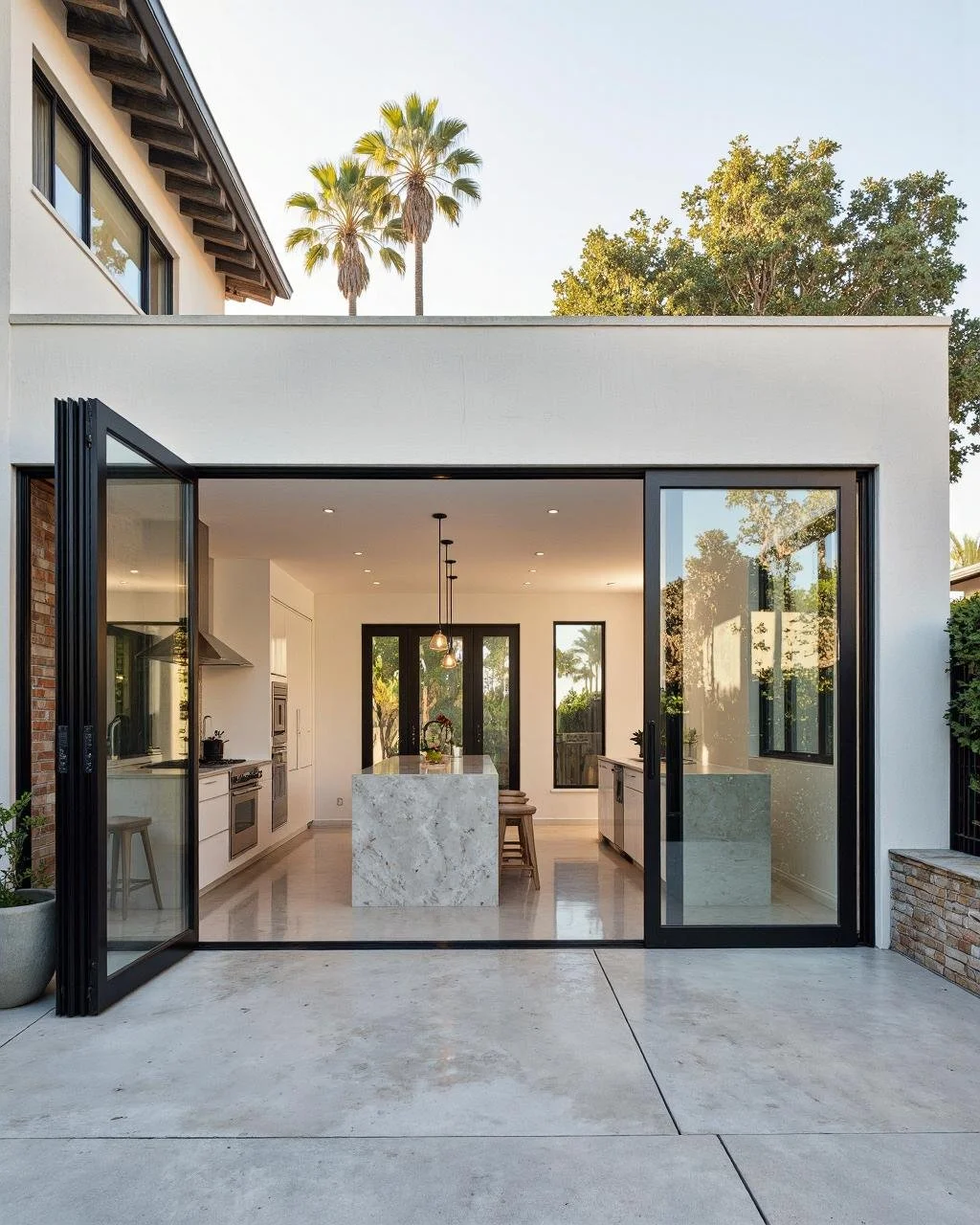
- Clean geometric volumes with flat or low-slope roofs
- Smooth integral-color stucco as primary cladding
- Contrasting cedar, Ipe, or composite wood panel accents
- Large fixed-pane windows in black aluminum frames
- Recessed or canopied entry sequences
- Privacy walls, gates, and landscaped buffers at street edge
- Minimal ornament — material contrast carries the design
- Open-plan interiors with polished concrete or wide-plank floors
- Rooftop decks and outdoor rooms as primary amenity
ADU Design Notes
Contemporary Modern is the most common ADU context in Los Angeles, and the vocabulary is well-suited to small footprints. Focus on material quality over complexity: smooth stucco in a color pulled from the main house, with one accent material — cedar or Ipe — to break the massing. Black powder-coated aluminum windows are cost-effective and consistent with the style. Prefab and modular ADU systems are largely designed in this idiom and can integrate seamlessly. Pay attention to the entry sequence even on very small units — a canopied door or recessed threshold reads as considered design rather than an afterthought.
ADU Compatibility
Ideal fit — the dominant ADU typology in LA

Style No. 04 · Los Angeles Residential Guide
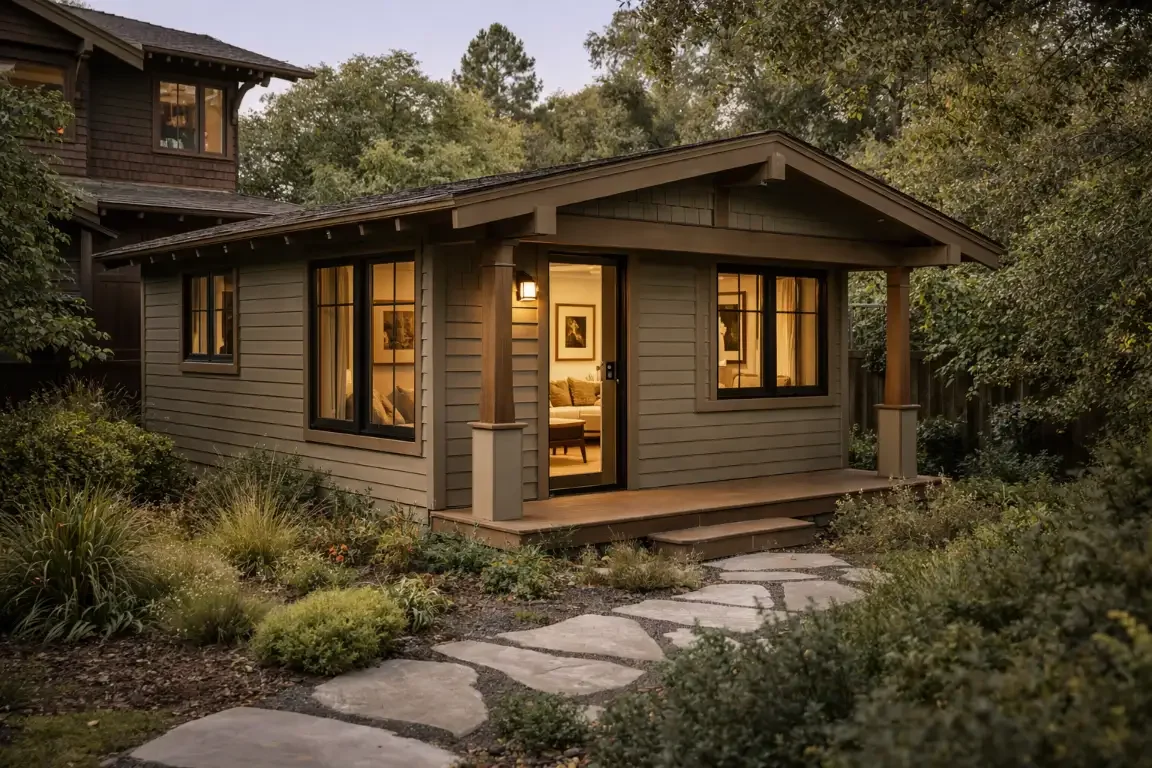
Craftsman
A philosophy turned into wood and stone — the belief that a well-made home is a form of moral clarity.
Charles & Henry Greene · Gustav Stickley · William Morris · Bernard Maybeck · Julia Morgan
History
The Craftsman style was California's answer to the Arts and Crafts movement that had swept through England under William Morris and John Ruskin — a philosophical rejection of industrial mass production in favor of handmade quality, natural materials, and honest construction. In Pasadena, brothers Charles and Henry Greene translated these ideals into some of the most sophisticated domestic architecture ever built in America: their Gamble House (1908) and Blacker House (1907) remain canonical masterworks of joinery, integrated furniture, and site-sensitive design. The bungalow — Craftsman's more modest everyday form — spread rapidly across Los Angeles in the 1910s through mail-order plan books, democratizing the style's warm material palette. By 1920, Craftsman bungalows lined streets from Highland Park to Boyle Heights, leaving a legacy so beloved that entire neighborhoods now carry historic preservation protections.
Defining Features
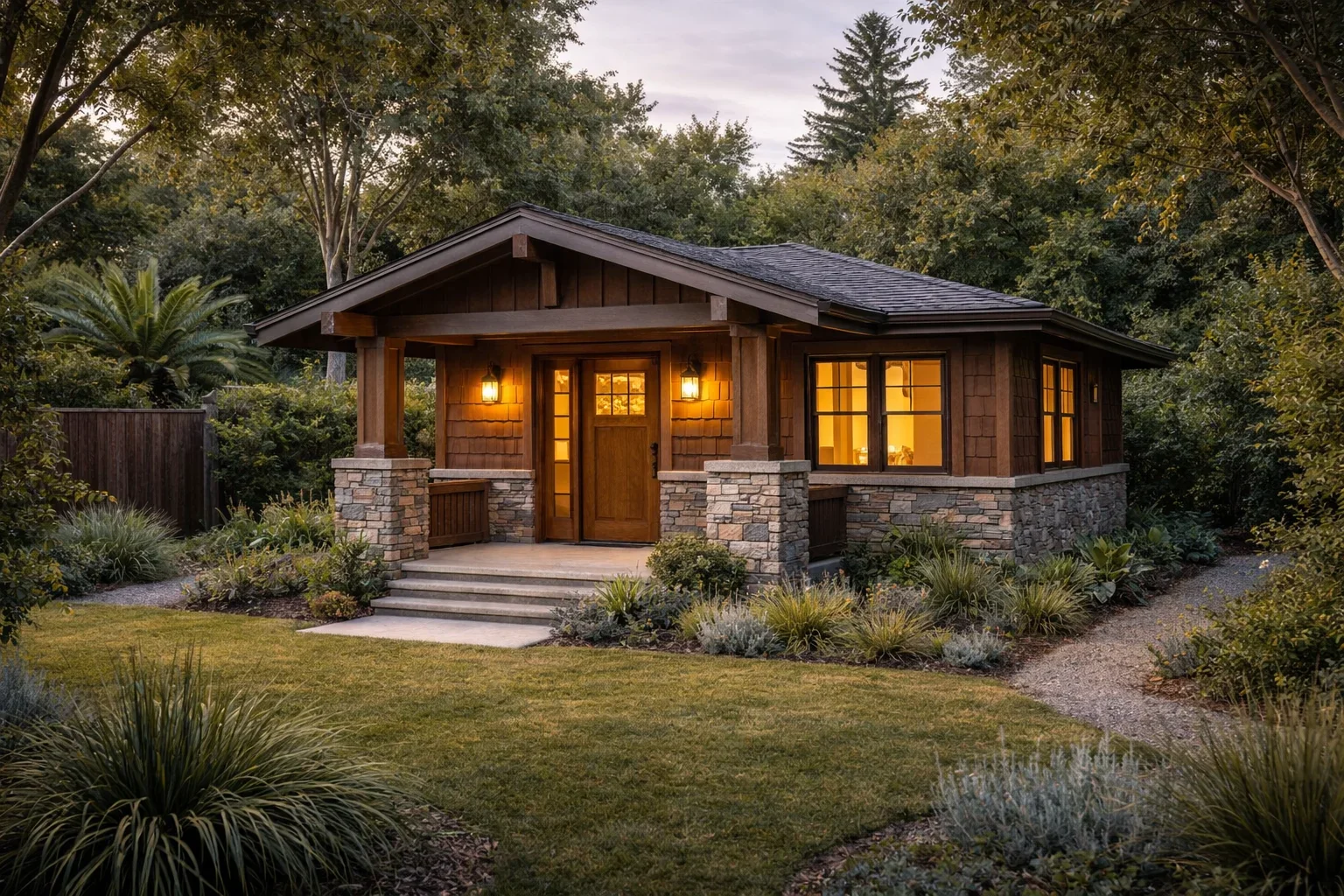
- Wide, low-pitched gable roofs with deep overhanging eaves
- Exposed rafter tails and decorative knee braces
- Tapered porch columns on brick, stone, or clinker-brick pedestals
- Front porch as primary social and entry space
- Natural wood shingle, clapboard, or board-and-batten siding
- Double-hung windows with divided lights, often in bands
- Stone, river rock, or brick chimney and foundation accents
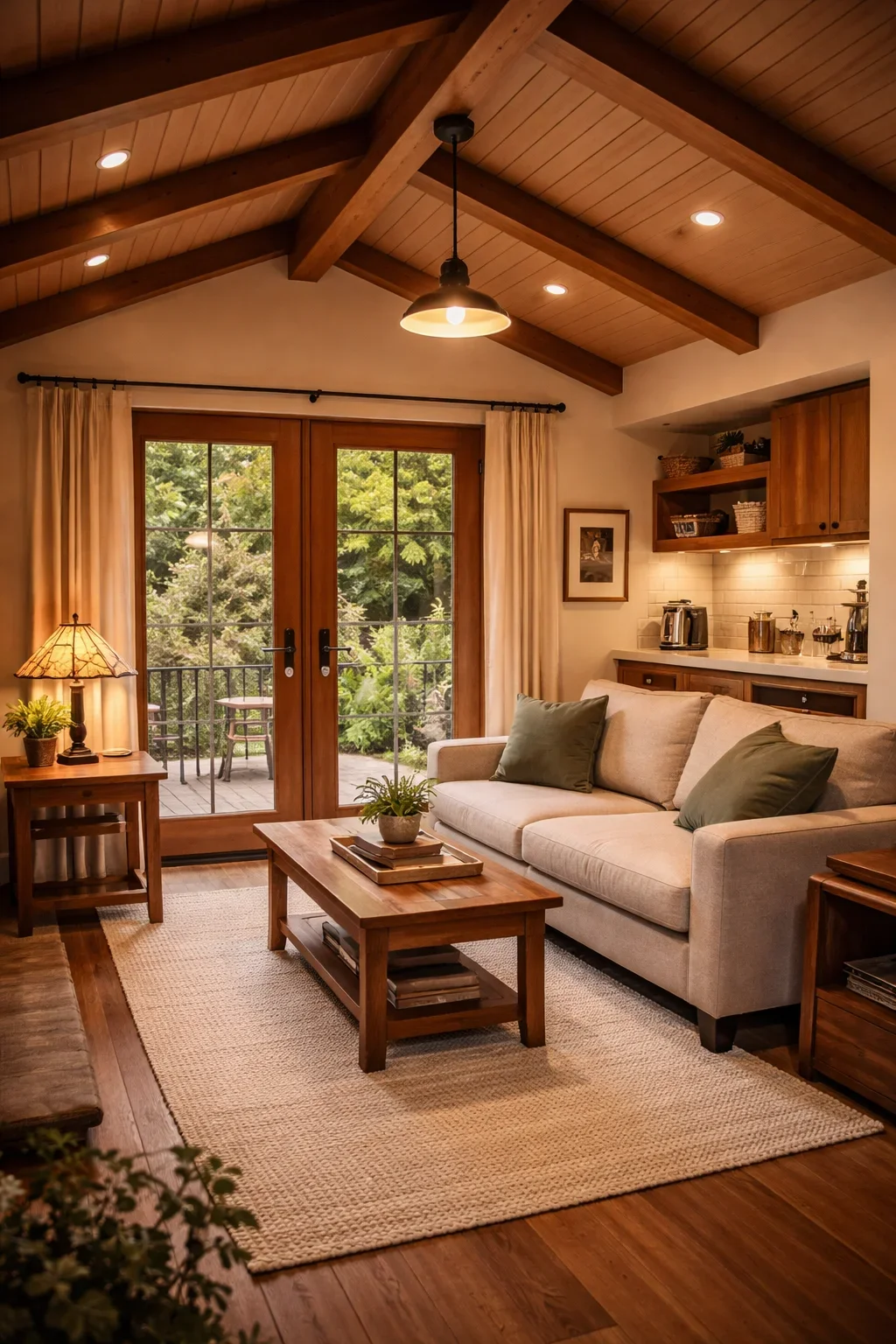
- Built-in bookcases, benches, and inglenooks inside
- Earth tones — mossy greens, warm browns, and ochres
ADU Design Notes
Craftsman neighborhoods in LA often carry design review requirements, so ADUs need genuine attention to compatibility. The most successful approach is a simplified Craftsman vocabulary — match the eave depth and roof pitch of the main house, use cedar or redwood shingle or board-and-batten siding in a complementary earth tone, and include a small covered entry even if budget is limited. Avoid wholesale replication of ornate Greene & Greene-style detailing at small scale, as it can read as pastiche. The Craftsman ideal of honest material and good proportion is a better guide than decorative mimicry. A simple shingled cottage with the right eave overhang is more authentic than an over-detailed miniature.
ADU Compatibility
Moderate — design review often applies
Style No. 05 · Los Angeles Residential Guide
Modern
Farmhouse
The agrarian dream, stripped of hay bales — white paint, black frames, and the comfort of the familiar.
Joanna & Chip Gaines · Studio McGee · Leanne Ford · Urban-Suburban infill developers
History
Modern Farmhouse is an unusual architectural phenomenon: a style born not in a school or a manifesto but in a television show. HGTV's Fixer Upper, which debuted in 2013 featuring Chip and Joanna Gaines renovating homes in Waco, Texas, introduced tens of millions of Americans to a specific aesthetic — white shiplap walls, black steel window frames, reclaimed wood accents, and simple gable-roofed forms that nodded to agrarian tradition while feeling thoroughly contemporary. Interior designers like Studio McGee and Leanne Ford amplified and refined the vocabulary across social media, transforming it from a regional renovation trend into the dominant language of suburban residential development nationwide by the late 2010s. In Los Angeles, it arrived alongside the city's teardown-and-rebuild cycle in the Valley, South Bay, and outer suburban corridors — offering new construction a legible, non-threatening domesticity distinct from the harder-edged Contemporary Modern vocabulary in hipper neighborhoods.
Defining Features
- White or light gray board-and-batten or shiplap exterior siding
- Matte black window frames, gutters, hardware, and fixtures
- Simple symmetrical gable roof — sometimes with metal roofing accents
- Covered front porch with simple square or turned columns
- Barn-style sliding doors as interior and exterior accent
- Contrasting dark trim against white or light siding
- Reclaimed wood beams and open kitchen shelving inside
- Apron sinks, shaker cabinetry, and subway tile details
- Landscaping with native grasses and simple planting beds
ADU Design Notes
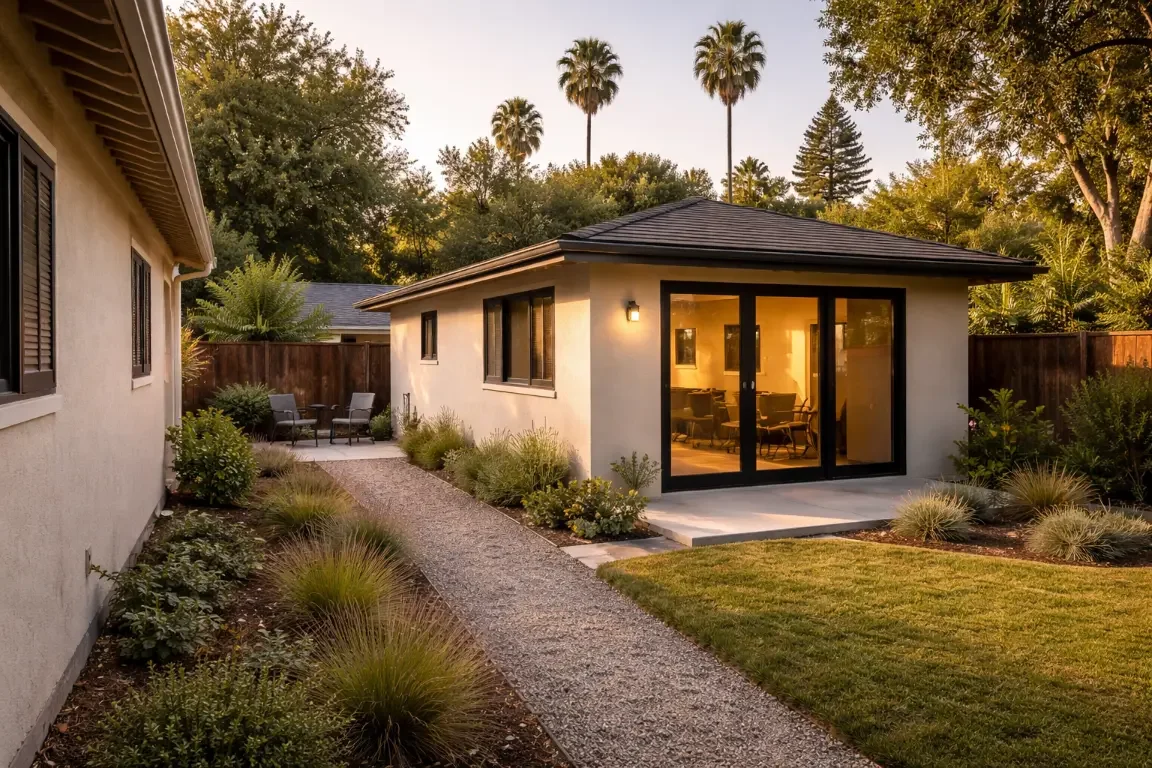
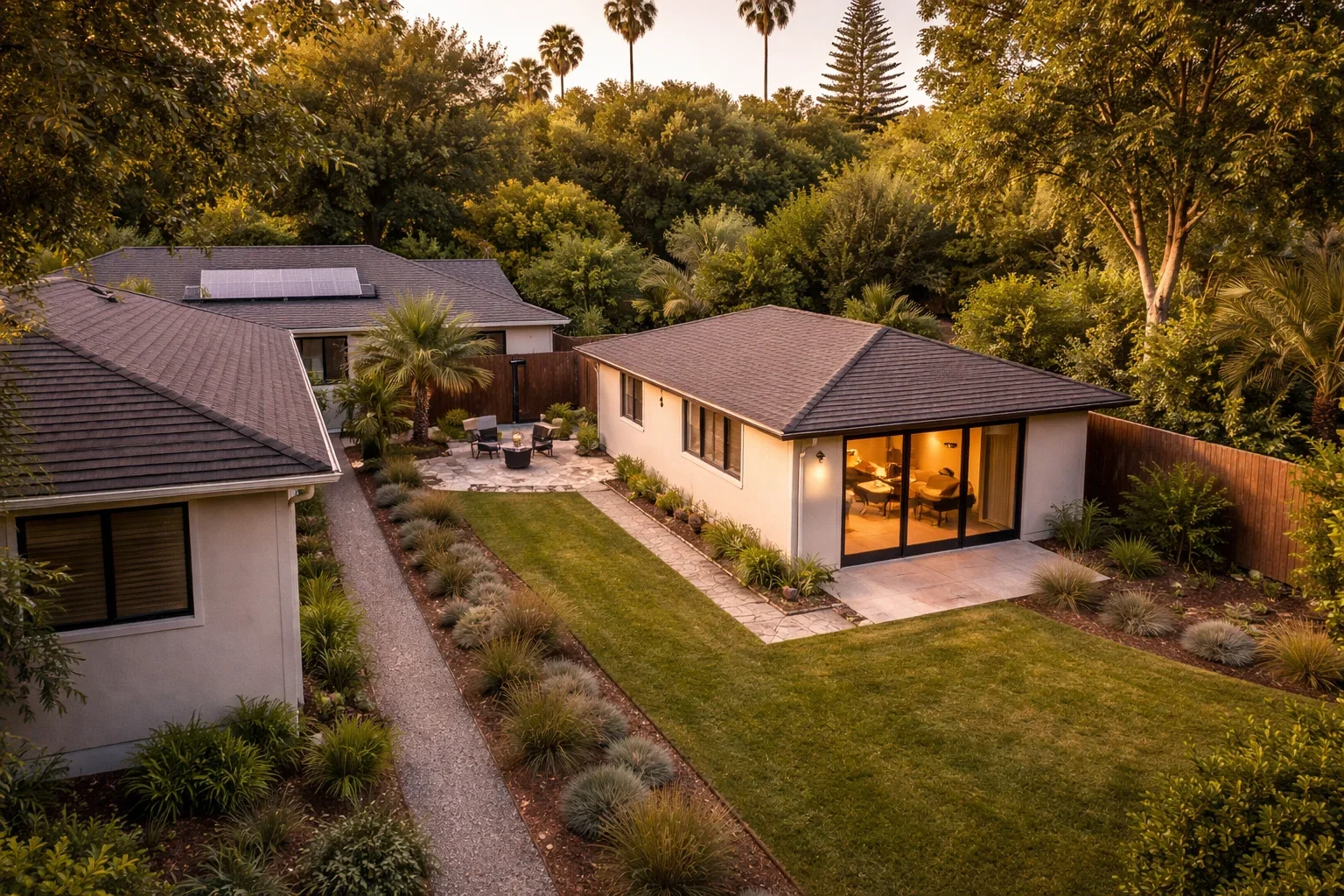
The Modern Farmhouse vocabulary translates to ADU scale with minimal effort — in fact, the style's simple geometry and limited palette are almost ideally suited to the compact footprints required by most backyard units. Replicate the white board-and-batten exterior with black-framed windows on the ADU and the family resemblance will be immediately clear. A single-gable footprint is sufficient — resist the urge to add dormers or cupolas that inflate cost without proportional benefit. Metal roofing on the ADU can be a cost-conscious choice that reads as a deliberate farmhouse detail. Keep landscaping between the main house and ADU consistent to unify the property visually.
ADU Compatibility
Strong fit — simple palette scales well
Style No. 06 · Los Angeles Residential Guide
Ranch &
Minimal Traditional
The postwar promise of a single-story life — a home that spread itself across the lot without pretension.
Cliff May · William Wurster · Joseph Eichler (adjacent) · FHA suburban mortgage standards · Levittown model
History
The Ranch house is inseparable from the postwar American dream, and nowhere was that dream more thoroughly built than in Los Angeles. Cliff May, a self-taught San Diego designer, is widely credited as the father of the California Ranch — his houses of the 1930s and '40s drew on Spanish hacienda precedents to create single-story, informally planned homes that sprawled across their lots and opened onto private rear gardens. The Federal Housing Administration's postwar mortgage programs made homeownership possible for returning veterans on an unprecedented scale, and builders adapted May's low-cost horizontal model into the template for millions of suburban homes across the San Fernando Valley, the South Bay, and the Inland Empire. The Minimal Traditional variant — smaller and even plainer, with a simple front gable and almost no ornamentation — was the most economical expression: a house reduced to its essential shelter components, built fast and bought gratefully.
Defining Features
- Single-story horizontal massing spread across the lot
- Low-pitched hip or simple gable roof
- Attached garage as dominant street-facing element
- Stucco, lap siding, or brick veneer exteriors
- Wide picture windows overlooking front or rear yard
- Sliding glass doors to rear patio — precursor to indoor-outdoor living
- Open or semi-open kitchen-dining-living plan
- Mature trees and deep rear yards from large postwar lots
- Minimal ornamental detail — simplicity by design and budget
ADU Design Notes
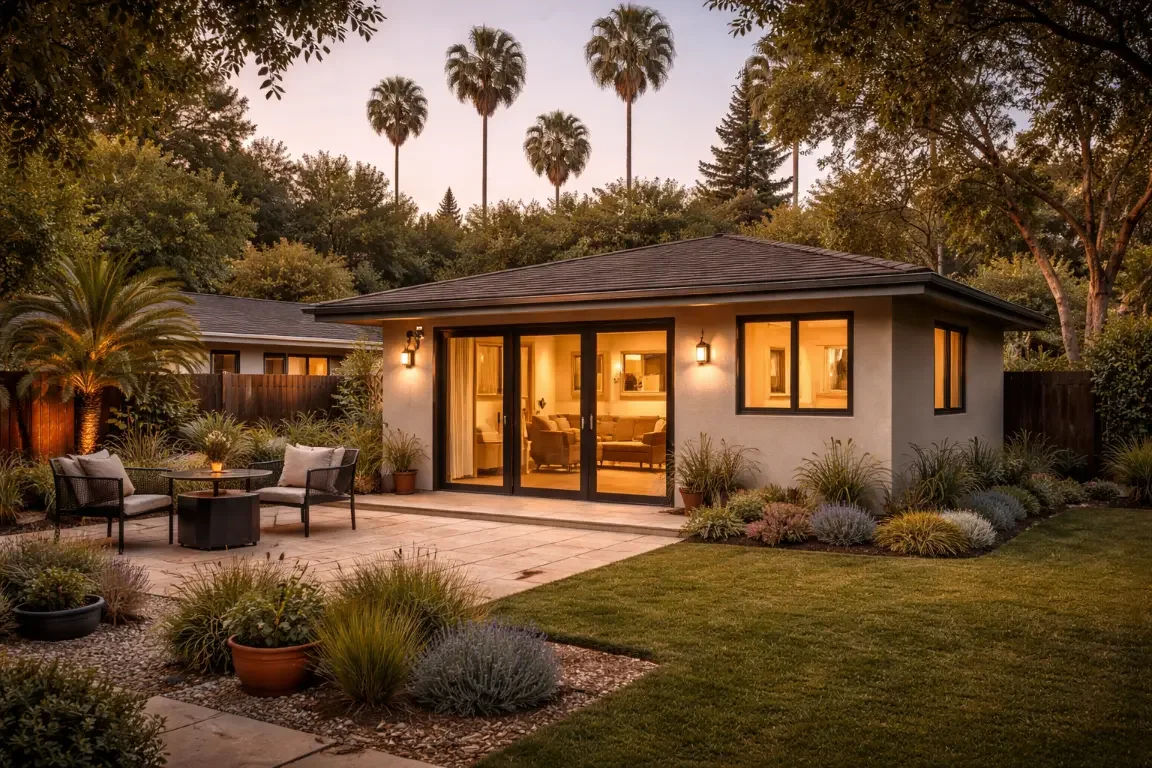
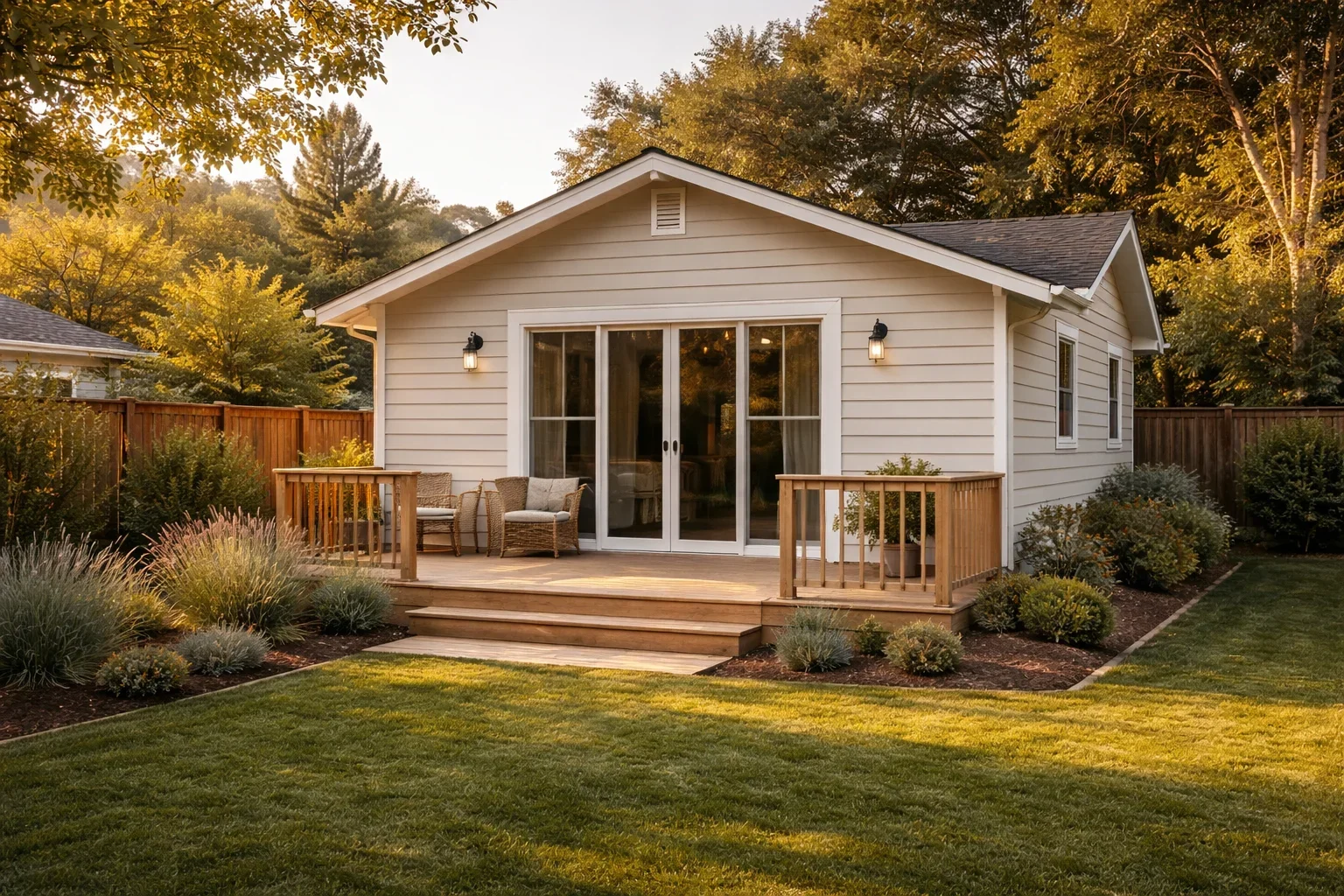
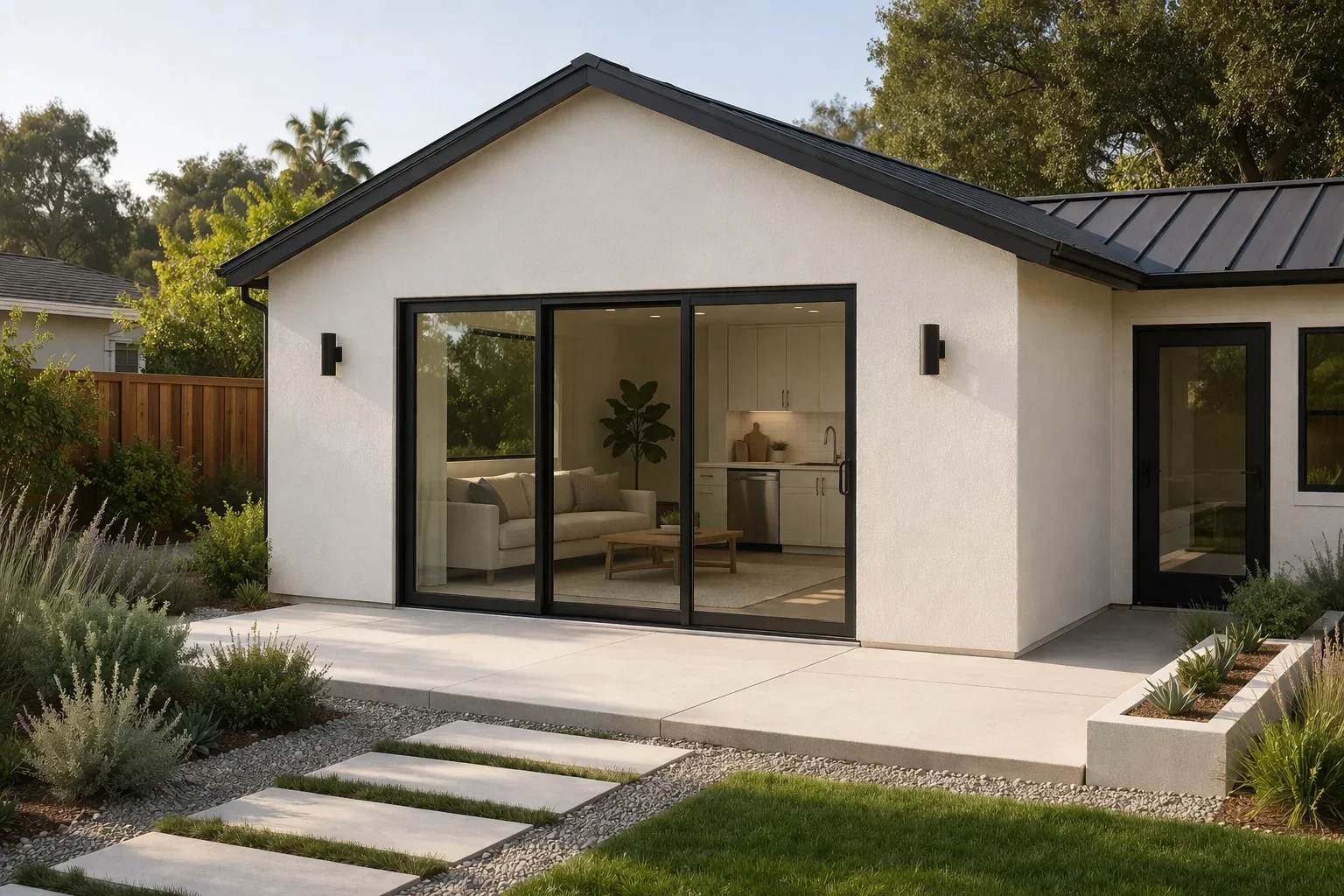
Ranch and Minimal Traditional properties are among the most practically advantageous for ADU placement in all of Los Angeles. Their large, flat rear yards offer ample area for a detached backyard cottage without impacting the primary home's livability, and their simple architecture sets a low bar for contextual matching. Detached studios with a matching low-pitch roof and stucco or lap siding will integrate naturally. Garage conversion ADUs are particularly cost-effective here — the attached garage's footprint often meets minimum ADU size requirements with modest structural intervention. Focus budget on kitchen and bathroom finish quality rather than exterior elaboration.
ADU Compatibility
Ideal fit — large lots, easy garage conversions
Style No. 07 · Los Angeles Residential Guide
Eclectic
Architecture
No single allegiance — a home assembled from history's best ideas, made coherent by confidence and care.
Paul Williams · Reginald Johnson · Gordon Kaufmann · Stanford White · Period Revival pattern books
History
Eclectic architecture flourished in America between roughly 1880 and 1940, when a newly wealthy middle and upper class wanted homes that communicated cultural sophistication — and found it by borrowing freely from European and historical precedents. In Los Angeles, the style found fertile ground during the city's first great building boom of the 1910s through 1930s, when architects like Paul Williams and Gordon Kaufmann designed homes that moved fluidly between Tudor Revival, French Norman, Colonial Revival, and Italianate references depending on the client's tastes and the neighborhood's character. Unlike the purer revival styles, Eclectic homes made no claim to archaeological accuracy — they were unapologetically composed, mixing a steeply pitched Norman roofline with Colonial shutters or a Mediterranean arcade with English half-timbering. The style fell out of fashion with the rise of Modernism but never disappeared from LA's residential fabric, and today it describes a large share of the pre-war housing stock in neighborhoods like Hancock Park, Windsor Square, and Los Feliz.
Defining Features
- Deliberate mixing of two or more historical or regional styles
- Steeply pitched rooflines — gable, hip, or mansard depending on the dominant influence
- Rich material variety: brick, stone, stucco, and wood often on a single facade
- Decorative half-timbering, corbels, or carved stone details at entry
- Asymmetrical facades with varied window shapes and sizes
- Prominent chimneys as compositional anchors
- Covered entry porches or porte-cochères on larger homes
- Formal front gardens with defined edges and mature plantings
- Interiors with period millwork, coffered ceilings, and wainscoting
ADU Design Notes
Eclectic properties present a unique ADU design opportunity and challenge. Because the main house already draws from multiple traditions, there is no single style to match — which gives designers more freedom, but also more responsibility. The most successful ADUs on Eclectic properties identify the one or two dominant material or formal elements of the primary home — a particular brick color, a roof pitch, a window proportion — and use those as the anchoring references rather than trying to replicate the full composition at small scale. A clean, well-proportioned cottage that shares the main house's masonry or trim palette will read as belonging without becoming a confused miniature. Avoid introducing an entirely unrelated contemporary vocabulary, which will feel like a collision rather than a conversation.
ADU Compatibility
Moderate — anchor to dominant materials, not the full mix