

ADU Plans Los Angeles:
Floor Plans from 400 to 1,200 Sq Ft
ADU Design Guide
The accessory dwelling unit has quietly become one of Los Angeles's most compelling architectural stories — a small-scale housing solution with outsized consequences for how the city grows.
Whether you are a homeowner exploring a backyard cottage, a property investor evaluating rental potential, or a family creating independent living space for a parent or adult child, understanding ADU plans is the essential first step. In Los Angeles, ADU plans range from tight 400 square foot studios designed with the precision of a yacht cabin to generous 1,200 square foot two-bedroom residences that feel every bit like a standalone home. ADU plans in California are shaped by a regulatory framework that has become increasingly permissive in recent years, making this an opportune moment to explore what is possible on your property.
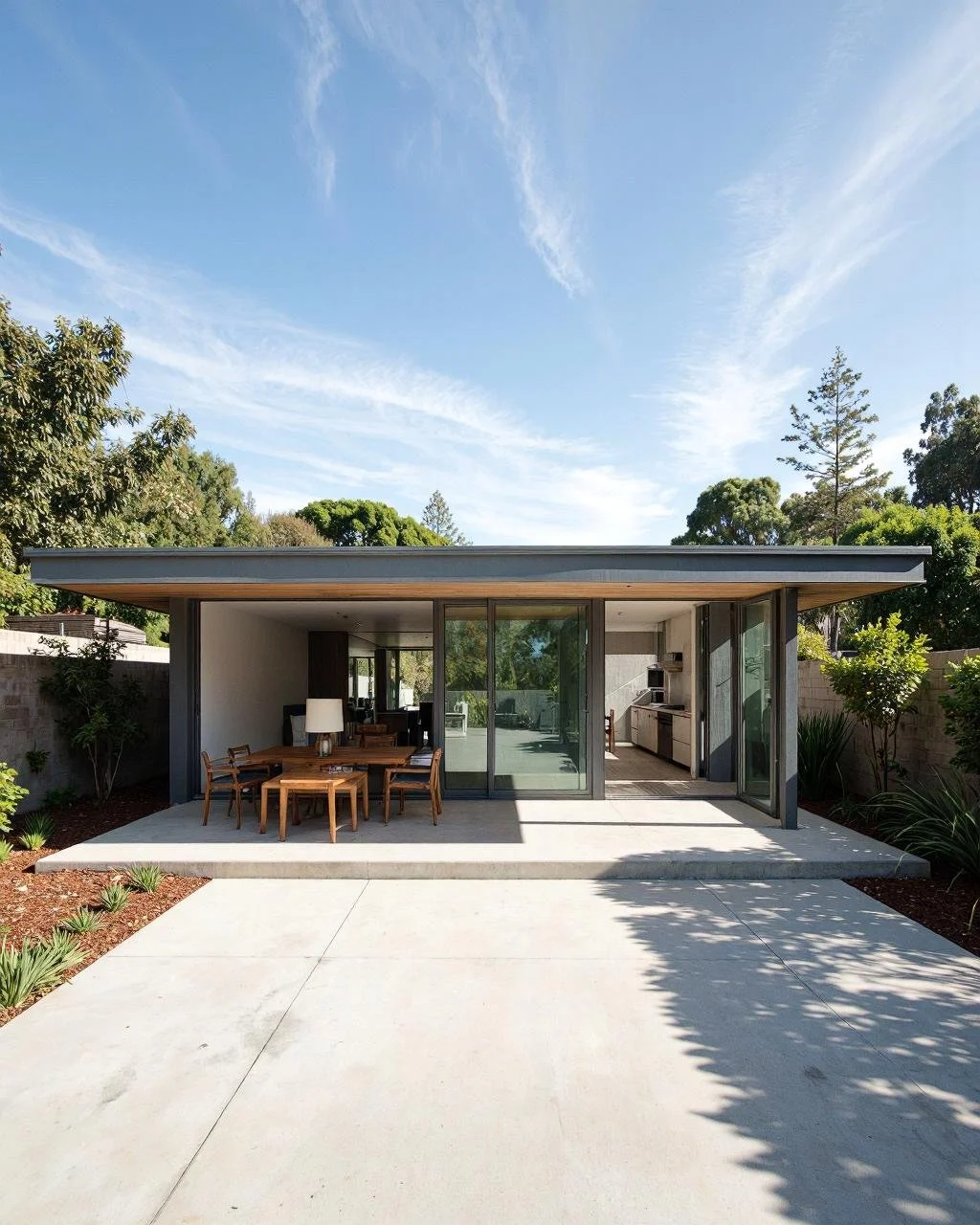

SKALWEST CONSTRUCTION
Your Trusted ADU Partner in LA
Understanding ADU Plans in Los Angeles
Foundation of ADUs in LA
An ADU plan is more than a simple drawing of rooms. It is a technical document that communicates the full spatial logic of a structure — where walls bear load, where plumbing chases run, how natural light enters, and how a resident will move through the space on an ordinary Tuesday morning. A well-conceived ADU plan resolves the tension between efficiency and comfort before a single foundation is poured.
In Los Angeles, most ADU plans are developed for one of three configurations: detached backyard units built new on an existing residential lot, garage conversions that transform an underused structure into a livable residence, or attached additions that expand the footprint of the primary home. California's ADU regulations — substantially liberalized through state legislation over the past several years — now permit ADUs on most single-family and multifamily properties, with size allowances that vary by lot and zoning designation. Understanding those parameters early shapes every design decision that follows
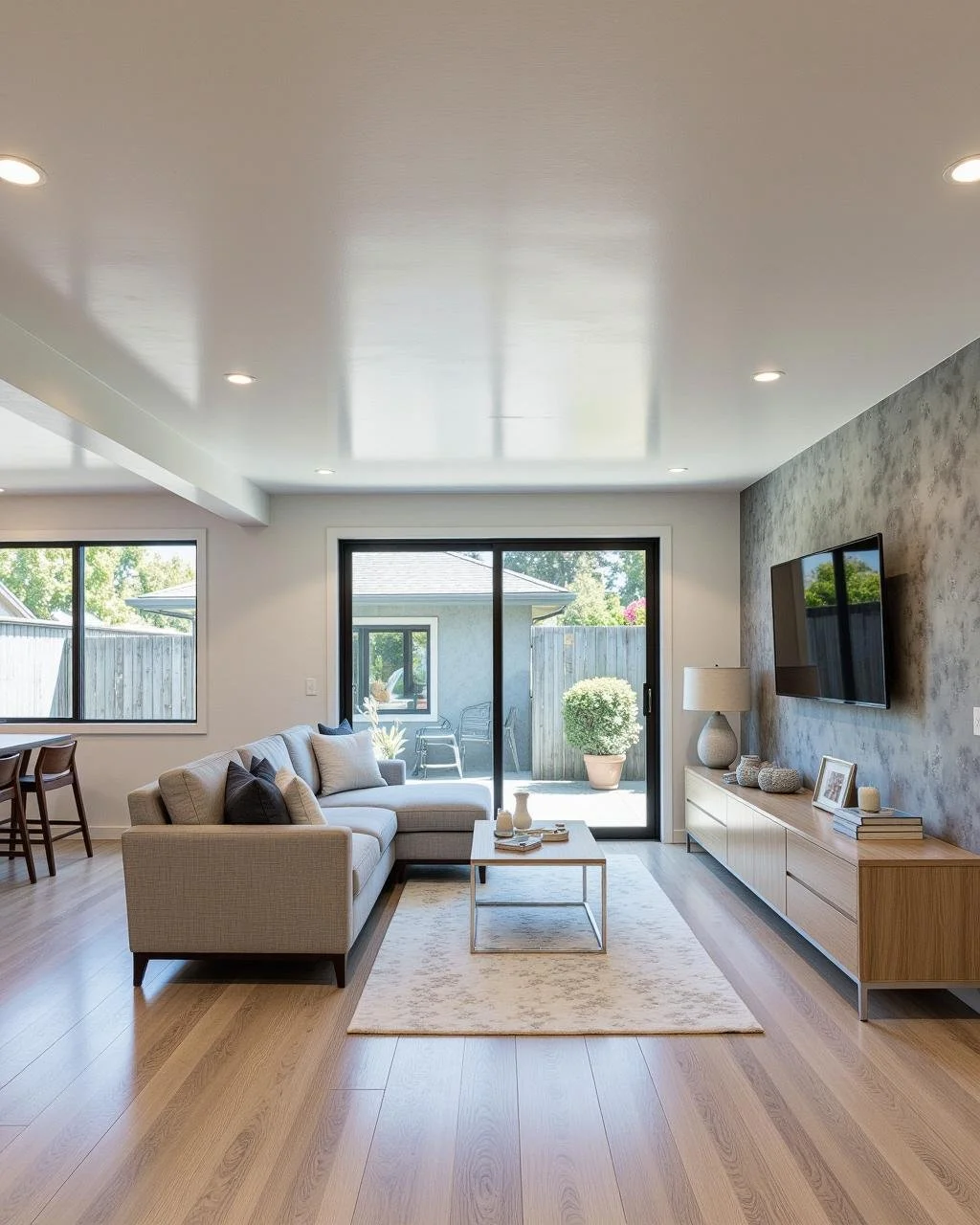
ADU Floor Plans by Size
Size Guide
Square footage is the organizing principle of ADU design. It determines not only how many rooms a plan can accommodate, but what quality of life those rooms can sustain. A 400 square foot plan demands a different kind of design intelligence than a 1,200 square foot plan — one prizes compression and multifunctionality, the other allows for breathing room and separation. The following sections examine each size category in the context of Los Angeles properties, from the most compact studios to the largest configurations permitted under California ADU law.
400 sq. ft. - Compact studio efficiency. Maximum function in minimum footprint.
500 sq. ft. - Studio to one-bedroom. Separation of sleep and living begins here.
600 sq. ft. - Full one-bedroom. Long-term living comfort with defined rooms.
900 sq. ft. - Small house feel. One or two bedrooms with generous shared space.
1000 sq. ft. - Two-bedroom comfort. Ideal for small families or premium rentals.
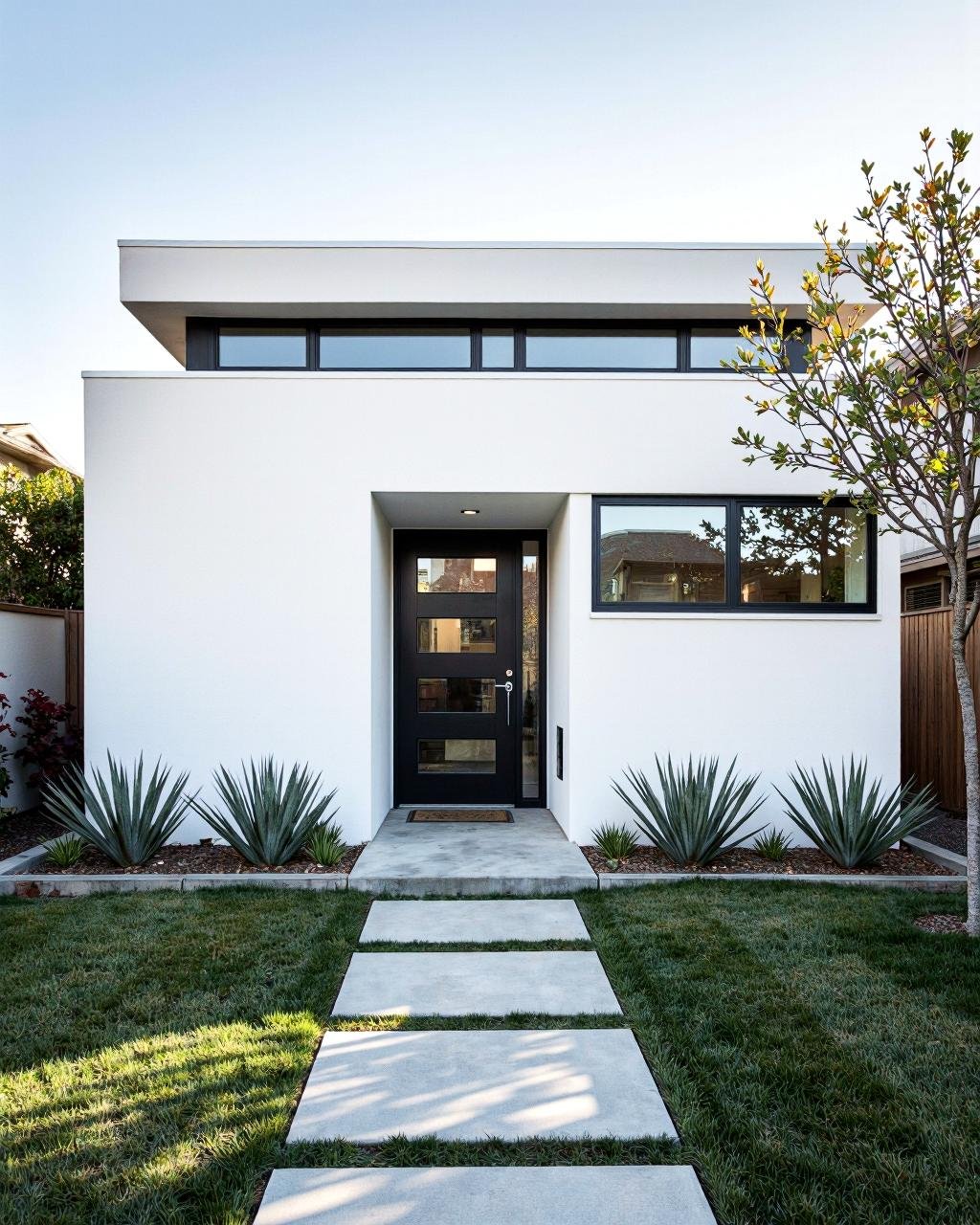
1200 sq. ft. - Maximum scale. Two bedrooms, two baths — a complete residence.
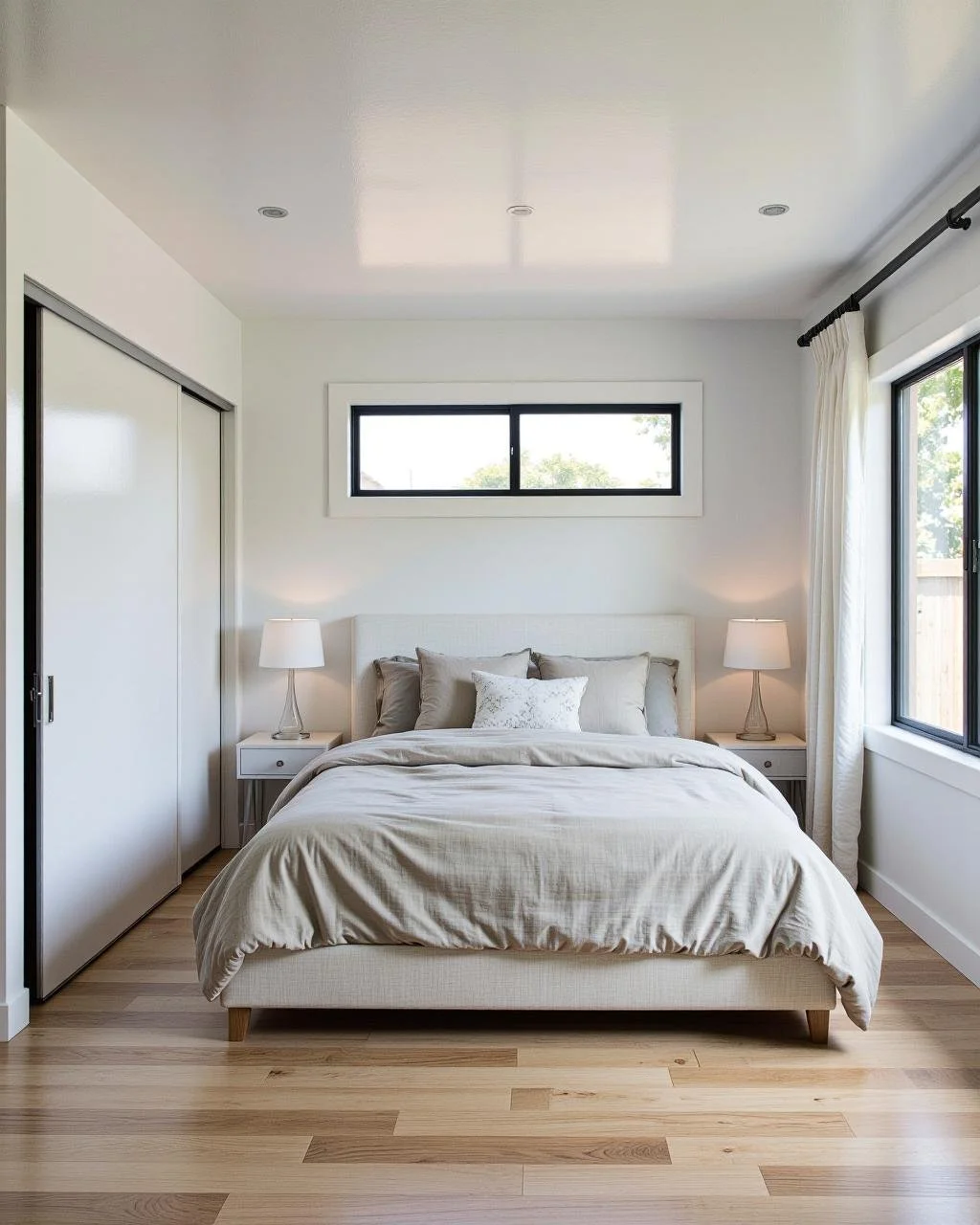

Get in touch to discuss your ADU in Los Angeles


FREE ON-SITE
CONSULTATION
PLANS & PERMITS
HANDELED
LICENSED & BONDED
PROFESSIONALS
FULL PROJECT
MANAGEMENT
We don’t guess or cut corners. Every project is carefully planned, expertly built, and fully managed—from initial blueprint to final inspection.
The Compact Studio
400 sq. ft. ADU
Four hundred square feet is not a limitation — it is a design brief. The best 400 square foot ADU plans in Los Angeles treat small-scale living as a discipline, borrowing spatial strategies from the finest small apartment traditions: built-in storage, multi-purpose furnishings, carefully positioned windows that make a room feel twice its measured dimensions. At this scale, the floor plan typically consolidates the living and sleeping area into a single open volume, with the kitchen and bathroom clearly delineated as distinct functional zones.
In Los Angeles, 400 square foot ADU plans are particularly well-suited to smaller lots in hillside neighborhoods where available backyard space is constrained, or as garden studios on properties where the primary goal is rental income rather than long-term family housing. Construction costs are proportionally lower, permitting tends to move faster, and the resulting unit can be designed with enough character and quality to command competitive rents.
Combined living and sleeping area
Compact kitchenette
Full bathroom with shower
Built-in or wall storage
Lower construction cost
Efficient for constrained lots
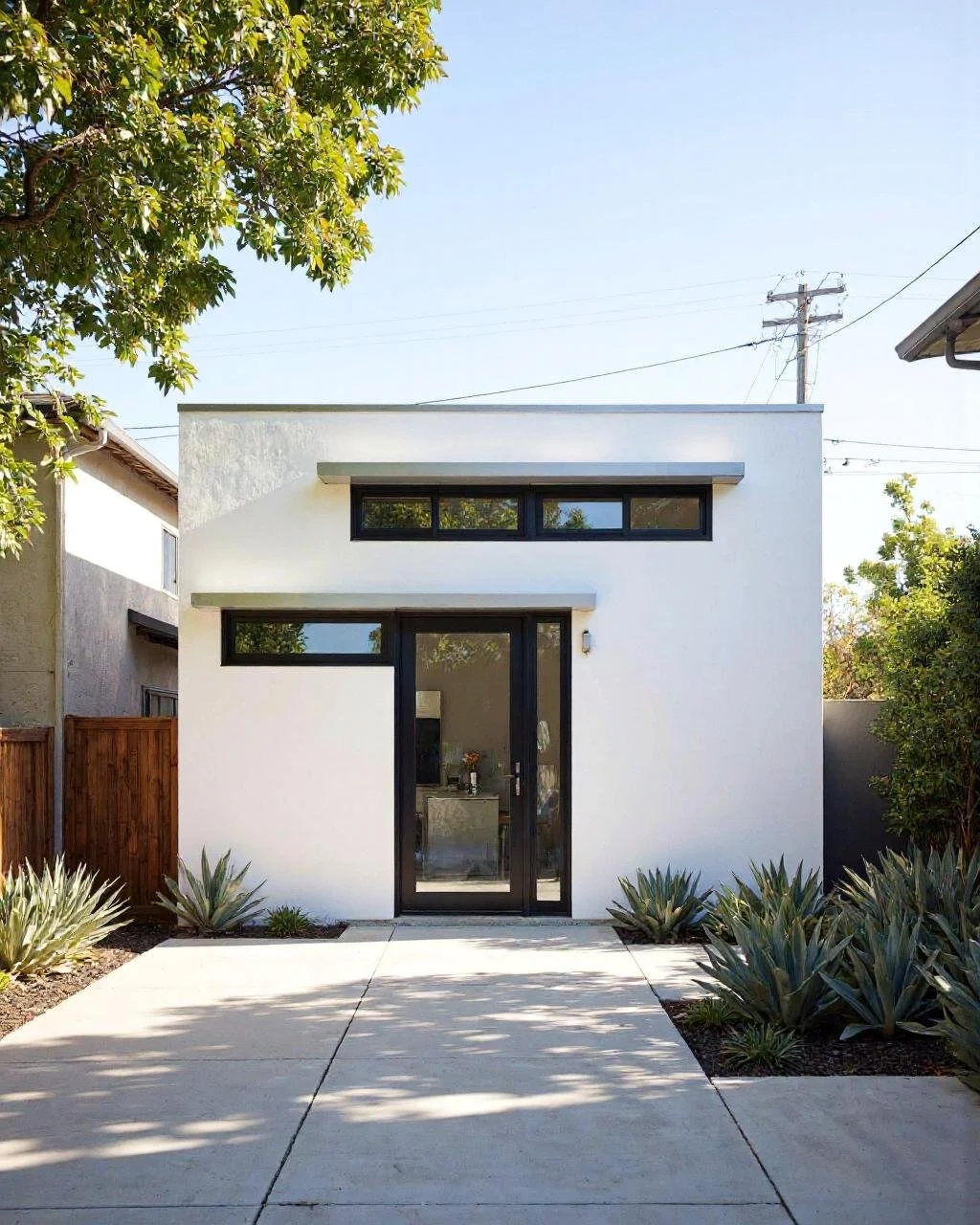
500 Sq. ft ADU plan
The additional hundred square feet that separates a 500 square foot plan from a 400 square foot plan is more significant than the number suggests. At 500 square feet, a designer can begin to create genuine separation between sleeping and living — a proper bedroom door, a distinct threshold, a room that closes. The sleeping area earns its own identity not as an alcove carved from an open volume, but as a real room with walls and privacy. The result is a unit that feels dramatically more livable than a pure studio while remaining accessible on budget-conscious construction schedules — which is precisely why this size has become one of the most requested ADU configurations in Los Angeles.
Five hundred square foot ADU plans are among the most popular configurations for rental units on mid-sized Los Angeles residential lots. They occupy a sweet spot between construction economy and tenant comfort. A well-designed 500 sq ft ADU plan — with high ceilings, well-placed glazing, and coherent material choices — can live far larger than its dimensions imply. The floor plan illustrated here is a custom ADU design for a Los Angeles property, measuring 20.5 by 22.5 feet and coming in just under 500 square feet. It demonstrates how efficiently that area can be distributed when the planning is deliberate.
Studio to One-Bedroom
What makes this plan particularly instructive is how clearly it resolves the four functional zones of residential life — sleeping, living, cooking, and bathing — without overlap or compromise. The bedroom occupies the upper-left quadrant, separated from the living room by a full wall and a closing door, giving its occupant genuine acoustic and visual privacy. The living room, positioned across the top-right, benefits from what would typically be the best natural light exposure on a standard Los Angeles lot. The kitchen runs along the bottom-right with an island that accommodates bar seating — a detail that prevents the kitchen from feeling isolated and creates a natural social connection between cooking and dining. The bathroom, tiled in full and finished with a walk-in shower, claims the bottom-left corner with a layout efficient enough to feel spa-like rather than merely functional. A closet adjacent to the bedroom and a clearly defined entrance complete a plan that, at under 500 square feet, asks very little of its occupants in the way of spatial compromise.
For Los Angeles homeowners evaluating this size, the case is straightforward: a 500 sq ft one-bedroom ADU is rentable to a wide tenant pool, financeable within a manageable construction budget, and permittable under California's current ADU framework with relatively few complications. It is, in many ways, the most practical starting point for an ADU investment on a mid-sized residential lot.
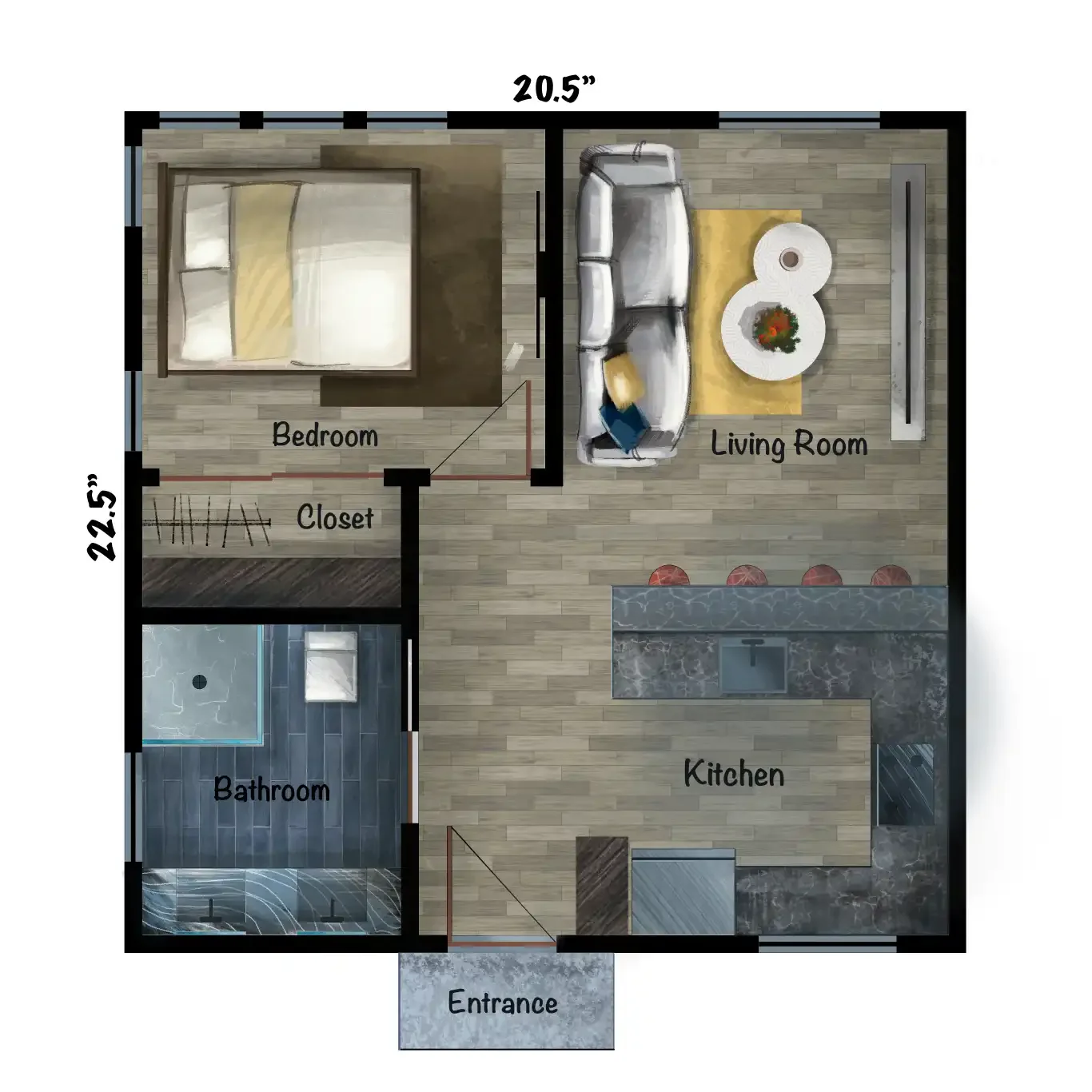
Custom 500 sq ft ADU floor plan, Los Angeles. 20.5′ × 22.5′ footprint. Layout includes a dedicated bedroom (top left), living room (top right), full kitchen with island seating (bottom right), bathroom with walk-in shower (bottom left), closet, and front entrance.
600 sq. ft. ADU
At 600 square feet, an ADU plan can deliver a genuine one-bedroom residence — not a studio with a partition, but a home with a proper bedroom door, a living room with room for a sofa and a coffee table, and a kitchen that accommodates actual cooking. This is the size at which ADU design begins to feel less like an exercise in compression and more like the craft of residential architecture.
Six hundred square foot ADU plans are well-suited to long-term occupancy: a family member who values independence, a tenant committing to a multi-year lease, or a homeowner who wants to maximize both livability and rental return. Optional features at this scale include a laundry closet — a significant quality-of-life addition that commands higher rents on the Los Angeles market — and a larger kitchen configuration with room for a dining area adjacent to the cooking space.
Read our other detailed article on ADU Design in LA
The Complete One Bedroom
Complete One Bedroom
Compact kitchenette
Full bathroom with shower
Built-in or wall storage
Lower construction cost
Efficient for constrained lots
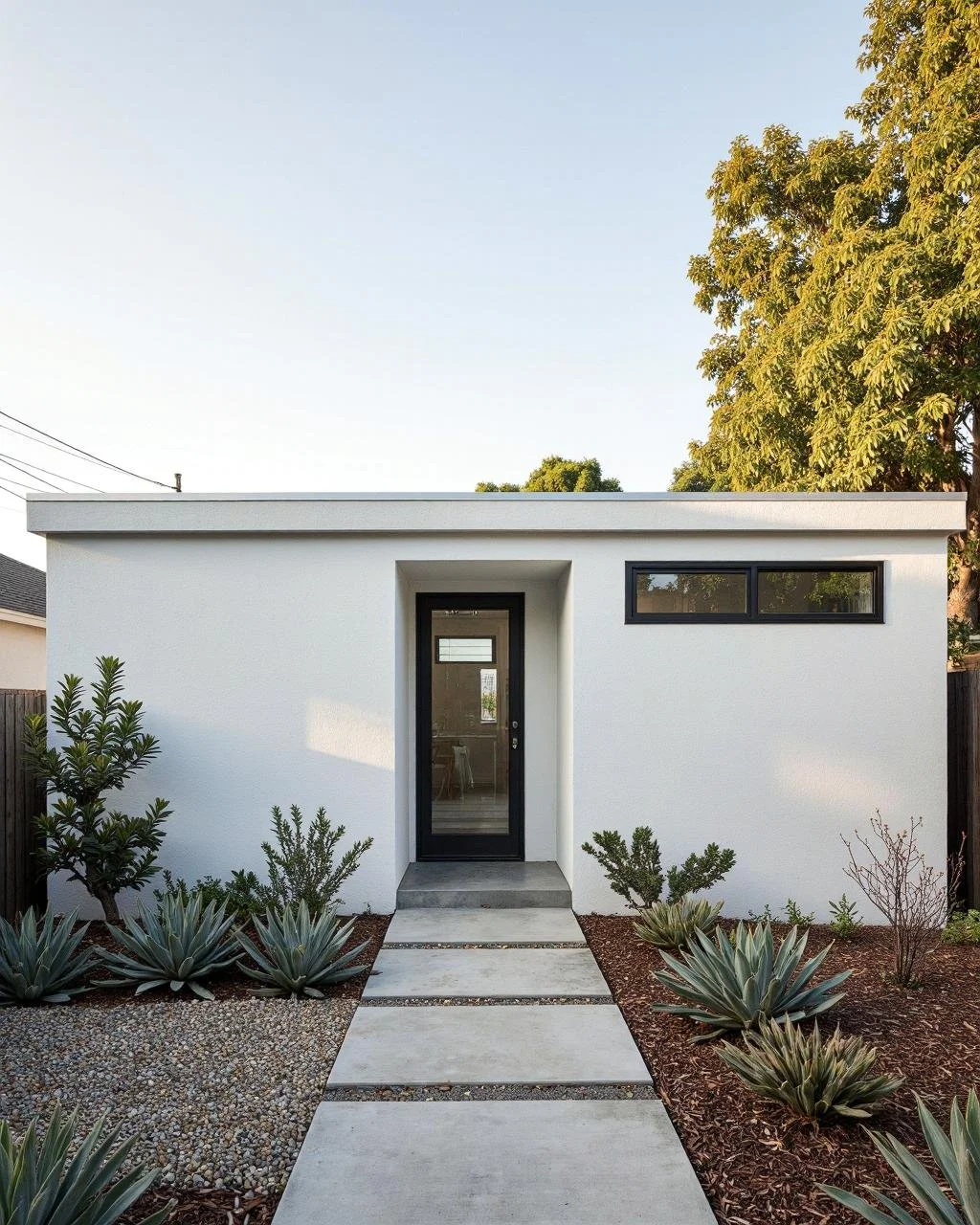
900 Sq. Ft. ADU
Nine hundred square feet marks a meaningful threshold in ADU design. At this scale, the unit stops being measured against what it lacks and starts being evaluated on its own terms. A 900 sq ft ADU plan can accommodate one or two bedrooms with genuine separation, a full kitchen designed for regular use rather than occasional reheating, a comfortable living room with room for a real sofa and a dining area that doesn't double as a workspace, and dedicated laundry tucked into its own closet or alcove. This is the complete infrastructure of domestic life — not approximated, not compressed into clever workarounds, but present in full.
In Los Angeles, where single-bedroom apartments in desirable neighborhoods routinely rent at significant premiums and vacancy rates remain persistently low, a well-located 900 square foot ADU represents a compelling investment. The construction cost per square foot at this size begins to distribute more favorably across the total program — the fixed costs of foundations, mechanical systems, and permitting are absorbed by a larger usable area, improving the overall economics of the project in ways that smaller ADUs cannot fully match.
These plans work particularly well for extended family living arrangements, and Los Angeles has more of these than perhaps any other American city. An aging parent who needs proximity but values independence. Adult children who want the emotional closeness of a shared property without the practical frictions of a shared home. A returning family member navigating a transition. The 900 sq ft configuration gives each of these scenarios enough room to breathe — a private bedroom, a living space that feels like one's own, a kitchen where a meal can be prepared with some pleasure rather than just efficiency.
What separates a well-designed 900 sq ft ADU plan from a merely adequate one is how the layout manages the relationship between public and private zones. The best plans at this scale position the bedroom or bedrooms toward the quieter side of the structure — away from street noise, away from the entrance — while opening the living and kitchen areas toward natural light and, where the lot allows, outdoor connection. A small covered patio or direct garden access transforms a 900 square foot interior into a living environment that feels substantially larger, a design move that costs relatively little and returns considerably more in daily quality of life. In Los Angeles's climate, where outdoor living is viable for most of the year, that connection to the exterior is not an amenity — it is a fundamental feature of how the space is actually used.
Where ADU Becomes Home
1000 sq. ft. ADU plan
The 1,000 square foot ADU plan is arguably the most versatile configuration in the California ADU landscape. It reliably accommodates two bedrooms, an open living and kitchen area generous enough for genuine social use, one or two bathrooms, and a laundry zone — all without the floor plan feeling stretched or the rooms feeling underfurnished. At this scale, design choices begin to matter in a different register: ceiling height, material quality, the finish of the floors, the relationship between indoor and outdoor space. These are no longer details to be deferred — they are what distinguishes a unit that rents in a week from one that sits.
The floor plan illustrated here is a custom ADU house plan designed for a Los Angeles property, measuring 26 by 38.5 feet and coming in right at 1,000 square feet. It is one of the clearest examples of how intelligently area can be distributed at this scale when the planning is given serious attention from the outset.
Two Bedrooms, Full Amenities
The plan organizes the two bedrooms along the left side of the structure, stacked vertically with a shared wall between them — a logical arrangement that consolidates the quieter, more private zones of the home away from the living and entry areas. The master bedroom at the bottom commands the most removed position on the plan, with its own ensuite bathroom directly adjacent. This is a detail that matters enormously to tenants and family members alike: the ability to move from bedroom to bath without passing through shared space is a mark of a plan that has been thought through rather than merely assembled. The second bedroom sits above it, served by a separate bathroom positioned at the center of the plan where it is equally accessible from the living area.
The upper portion of the plan belongs to living and cooking. The living area occupies the top-left corner with enough room for a proper seating arrangement — not a loveseat pushed against a wall, but a real living room configuration that can accommodate two or three people comfortably. The kitchenette runs across the top-right with a dining bar that creates a natural social boundary between cooking and living without closing either space off. Adjacent to the kitchen, a dedicated laundry room — a feature that carries real weight in the Los Angeles rental market — sits next to the entrance vestibule, which gives the unit a genuine sense of arrival rather than a door that opens directly into the living room.
From a rental perspective, 1,000 sq ft two-bedroom ADU plans perform exceptionally well in the Los Angeles market, attracting tenants who might otherwise compete for scarce two-bedroom apartment inventory. For homeowners considering long-term value, a 1,000 square foot ADU with two bathrooms and dedicated laundry represents one of the strongest additions a Los Angeles residential property can absorb — in rental income, in appraised value, and in the quality of life it makes possible for whoever calls it home.
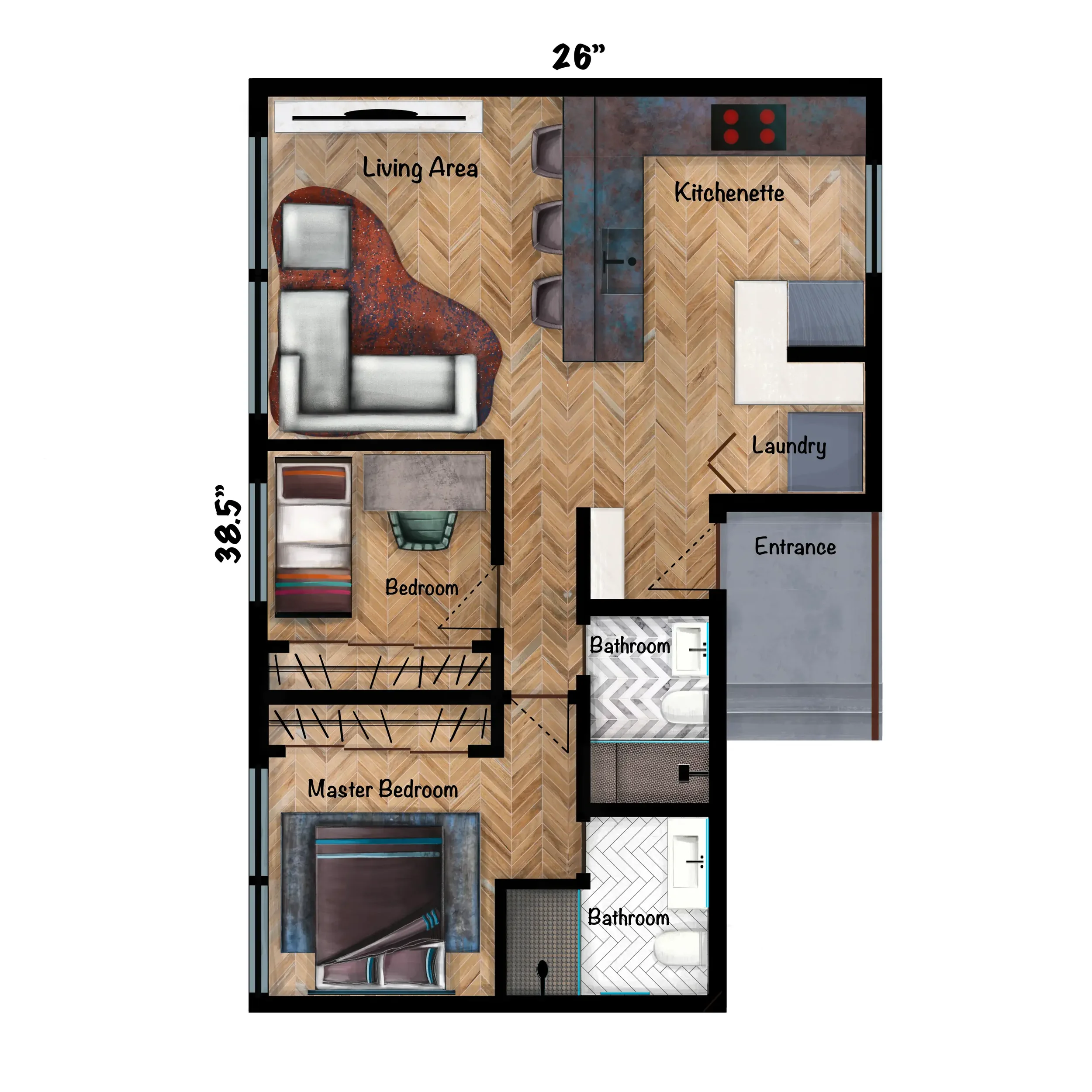
Custom 1,000 sq ft ADU house plan, Los Angeles. 26′ × 38.5′ footprint. Layout includes master bedroom with ensuite bathroom (bottom left), second bedroom (middle left), living area (top left), kitchenette with dining bar (top right), shared bathroom, dedicated laundry room, and entrance vestibule (right side). Herringbone hardwood flooring throughout.
1200 Sq. Ft. ADU Plan
At 1,200 square feet, an ADU plan reaches the upper boundary of what California regulations permit on most residential lots — and the best ones use every inch with intent. This is no longer a question of making a small space work. It is a question of how to design a complete, independent residence that happens to share a property. Two bedrooms, two bathrooms, a proper kitchen, a dining area, a full living room, dedicated laundry, and storage: at 1,200 square feet, none of these need to be compromised or combined. Each room can be what it is, furnished and used as it was designed to be.
The floor plan shown here is a custom 1,200 sq ft ADU design for a Los Angeles property, measuring 21′8″ × 52′ — a long, narrow footprint of the kind common on many LA lots, and one that this plan resolves with particular clarity. The elongated form that can feel like a liability in lesser plans becomes here an organizing spine, with zones stacked logically from the social and active spaces at the south end to the private sleeping quarters at the north.
The Maximum Expression
The lower third of the plan belongs to daily social life. The living room, entered directly from a covered entrance vestibule on the left side, is generously proportioned — room enough for a real sectional, a coffee table, and the television that every tenant expects as a baseline. The kitchenette and dining area occupy the bottom-right corner as a unified zone, the kitchen running along the wall with counter space sufficient for actual cooking, the dining table positioned to receive light from the south-facing end of the structure. These two spaces — living and dining — read as distinct rooms without being physically separated, a spatial relationship that makes the lower floor feel open and connected rather than subdivided.
Moving up the plan, the laundry room and storage room form a practical service core on the right side — features that in the Los Angeles rental market meaningfully separate this category of ADU from smaller configurations. A second full bathroom serves this transitional zone and the second bedroom, which sits at the middle-left with enough floor area for a queen bed, nightstands, and a dresser without crowding. At the top of the plan, the master bedroom claims the full right-side width — a room that reads less like an afterthought and more like a genuine primary suite, with a dedicated bathroom positioned directly adjacent and a closet running along the shared wall.
In Los Angeles neighborhoods where detached single-family homes under 1,500 square feet command significant market values, a well-built 1,200 sq ft ADU is not simply an accessory to the property — it is a second asset on the same lot. For homeowners thinking about long-term financial strategy alongside the immediate practicalities of housing a family member or generating rental income, this is the ADU configuration that most fully delivers on both.
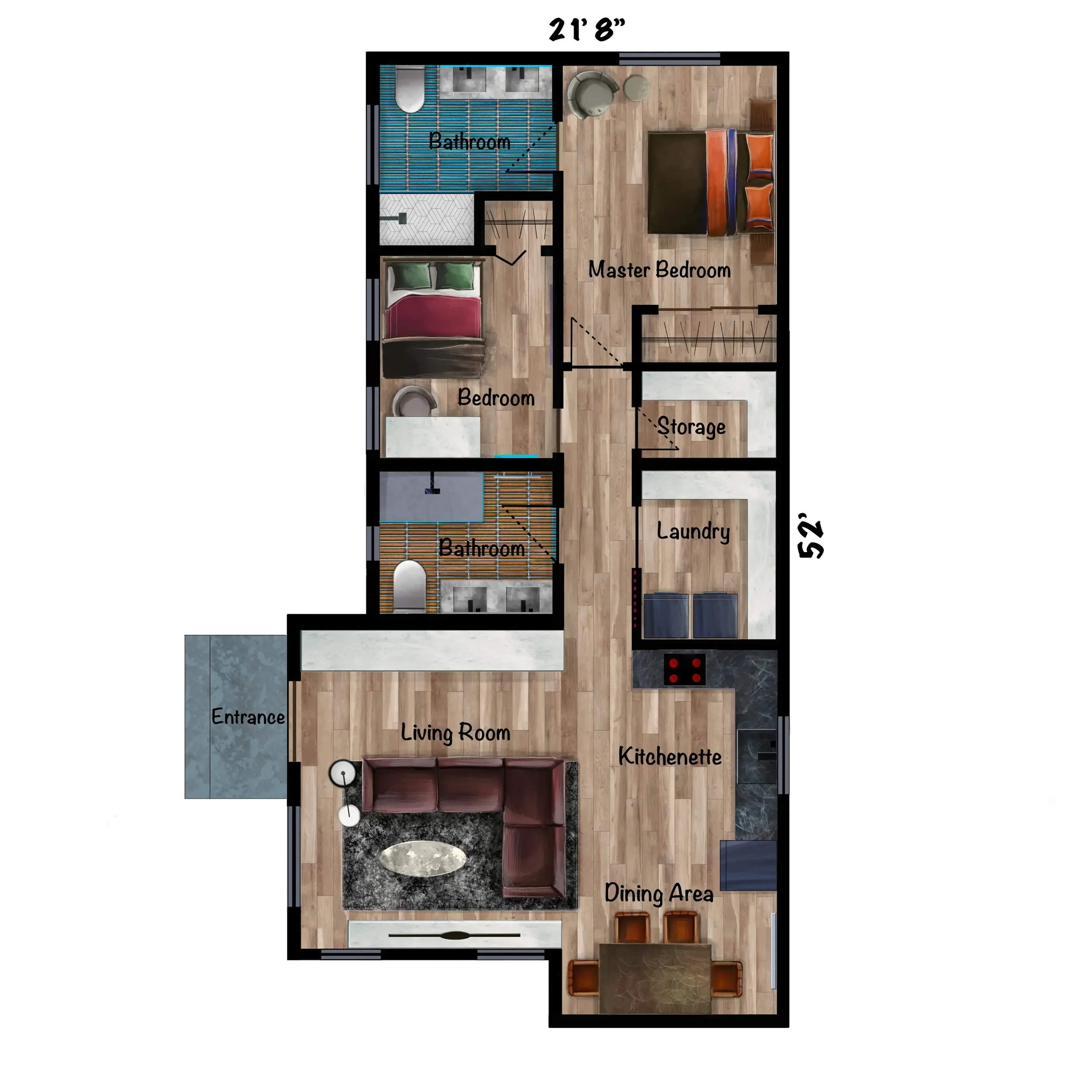
Custom 1,200 sq ft ADU floor plan, Los Angeles. 21′8″ × 52′ footprint. Layout includes master bedroom with closet (top right), second bedroom (middle left), two full bathrooms, living room with entrance (bottom left), kitchenette (bottom right), dining area, dedicated laundry room, and storage room.
2 Car Garage ADU
The two-car garage conversion is one of the most pragmatic and architecturally interesting ADU typologies available to Los Angeles homeowners. A standard two-car garage offers between 400 and 600 square feet of existing building footprint — structure already in place, utilities often nearby, and a distinct relationship to the rear of the property that can provide both privacy and outdoor access. Converting that space into a livable ADU preserves the existing investment in the structure while fundamentally transforming its contribution to the property.
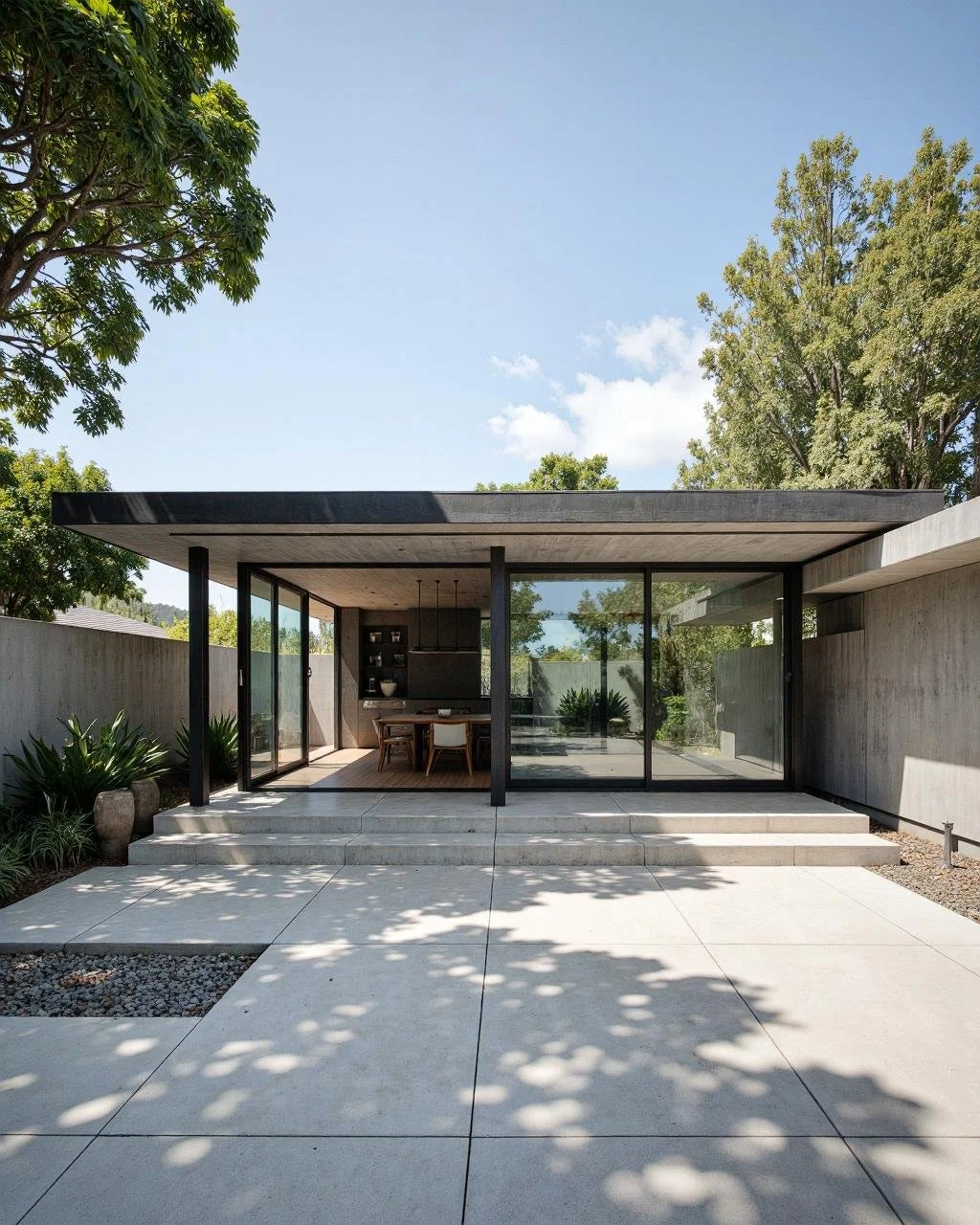
Two car garage ADU plans typically reorganize the open garage volume into a bedroom, living area, kitchen, and bathroom, often adding a loft or raised sleeping platform to take advantage of the ceiling height that garage structures commonly provide. The large original opening — once the garage door — becomes a prime opportunity for glazing: a wall of windows or a glass door system that connects the interior to the rear garden and floods the space with the southern or western light that Los Angeles so reliably delivers.
California's regulations treat garage conversions favorably, and the Los Angeles Department of Building and Safety has developed relatively streamlined pathways for these projects. Because the structure already exists, garage conversion ADU plans can move through permitting and construction more quickly than new detached builds — an important consideration for homeowners prioritizing time to occupancy.
400-600 sq. ft. ADU

The Loft ADU
Not every ADU story is told horizontally. The loft ADU — a two-story configuration that stacks a mezzanine sleeping level above a compact but complete main floor — is one of the most architecturally interesting options available to Los Angeles homeowners, and one of the most practical solutions for lots where ground-level square footage is at a premium. By building vertically rather than spreading laterally, a loft ADU can deliver a genuinely multi-room living experience on a footprint that would otherwise limit the design to a modest studio.
The plan illustrated here is a custom Loft ADU designed for a Los Angeles property, measuring 16.5 by 31.5 feet across two floors. On paper, the numbers are modest. In practice, the spatial experience is anything but. The mezzanine configuration — a loft floor that opens visually to the main floor below through a generous central void — creates a sense of vertical volume that fundamentally changes how the interior feels. You are not living in a small box. You are living in a small building.
Two Floors, One Foot Print
The main floor organizes the daily functional requirements of living with notable efficiency. The kitchenette occupies the upper-left corner, finished in teal tile with a bar counter that faces into the space — a design choice that keeps the cook visually connected to the living area rather than isolated against a wall. The bathroom sits opposite, tiled in a geometric herringbone pattern and fully equipped despite its compact footprint. The staircase runs along the center of the plan, its placement deliberate: it divides the more utilitarian upper zone from the living room below without interrupting the flow between them. The living room itself is the generous heart of the main floor — an open, light-filled area large enough for a proper sofa arrangement, anchored by the entrance on the left side and a storage room tucked neatly into the bottom corner.
The loft floor is where the plan earns its character. The bedroom claims the top-left position — the quietest, most removed corner of the structure, elevated above the street and the entrance activity below. An office and study carves out a defined workspace on the right side, a detail that reflects how people actually live today: remote work, creative projects, and the need for a desk that isn't the kitchen table. The central mezzanine opening — the large void that connects loft floor to main floor — is the spatial move that makes the whole plan sing. It prevents the upper level from feeling like an attic and turns the vertical section of the home into a single connected volume, with light and air circulating freely between floors.
For Los Angeles homeowners evaluating this configuration, the loft ADU answers a specific question: how do you create a one-bedroom-plus-office residence on a footprint that most plans would treat as a studio? The answer, as this plan demonstrates, is to think in three dimensions. The result is an ADU that appeals to a particular kind of tenant — design-conscious, likely working from home, drawn to the elevated aesthetic of a space that feels like a converted artist's studio rather than a backyard apartment — and commands rents to match.
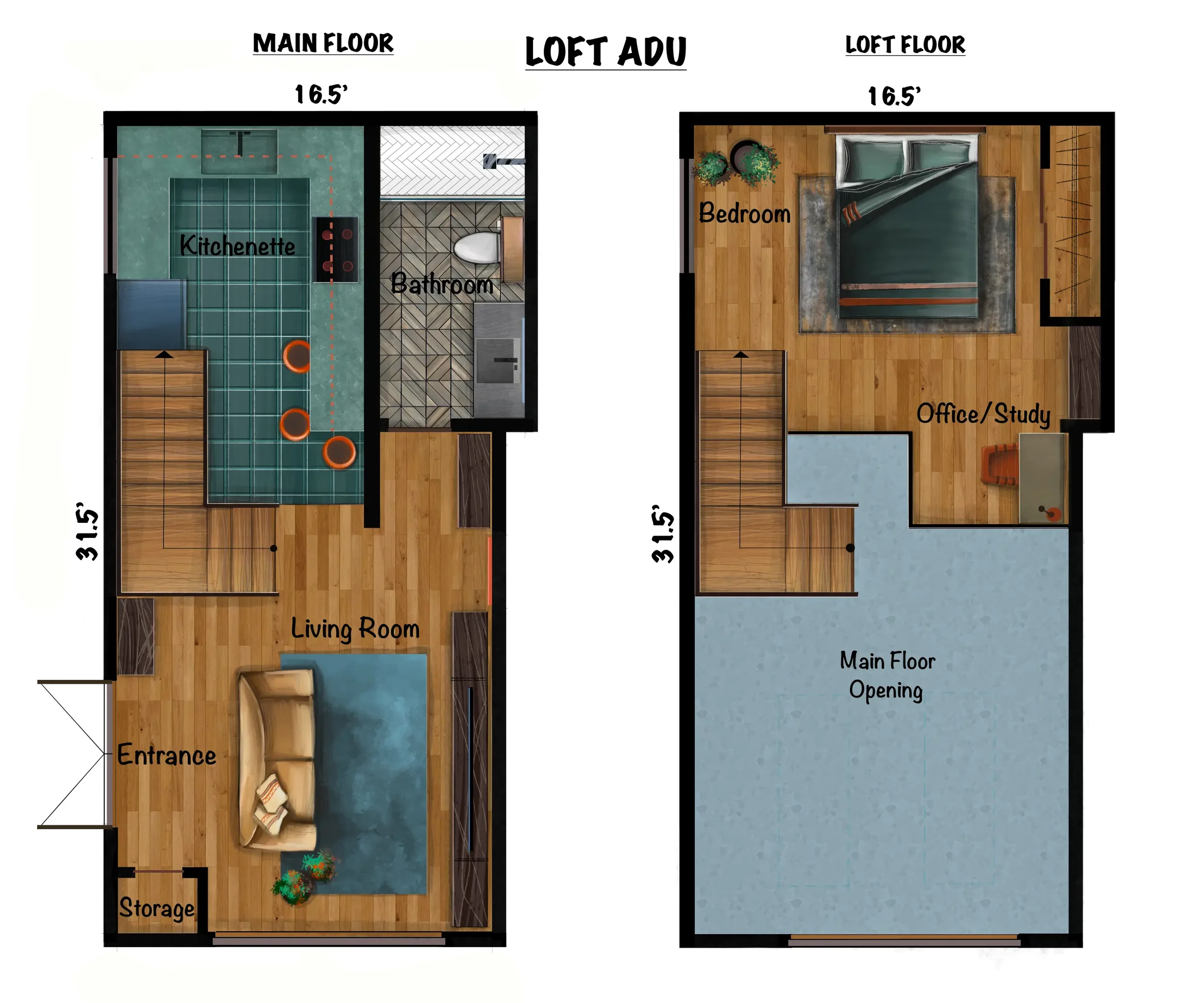
Custom Loft ADU floor plan, Los Angeles. 16.5′ × 31.5′ footprint across two floors. Main floor: kitchenette (top left), bathroom (top right), living room with entrance, and storage. Loft floor: bedroom (top left), office/study (right), and open mezzanine opening to main floor below.
ADU Plans in California
Developing ADU plans in California means working within a regulatory framework that is at once more permissive than it has ever been and more nuanced than it first appears. State legislation has progressively expanded homeowners' rights to build ADUs, reducing barriers related to parking, owner-occupancy requirements, and minimum lot sizes. For Los Angeles properties, this means that most single-family lots can now support at least one ADU — and in many cases, both an ADU and a Junior ADU within the same property.
Key design parameters include maximum unit size, which varies by configuration and lot characteristics; setback requirements that determine how close to property lines a new structure can be placed; height limits that typically cap detached ADUs at sixteen feet; and separate entry requirements that ensure the ADU functions as an independent dwelling. An ADU plan developed without a thorough understanding of these parameters risks costly revisions during the permitting process — a common source of delays for homeowners who begin design before confirming their site's specific constraints.
Design Consideration
Max ADU Size - 1,200 sq ft (detached); up to 50% of primary home (attached)
Setbacks - 4 ft from rear and side property lines (standard)
Height Limit - 16 ft for detached ADUs on most lots
Parking Required - None for most ADU types under current California law
Junior ADU - Up to 500 sq ft within existing home structure
ADU Planning and Construction Services in Los Angeles
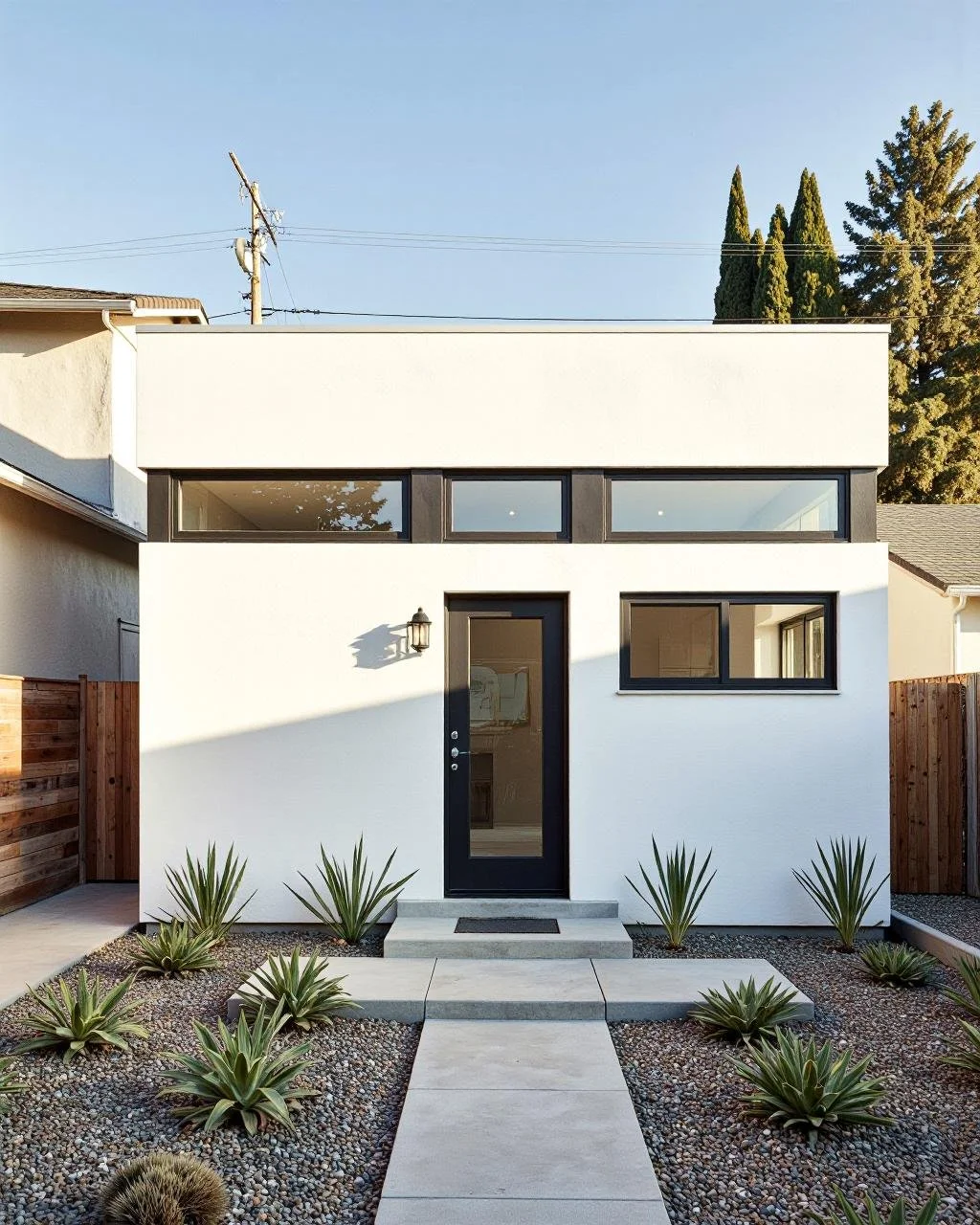
SKALWEST Construction provides ADU planning, design coordination, and construction services throughout Los Angeles and surrounding coastal and hillside communities. Our work focuses on creating well-integrated accessory dwelling units that respond to the character of each property while meeting local building requirements. From compact backyard studios to larger two-bedroom layouts, each ADU project begins with careful planning and a clear understanding of how the new space will function within the existing property.
Our team assists homeowners at every stage of the process. This typically includes reviewing the property conditions, discussing potential ADU layouts, and developing floor plans that fit the lot size and intended use. Once the planning phase is established, the project moves into design preparation, permitting coordination, and construction management. Throughout the process, attention is placed on maintaining structural integrity, efficient space planning, and thoughtful integration with the existing home.
SKALWEST Construction works with homeowners across several Los Angeles communities, including Santa Monica, Pasadena, Beverly Hills, Malibu, Manhattan Beach, Hermosa Beach, Redondo Beach, Torrance, and Altadena. Each neighborhood presents different planning considerations, from lot configurations and access requirements to architectural character and municipal regulations. Our approach adapts to these local conditions while maintaining a consistent focus on quality construction and clear project organization.
Accessory dwelling units can serve many purposes, from rental housing and guest accommodations to private living space for extended family members. Because of this flexibility, ADU design requires careful coordination between layout, utilities, and construction methods. Our role is to guide homeowners through that process while ensuring that each phase of the project supports the overall plan.
Frequently Asked Questions
Common Questions About ADU Plans in Los Angeles
Under current California law, a detached ADU can be up to 1,200 square feet on most residential lots in Los Angeles. Attached ADUs — those sharing a wall with the primary home — are generally limited to 50% of the existing home's living area. A Junior ADU, which must sit entirely within the existing structure, is capped at 500 square feet. Lot conditions, zoning overlays, and specific neighborhood designations can all affect these limits, which is why a proper site review before design begins is always the right first move.
Yes — all ADU construction in Los Angeles requires permits through the Department of Building and Safety, whether you are building a new detached unit, converting a garage, or adding an attached structure. The process covers plan check review, structural and mechanical approvals, and inspections at key construction milestones. Working with a contractor who manages permitting coordination from the start — as SKALWEST does — is the most reliable way to keep the process on track and avoid costly mid-project corrections.
Timelines vary by project type. Garage conversion ADUs tend to move fastest — typically 3 to 5 months from permit approval to occupancy — since the existing structure removes much of the early groundwork. A new detached ADU generally runs 6 to 9 months depending on size and site conditions. Permitting in Los Angeles can take 4 to 12 weeks on its own, which makes submitting a complete and accurate set of plans from the outset one of the single most impactful things a homeowner can do to protect their overall schedule.
A detached ADU is a fully independent structure on the same lot as the primary home — separate foundation, separate walls, separate entrance. It offers the highest level of privacy and acoustic separation, making it the preferred configuration for rental use and for multigenerational households where independence on both sides matters. An attached ADU shares at least one wall with the main residence, which often reduces construction cost and can be the right fit when lot size doesn't support a separate footprint or when physical proximity between the two households is intentional.
Yes. California law explicitly allows ADUs to be rented to tenants, and Los Angeles currently has no owner-occupancy requirement for most ADU types under state legislation — meaning you do not need to live on the property to lease the unit. Rental demand for ADUs in well-located Los Angeles neighborhoods is consistently strong, and two-bedroom configurations in particular attract a broad and competitive tenant pool. Always verify the specific rental rules for your property type and zoning district, as local ordinances can add nuance to the state framework.
ADU construction costs in Los Angeles vary based on size, configuration, site conditions, and finish level. New detached ADUs generally run between $250 and $400 per square foot, while garage conversions typically come in at a lower cost per foot given the existing structure. Soft costs — design, engineering, and permitting — usually add 10 to 20% on top of construction. The most reliable way to understand what your specific project will cost is through an on-site consultation, where lot access, utility connections, and project goals can all be evaluated together from the start.
For pure rental performance, the 500 to 900 square foot range covers the widest tenant pool in Los Angeles. A well-designed 500 sq ft one-bedroom ADU attracts singles and couples and commands competitive rents in most neighborhoods. Step up to 900 or 1,000 square feet with two bedrooms and you open the unit to small families and roommate pairs — a segment with strong demand and lower turnover. The sweet spot depends on your lot, your budget, and the specific rental market in your neighborhood, all of which are worth reviewing before committing to a plan size.
In most cases, yes — and the increase can be substantial. A permitted, well-built ADU adds an income-producing unit to the property, which appraisers and buyers in the Los Angeles market consistently treat as a significant value driver. ADU properties routinely command premiums over comparable single-family homes without them. In high-demand zip codes across LA, a 1,000 or 1,200 square foot ADU frequently adds more in appraised value than its total construction cost — making it one of the strongest returns on investment available to a residential property owner in the city.
How To Choose The Right ADU Floor Plan in LA
Selecting an ADU plan is ultimately an act of prioritization. The right plan for a homeowner focused on maximizing rental income in a high-demand Los Angeles neighborhood may look very different from the right plan for a family creating a multigenerational living arrangement. Several factors consistently shape this decision: the usable area of the lot and its orientation to the sun; the intended occupant and their daily needs; the construction budget and timeline; and the degree to which the ADU should feel integrated with or independent from the primary residence.
Smaller plans — 400 to 600 square feet — are most effective when simplicity and construction economy are priorities. Larger plans — 900 to 1,200 square feet — make more sense when the ADU needs to function as a primary residence for its occupant, or when the property's location supports premium rental positioning. In all cases, the quality of the design matters enormously: a thoughtful 500 square foot plan, well-proportioned and carefully detailed, will outperform a poorly designed 900 square foot plan on every measure that matters to the people who live in it.