

In Law Suite House Plans:
Mother-in-Law Suite Floor Plans from 400 to 1,200 Sq Ft
In-Law Suite Design Guide — Los Angeles, California
Few home additions have reshaped how Los Angeles families think about property as quietly — or as profoundly — as the in-law suite. What was once a niche addition reserved for large estates has become a mainstream housing strategy across every neighborhood in the city, driven by rising multigenerational living, soaring rental demand, and a state regulatory environment that now actively encourages homeowners to build.
In-law suite house plans in Los Angeles span a wide range: from 400 square foot studios that use every inch with purpose, to 1,200 square foot two-bedroom residences fully equipped for independent long-term living. Whether the goal is housing a parent close by, generating rental income, or adding lasting value to a residential property, the right house plan for an in-law suite is the foundation every successful project rests on. This guide walks through each size category, each configuration type, and the design principles that determine whether a plan merely works — or truly lives well.
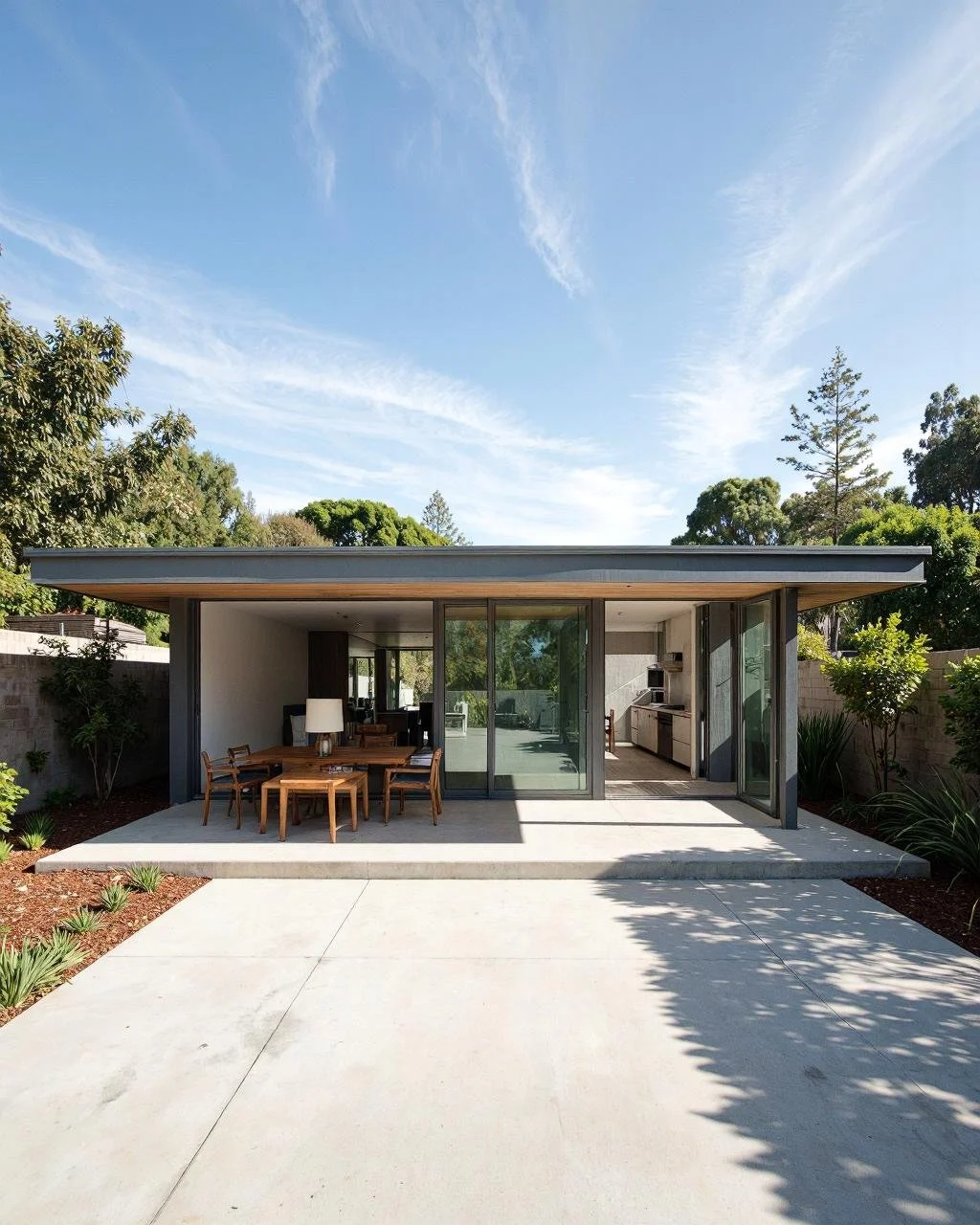

SKALWEST CONSTRUCTION
Your Trusted In-Law Suite Construction Partner in LA
THE BASICS
What Makes a Strong In-Law Suite Floor Plan?
A mother-in-law suite floor plan is a precise document that goes well beyond a simple room layout. It maps how structural loads are carried, where mechanical systems run, how daylight reaches the interior, and how an occupant will actually inhabit the space day to day. The best in-law suite floor plans do something harder than meeting code — they balance privacy, functionality, and comfort in a footprint that often asks a great deal of every square foot.
In Los Angeles, in-law suite home plans typically take one of three physical forms. The most common is a detached backyard structure built new on an existing residential lot — a standalone unit that offers the greatest separation from the main home. Garage conversions are the second major type, transforming existing structures into livable space while keeping construction timelines and costs down. The third is an attached addition that expands directly off the primary residence, sharing at least one wall with the existing structure. California's housing legislation has opened the door for in-law suite additions on nearly all single-family and multifamily lots in Los Angeles, with lot size, zoning, and configuration determining the specific parameters. Getting those parameters right before design begins is what separates a smooth permitting process from an expensive one.
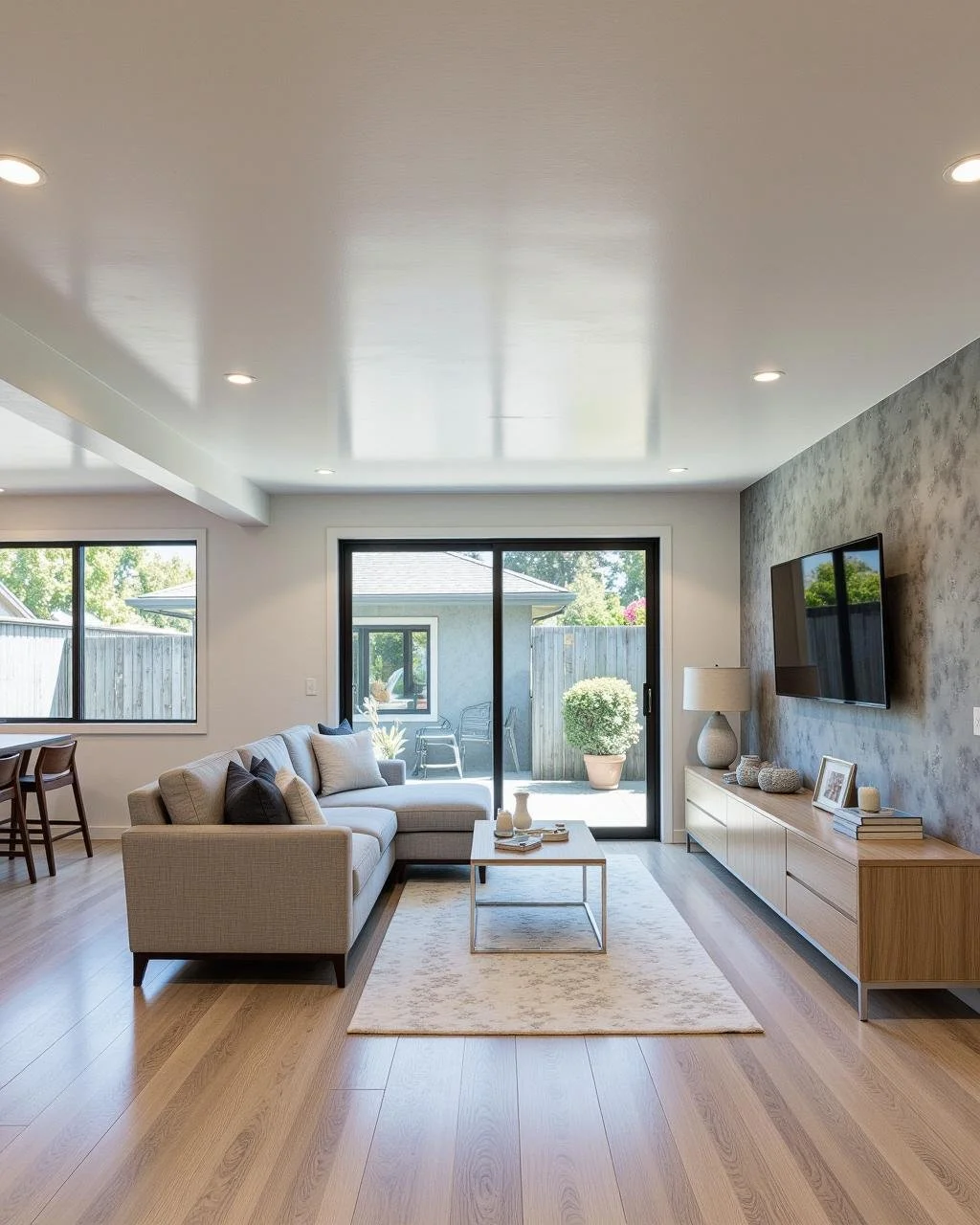
Mother-in-Law Suite Floor Plans by Size
Size Guide
The square footage of an in-law suite doesn't just determine how many rooms it contains — it shapes the entire quality of daily life inside it. A 400 square foot plan and a 1,200 square foot plan call for completely different design approaches. One is an exercise in precision; the other is an exercise in proportion. Understanding what each size range can and cannot deliver helps homeowners match the plan to the actual goals of the project before a dollar is spent.
400 sq. ft. - Studio efficiency. Every element earns its place.
500 sq. ft. - Studio or one-bedroom. Real separation between sleeping and living becomes possible.
600 sq. ft. - Defined one-bedroom. A proper home for long-term occupancy.
900 sq. ft. - Small house territory. One or two bedrooms with room to breathe.
1000 sq. ft. - Full two-bedroom. Ideal for families or high-end rental positioning.
1200 sq. ft. - The maximum. A fully independent two-bedroom, two-bath residence.

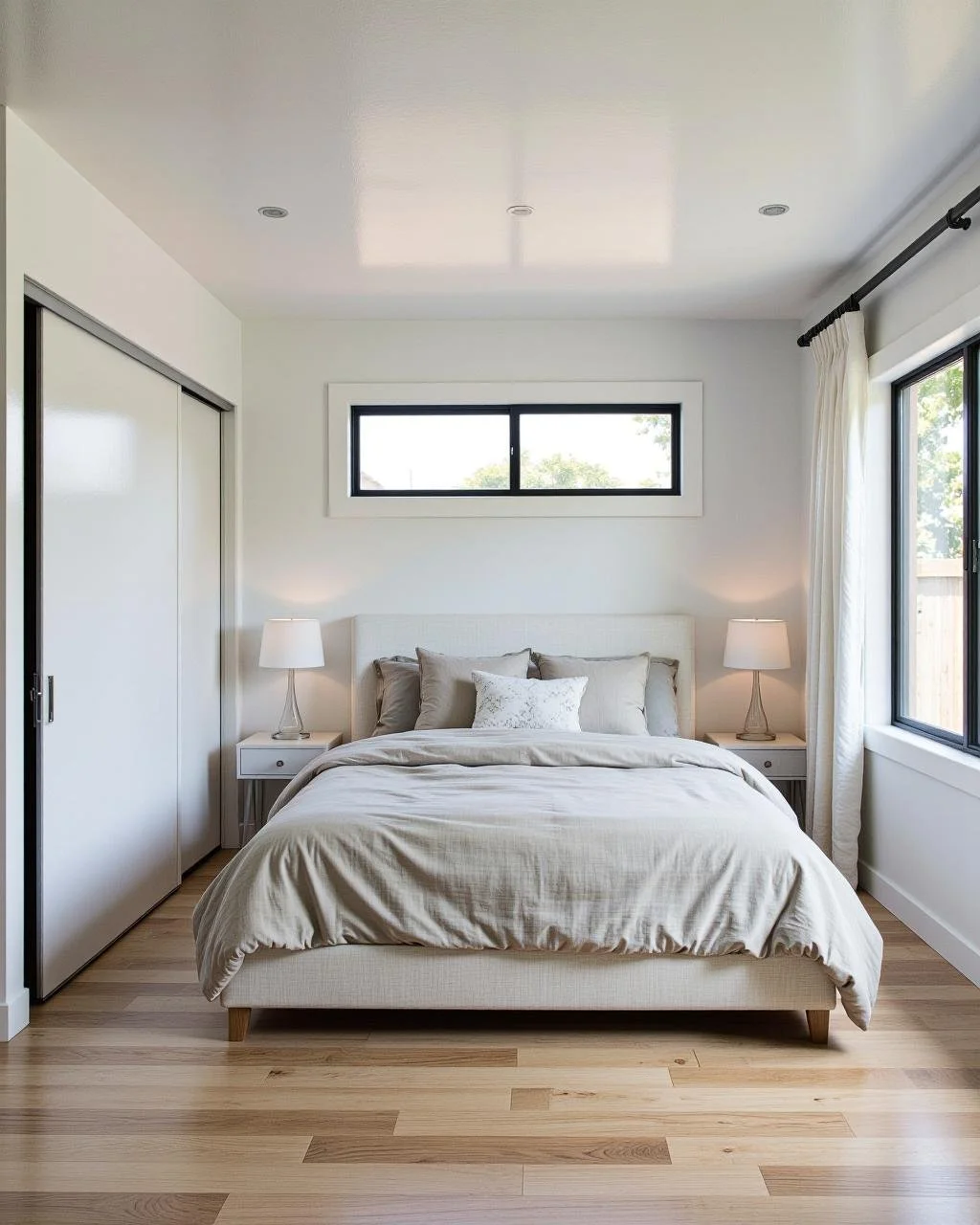

Get in touch to discuss your ADU in Los Angeles


FREE ON-SITE
CONSULTATION
PLANS & PERMITS
HANDELED
LICENSED & BONDED
PROFESSIONALS
FULL PROJECT
MANAGEMENT
We don’t guess or cut corners. Every project is carefully planned, expertly built, and fully managed—from initial blueprint to final inspection.
The Compact Studio
400 sq. ft. In-Law Suite
Designing a 400 square foot in-law suite well is a discipline, not a compromise. The finest compact mother-in-law suite floor plans draw from the same spatial intelligence found in well-designed small apartments in dense cities — where multifunctional furniture, integrated storage, and precisely placed windows create an interior that feels open and purposeful rather than cramped and improvised. At this scale, the sleeping and living areas typically share a single open volume, while the kitchen and bathroom are carved out as distinct, clearly defined zones.
For Los Angeles homeowners with tighter lots — particularly hillside properties where usable rear yard space narrows quickly — a 400 square foot in-law suite house plan often represents the most practical entry point. The construction cost is proportionally lower than larger configurations, the permitting path tends to be more straightforward, and a well-designed unit at this scale can serve its occupant comfortably as a rental, a guest retreat, or private quarters for a family member who values independence over square footage.
Open living and sleeping volume
Compact kitchenette
Full bathroom with shower
Integrated and built-in storage
Lower overall construction cost
Suited to constrained or hillside lots
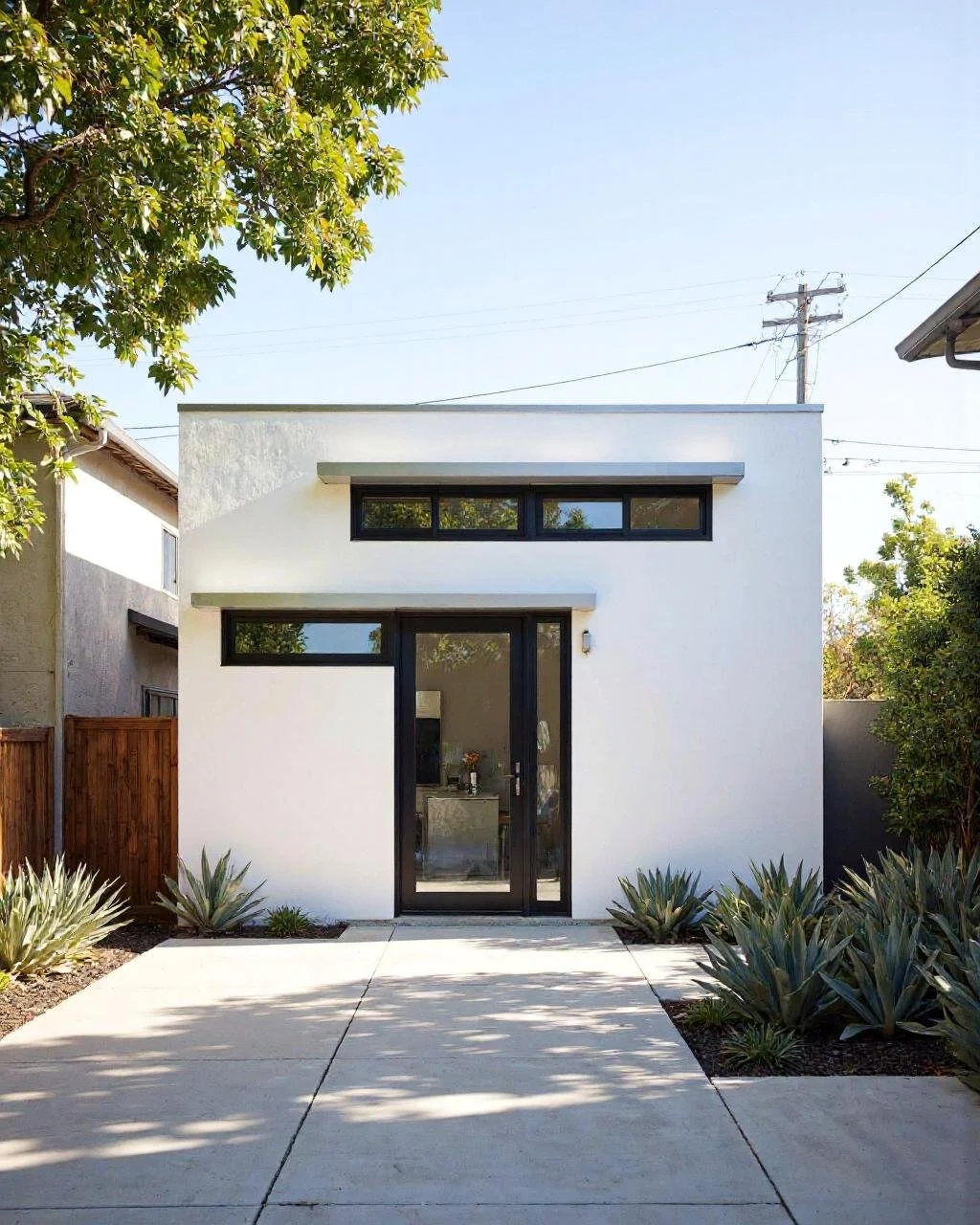
500 Sq. Ft. Mother-in-Law Suite Floor Plan
The jump from 400 to 500 square feet changes more than the numbers on the plan. It changes the character of the living experience entirely. A hundred additional square feet is enough to introduce a closing bedroom door — a real wall, real acoustic separation, a space that the occupant can retreat into rather than simply sleep in. That distinction is what moves a plan from studio territory into one-bedroom territory, and it is the reason 500 square foot mother-in-law suite floor plans are among the most frequently requested configurations in Los Angeles. They hit a practical sweet spot: a genuine one-bedroom layout on a budget that most homeowners can realistically reach.
The custom in-law suite floor plan shown here was designed for a Los Angeles property at 20.5 by 22.5 feet — just under 500 square feet total. It is a study in what thoughtful planning can accomplish within tight boundaries. Four distinct zones of daily life — sleeping, living, cooking, bathing — are each given their own defined territory without any of them feeling reduced or forced to borrow from another.
The bedroom sits in the upper-left quadrant behind a full wall and a door that closes. The living area occupies the upper-right, positioned to capture the best natural light. The kitchen runs along the bottom-right with an island that doubles as informal seating — a practical move that keeps the kitchen from reading as an isolated utility zone. The bathroom in the bottom-left corner is compact but well-proportioned, with a walk-in shower and enough room to move without feeling constrained. A closet off the bedroom and a proper entry sequence complete a plan that, for its size, refuses to feel like a compromise.
Studio to One-Bedroom
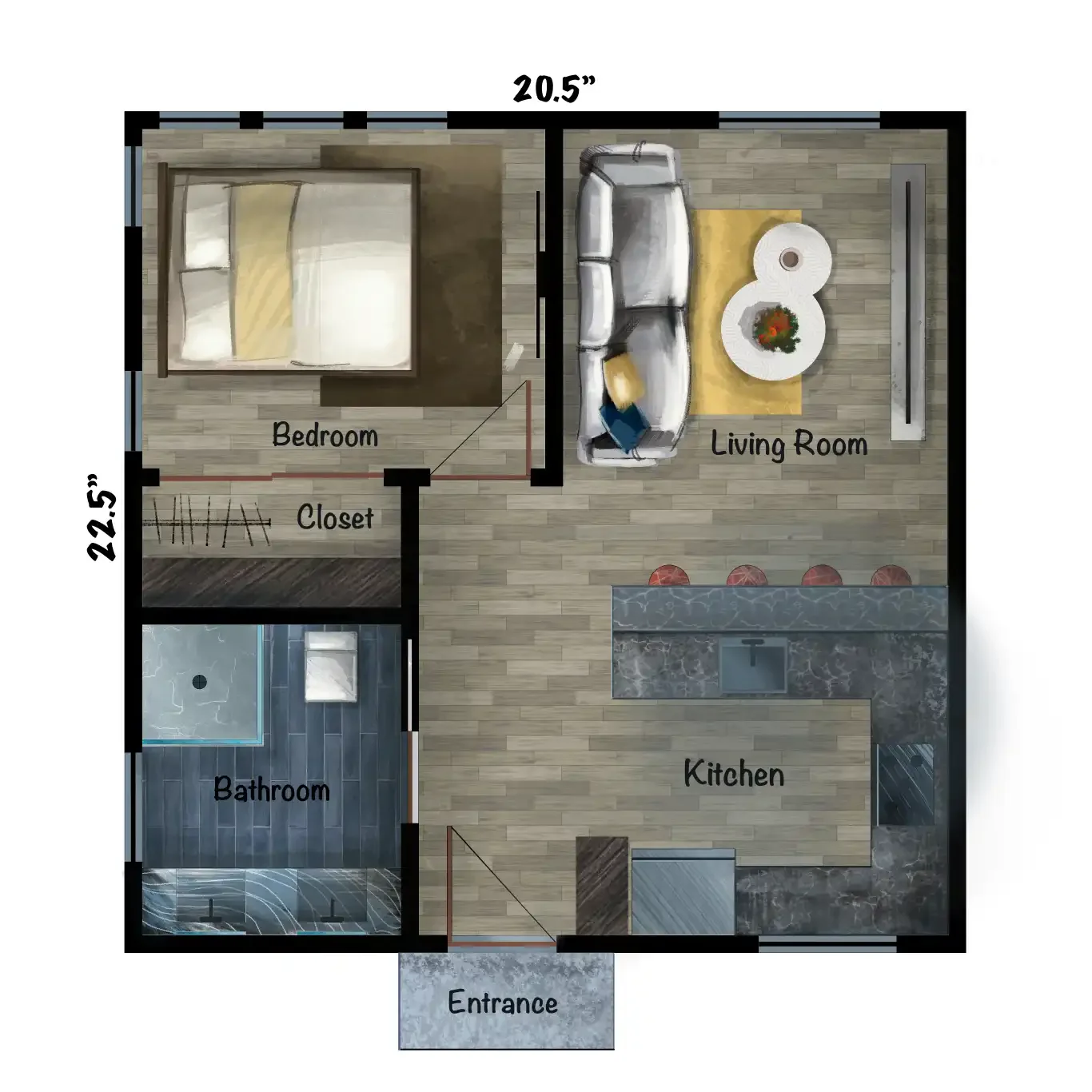
Custom 500 sq ft in-law suite floor plan, Los Angeles. 20.5′ × 22.5′ footprint. Bedroom (top left), living room (top right), kitchen with island (bottom right), bathroom with walk-in shower (bottom left), closet, and entry.
600 sq. ft. ADU
600 Sq. Ft. In-Law Suite Addition Floor Plan
Six hundred square feet is the point at which a mother-in-law suite stops asking its occupant to adapt to the space and starts adapting to the occupant instead. A proper bedroom with a real door and a window. A living room where a standard sofa fits without crowding the walls. A kitchen with enough counter space to actually prepare a meal. These are not luxuries at this scale — they are the baseline, and a well-planned 600 square foot in-law suite addition floor plan delivers all of them without asking for workarounds.
This configuration is particularly well-matched to situations where the in-law suite will serve as someone's primary residence over an extended period — a parent aging in place with family nearby, a long-term tenant, or a family member in transition who needs real stability rather than a temporary arrangement. At 600 square feet, there is also room to include a dedicated laundry closet, a detail that carries real weight in the Los Angeles rental market and contributes meaningfully to both tenant satisfaction and rental income.
Full one-bedroom
Kitchen with prep space
Full bathroom with shower
Defined living area
Optional laundry closet
Suited to long-term occupancy
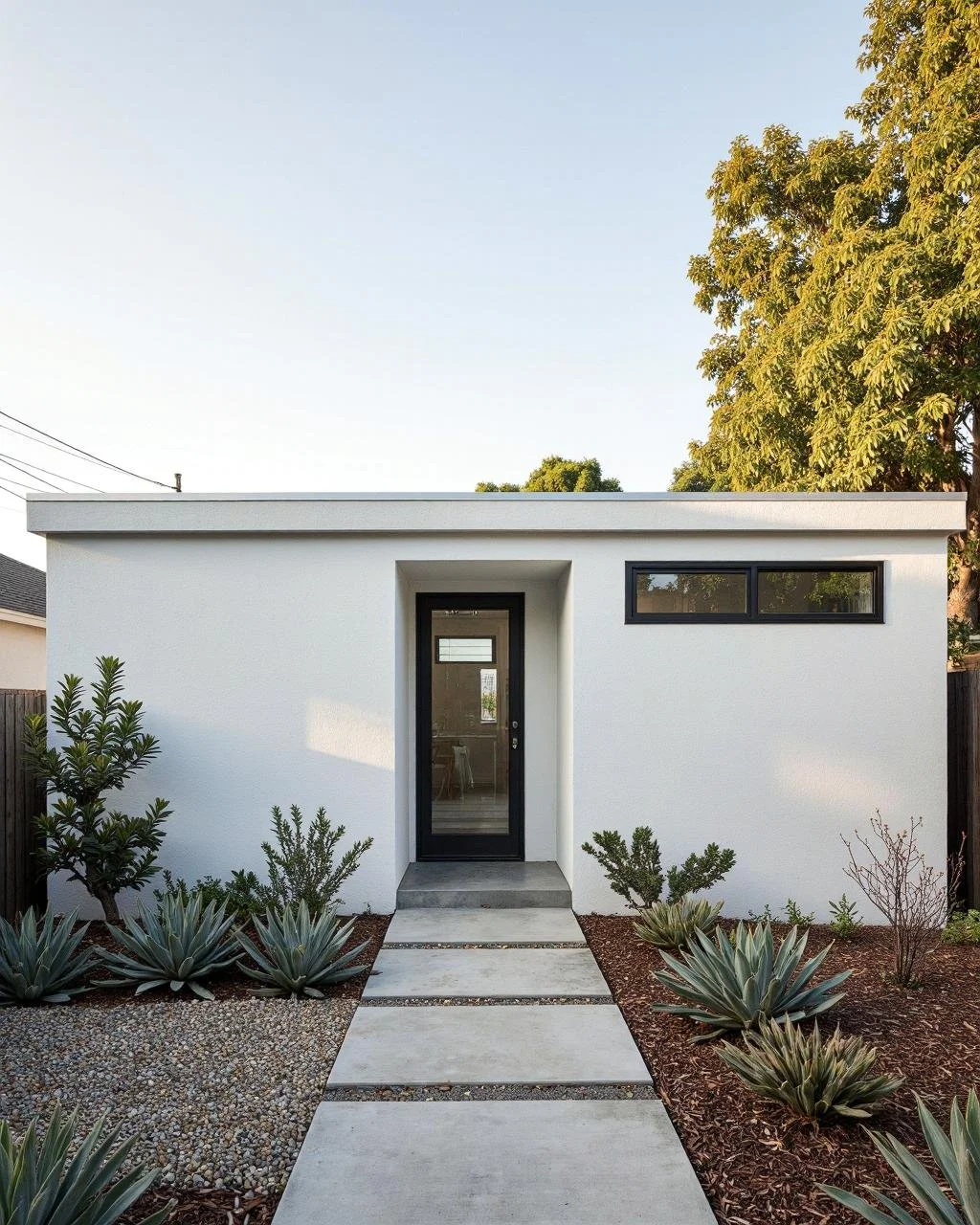
900 Sq. Ft. In-Law Suite Home Plan
Where It Becomes Home
At 900 square feet, the conversation about what an in-law suite home plan can offer shifts fundamentally. Below this threshold, design is partly about managing scarcity — making the most of what is available. At 900 square feet, the design brief changes: the question is no longer what to leave out, but how to organize what is fully present. A bedroom or two with genuine separation from the living spaces. A kitchen that is used for cooking, not just reheating. A living room with a real seating arrangement. A dining area that exists on its own terms. Dedicated laundry. These are not optional features at this scale — they are expected components of a complete home.
In Los Angeles, where multigenerational living has become an increasingly common and practical response to housing costs, the 900 square foot in-law suite occupies a particularly meaningful place. It is large enough to give a parent or adult child real autonomy — their own kitchen, their own schedule, their own front door — while keeping the distance between households measured in steps rather than miles. For families navigating questions of care, proximity, and independence, this configuration often resolves all three at once.
From an investment standpoint, the economics of a 900 square foot in-law suite tend to work out favorably. The fixed costs of construction — permitting, foundations, mechanical systems — are spread across enough square footage that the cost per livable foot drops noticeably compared to smaller configurations. The rental income potential in well-located Los Angeles neighborhoods is substantial, and vacancy rates in this category remain persistently low.
The distinguishing quality of a well-executed 900 sq ft plan is how it handles the boundary between private and shared space. Bedrooms positioned toward the quieter, more sheltered side of the structure. Living areas oriented toward natural light. And wherever the lot allows, a connection to the outdoors — a small patio, a garden door — that multiplies the perceived size of the interior in a city where the climate invites outdoor living nearly year-round.
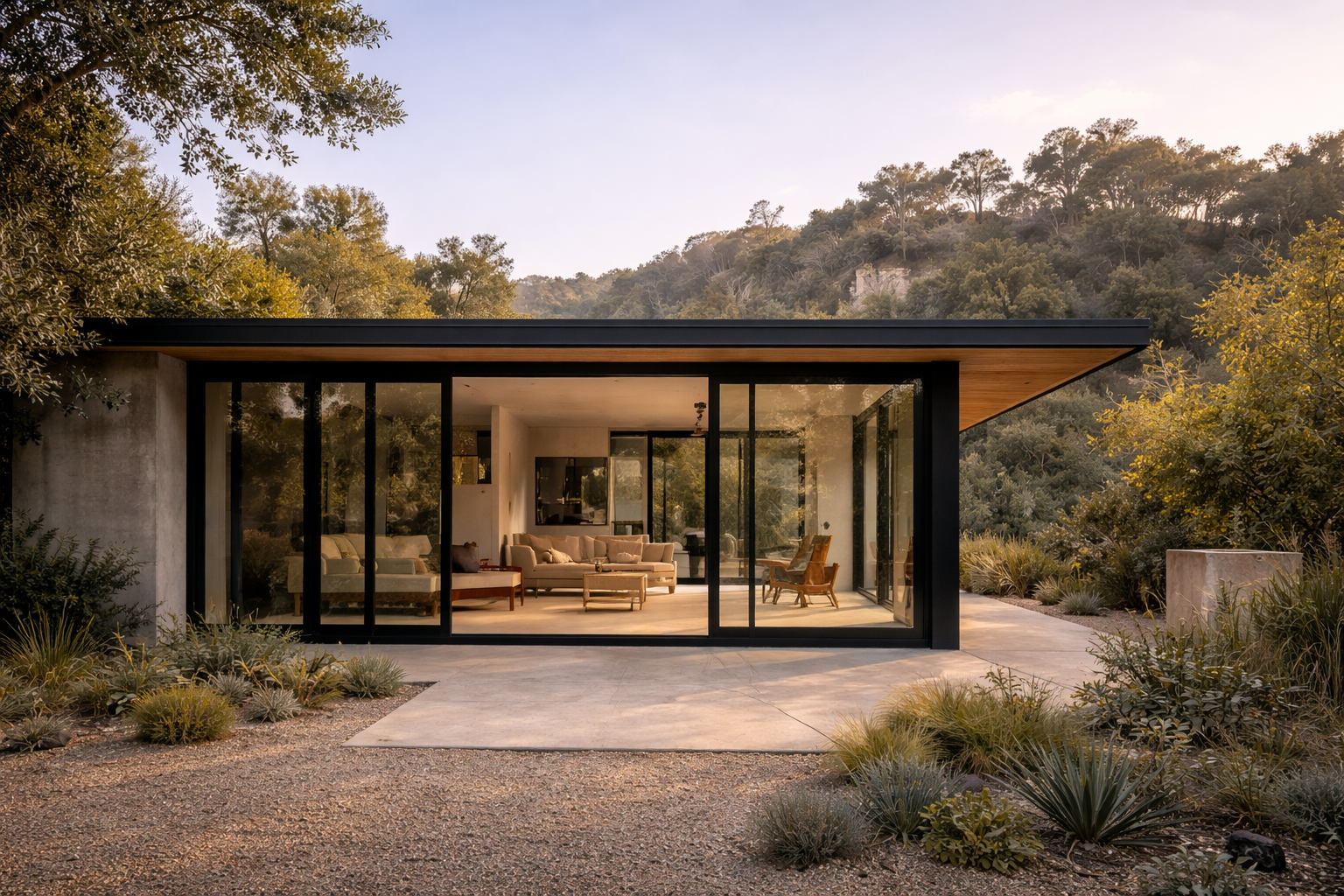
1,000 Sq. Ft. House Plan for In-Law Suite
A 1,000 square foot house plan for an in-law suite is where flexibility peaks. Two bedrooms, a generous open living and kitchen area, one or two bathrooms, and a dedicated laundry space all fit within this footprint without the plan feeling like it is stretching to accommodate them. It is also the scale at which finish quality begins to carry real weight — where the ceiling height, the floor material, the way light moves through the space in the late afternoon — all of these start defining the character of the home rather than just its functionality.
The custom plan shown here was developed for a Los Angeles property measuring 26 by 38.5 feet, landing right at 1,000 square feet. The layout reflects deliberate planning at every level.
Both bedrooms are positioned along the left side of the plan — a decision that clusters the private, quiet zones of the home away from the entry and the active living areas. The master bedroom occupies the most removed position on the plan with a dedicated ensuite bathroom immediately adjacent, eliminating the need to pass through shared space to access it. The second bedroom sits directly above, connected to a separate bathroom at the center of the plan that serves both the bedroom and the living area with equal convenience.
The upper half of the plan is the social core of the home. The living area is large enough for a proper furniture arrangement — an actual sofa configuration, not a loveseat pushed against a wall. The kitchen runs across the opposite corner with a dining bar that creates a natural, open connection between cooking and the rest of the living space. Beside the kitchen, a dedicated laundry room anchors the entry vestibule — a feature that commands attention in the Los Angeles rental market and adds tangible value to the unit.
Two Bedrooms, Full Amenities
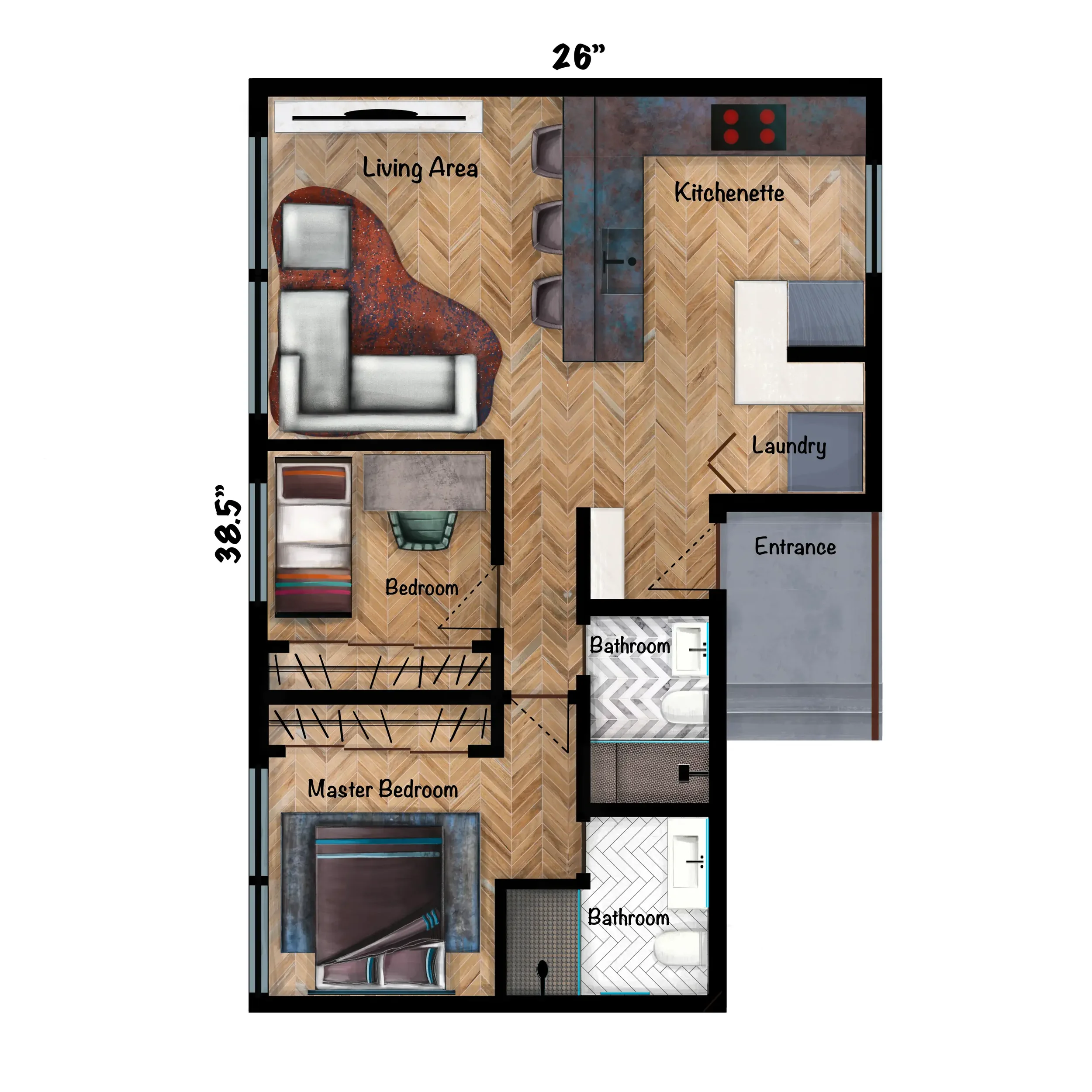
Custom 1,000 sq ft in-law suite floor plan, Los Angeles. 26′ × 38.5′ footprint. Master bedroom with ensuite (bottom left), second bedroom (middle left), living room (top left), kitchen with dining bar (top right), shared bathroom, laundry room, and entry vestibule (right side). Herringbone hardwood flooring throughout.
1,200 Sq. Ft. In-Law Suite House Plan
At the upper limit of what California regulations permit on most residential lots, a 1,200 square foot in-law suite house plan is a different kind of project. Not an exercise in efficiency or creative constraint — but a full residential design challenge. Two bedrooms. Two bathrooms. A kitchen designed for serious daily use. A dining space. A proper living room. Storage. Laundry. Each of these is present in its entirety, designed as a room, not a workaround.
The custom plan shown here measures 21′8″ × 52′ — a long, narrow footprint of the kind found on many Los Angeles lots, and one that lesser plans often struggle with. Here, the elongated form becomes an organizational advantage. Zones are stacked along a single clear axis: social and active spaces at one end, private sleeping quarters at the other, with service spaces — laundry, storage, bathrooms — anchoring the middle.
The entry leads directly into a generously sized living room, expansive enough for real furniture and a comfortable evening at home. The kitchen and dining area occupy the far corner of the social end, designed as a unified zone where cooking and gathering happen in the same breath. The counter space is proportioned for actual meal preparation, and the dining table sits close enough to the kitchen to feel connected without crowding it.
Moving toward the private end of the plan, a laundry room and dedicated storage space form a transition zone between the social and sleeping areas — a practical buffer that also adds meaningful rental value. The second bedroom sits in the middle of the plan with enough floor area for a queen bed and standard furniture. The master bedroom at the far end of the structure is a genuine primary suite — private, quiet, and served by its own dedicated bathroom and a closet along the shared wall.
In many Los Angeles neighborhoods, a thoughtfully built 1,200 sq ft in-law suite is not a secondary feature of the property. It is a second asset — one that generates income, serves family, or does both simultaneously depending on the season of life the homeowner is in.
The Maximum Expression
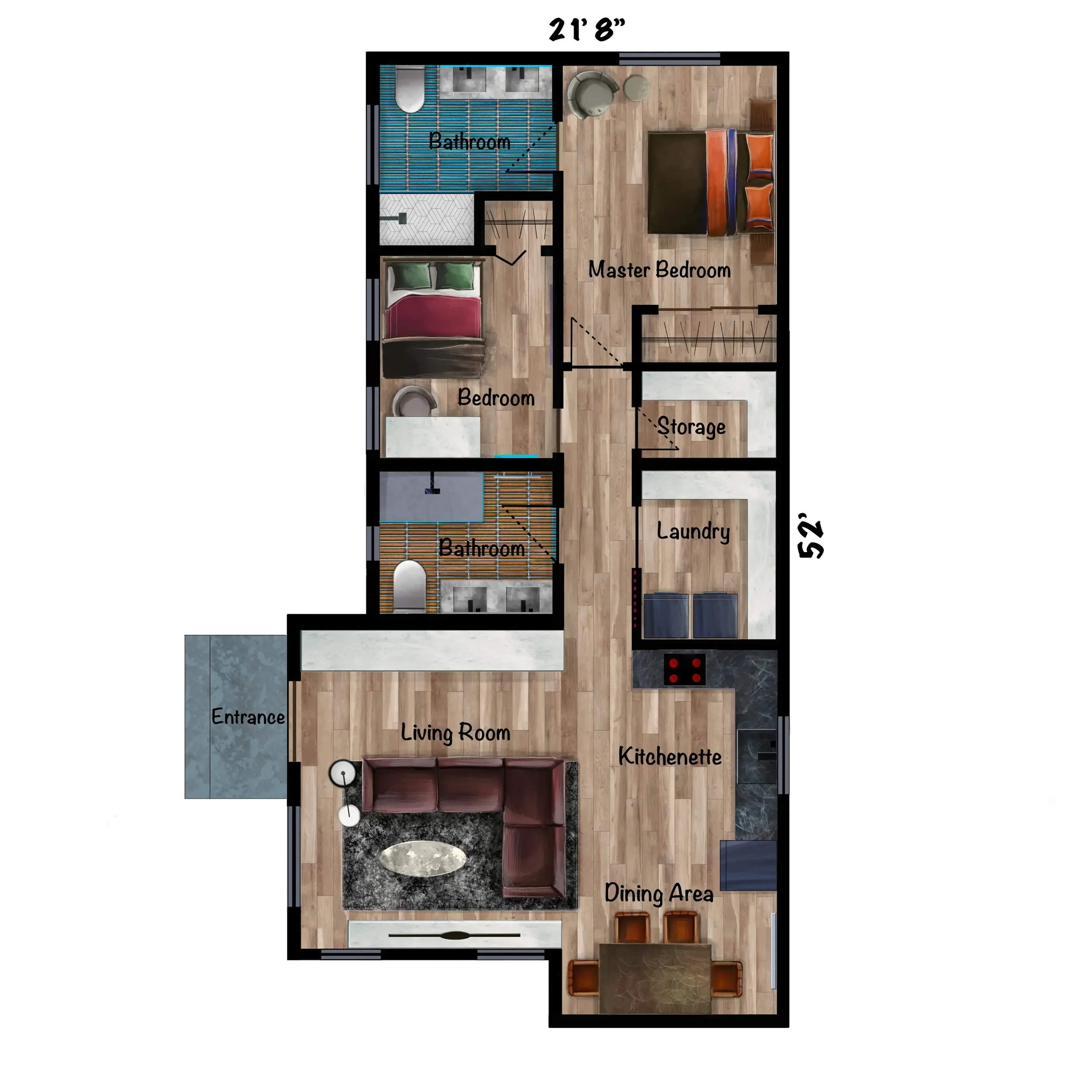
Custom 1,200 sq ft in-law suite floor plan, Los Angeles. 21′8″ × 52′ footprint. Master bedroom with closet (top right), second bedroom (middle left), two full bathrooms, living room with entry (bottom left), kitchen (bottom right), dining area, laundry room, and storage room.
2-Car Garage In-Law Suite Conversion
Among all the mother-in-law suite ideas available to Los Angeles homeowners, the two-car garage conversion consistently delivers the strongest combination of practicality and speed. A standard two-car garage brings to the project what most new construction has to start from zero to achieve: an existing structure, a concrete slab, proximity to the main home's utilities, and a footprint that typically runs between 400 and 600 square feet. The core investment in the building envelope is already made. The task is transformation, not construction from scratch.
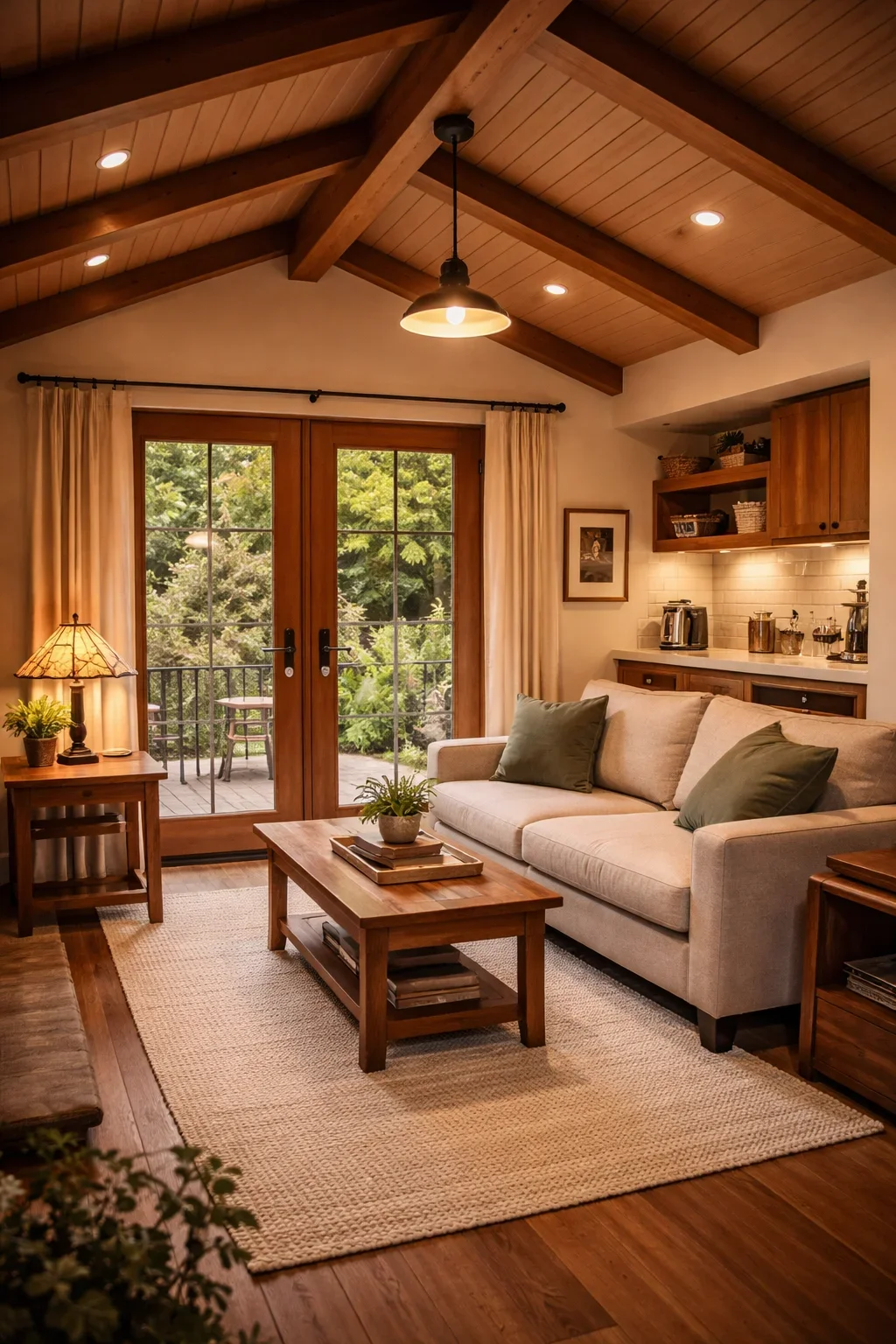
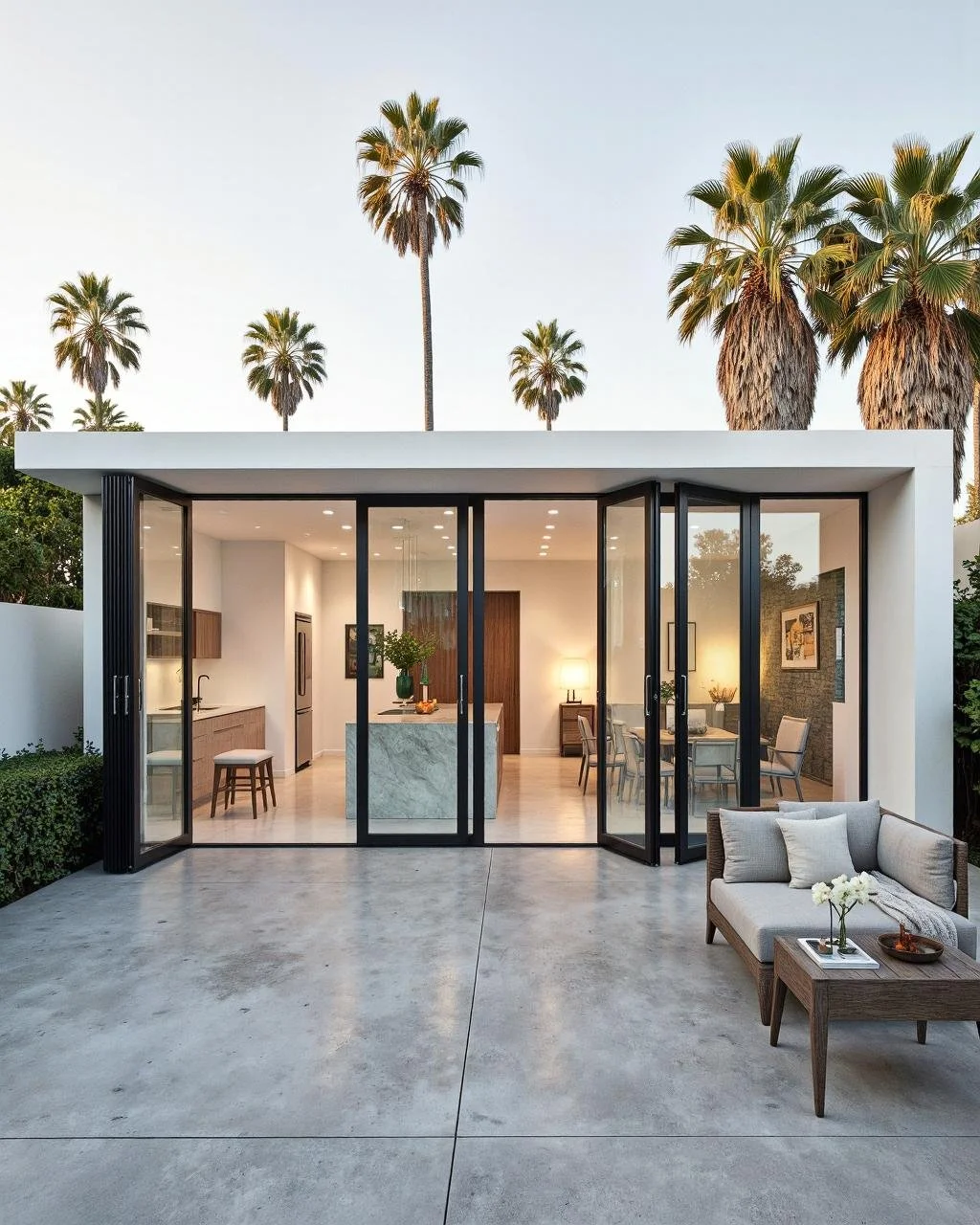
Garage in-law suite floor plans reorganize the open bay into a complete living unit — a bedroom or sleeping area, a living space, a kitchen, and a bathroom. Where ceiling height allows, a loft or raised sleeping platform introduces a second level without expanding the footprint, significantly increasing the spatial richness of the finished unit. The garage door opening — often spanning the full width of the structure — presents one of the more architecturally interesting opportunities in the conversion: replaced with a wall of glazing or a folding glass door system, it brings in light and outdoor connection that a conventional small building rarely enjoys.
California's planning rules are favorable to garage conversions, and the Los Angeles Department of Building and Safety has developed a more direct permitting pathway for these projects than for new detached construction. For homeowners who want a livable in-law suite on a compressed timeline, the garage conversion is typically the fastest route from decision to occupancy.
400-600 sq. ft. ADU

The Loft In-Law Suite
Among mother-in-law suite ideas worth serious consideration, the loft configuration stands apart. It is the approach that gets the most out of a small ground footprint by thinking vertically — stacking a mezzanine sleeping level above a complete main floor rather than spreading rooms horizontally across a lot that may not have the space to spare. On paper it reads compact. In person, it reads like a home.
The custom loft in-law suite shown here was designed for a Los Angeles property at 16.5 by 31.5 feet across two floors. The numbers are modest. The experience is not. The key spatial move is a central void that connects the mezzanine to the main floor below — an open section that allows light, air, and a sense of vertical volume to flow through the entire interior. You are not living in a box with a ladder. You are living in a small building that happens to occupy a small footprint.
On the main floor, the kitchenette anchors the upper-left corner with teal tile and a bar counter that keeps the cook visually present in the room rather than turned to a wall. The bathroom sits across from it — compact but fully equipped, finished in herringbone tile. A staircase running along the center of the plan creates a natural division between the functional upper zone and the living room below without acting as a barrier between them. The living room itself is the social heart of the floor — open, well-lit, and large enough for a real seating arrangement.
The loft level holds the private spaces. The bedroom occupies the quietest corner — elevated, removed from entry activity, with the natural privacy that height provides. Across from it, a dedicated office and study creates a defined workspace that has nothing to do with the kitchen table — an increasingly important distinction in how people actually use a home today. The open mezzanine void between the two ensures neither space feels isolated from the life happening on the floor below.
This in-law suite configuration speaks directly to a tenant type Los Angeles has in abundance: design-conscious, working from home at least part of the time, interested in a space with genuine architectural character. For homeowners, it solves the specific challenge of delivering a one-bedroom-plus-study residence on a footprint that most plans would treat as a studio limit.
Two Floors, One Foot Print
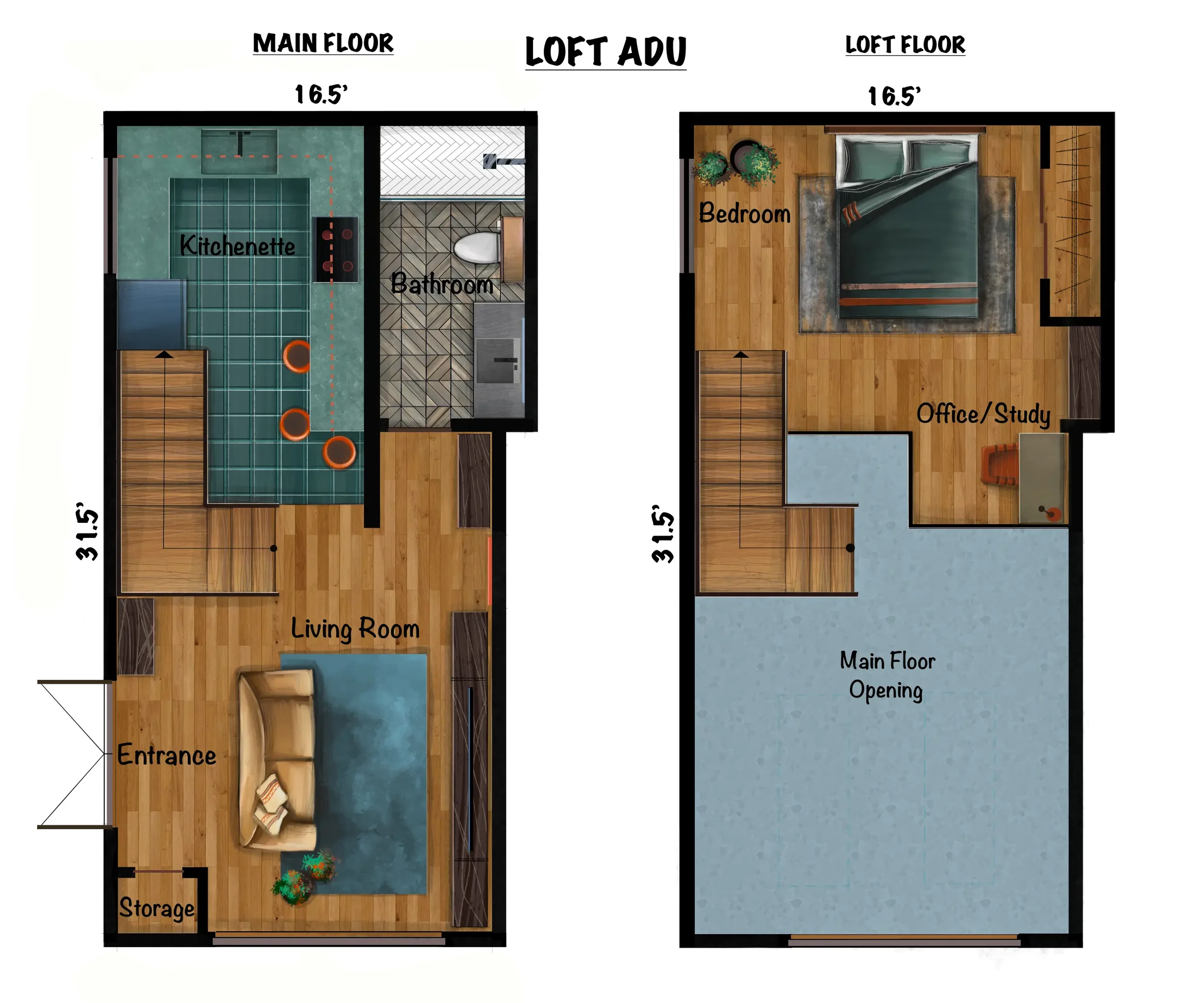
Custom Loft in-law suite floor plan, Los Angeles. 16.5′ × 31.5′ footprint across two floors. Main floor: kitchenette (top left), bathroom (top right), living room, storage. Loft: bedroom (top left), office/study (right), open mezzanine void.
In-Law Suite Addition Rules in California
The regulatory environment for in-law suite additions in California has changed significantly over the past several years — and almost entirely in the homeowner's favor. A series of state-level housing bills has steadily removed the restrictions that once made these projects difficult to permit: owner-occupancy mandates, excessive parking requirements, and minimum lot size thresholds have all been relaxed or eliminated. For most single-family lots in Los Angeles today, the question is no longer whether you can build an in-law suite, but what configuration is right for your specific property.
That specificity still matters. Each lot brings its own set of parameters — setback distances, zoning overlays, height restrictions, and utility connection requirements — that shape what an in-law suite home plan can look like before a designer draws a single line. The homeowners who navigate this process most smoothly are invariably the ones who nail down those parameters early, before design work begins, rather than discovering conflicts mid-permit. Working with an experienced contractor from the start is the most reliable way to avoid costly plan revisions down the line.
Regulatory Framework
Max In-Law Suite Size - 1,200 sq ft (detached); up to 50% of primary home (attached)
Setbacks - 4 ft from rear and side property lines (standard)
Height Restriction - 16 ft for detached In-Law Suites on most lots
Parking Requirement - None for most In-Law types under current California law
Junior In-Law Suite - Up to 500 sq ft within existing home structure
Los Angeles Construction Services
In-Law Suite Planning and Construction Services in Los Angeles
SKALWEST Construction builds in-law suites throughout Los Angeles and the surrounding communities — from compact backyard studios to full two-bedroom residences designed for long-term independent living. Every project begins the same way: with a thorough review of the property, an honest conversation about goals and constraints, and a floor plan developed specifically for the site rather than pulled from a generic catalog.
Our team manages the full arc of the project. That means reviewing lot conditions and zoning parameters before design begins, coordinating with designers on in-law suite floor plans that fit the property and the intended use, shepherding applications through the permitting process, and running construction from groundbreaking through final inspection. We handle the complexity so homeowners do not have to.
We work across a wide range of Los Angeles neighborhoods — Santa Monica, Pasadena, Beverly Hills, Malibu, Manhattan Beach, Hermosa Beach, Redondo Beach, Torrance, and Altadena among them. Each area has its own planning considerations, its own architectural sensibilities, and its own municipal review process. Our approach is calibrated to those local conditions while maintaining the consistent build quality and clear project communication that every client expects regardless of location.
In-law suites serve different families in different ways — rental income, multigenerational housing, guest accommodations, a private workspace. What all of these uses share is the need for a carefully considered floor plan and a construction process that delivers exactly what was designed. That is what we are here to do.
Frequently Asked Questions
Common Questions About In-Law Suite House Plans in LA
Under current California law, a detached in-law suite can be up to 1,200 square feet on most residential lots in Los Angeles. If you are building an attached in-law suite addition — one that shares a wall with the primary home — the maximum is generally up to 50% of the existing home's living area. A junior in-law suite, which must be contained entirely within the existing structure, is capped at 500 square feet. Specific lot conditions and zoning overlays can affect these limits, which is why a site review before design begins is always the right first step.
Yes — all in-law suite construction in Los Angeles requires permits through the Department of Building and Safety. This includes new detached structures, garage conversions, and attached additions. The permitting process involves plan check review, structural and mechanical approvals, and inspections at key stages of construction. While it adds time to the project timeline, working with an experienced contractor who handles permitting coordination — as SKALWEST does — keeps the process moving without unexpected delays or costly plan revisions.
The total timeline depends on the type and size of the project. A garage conversion typically moves the fastest — often 3 to 5 months from permit approval to occupancy — because the existing structure eliminates much of the early construction work. A new detached in-law suite generally runs 6 to 9 months depending on size and complexity. Permitting itself can take anywhere from 4 to 12 weeks in Los Angeles, which is why starting the process early and having a complete, accurate set of plans from the beginning matters so much for keeping the overall schedule on track.
A detached in-law suite is a fully separate structure on the same lot as the primary home — its own four walls, its own foundation, its own entrance. It offers the greatest degree of physical and acoustic separation between households, which makes it the preferred configuration for rental use and for multigenerational families who want genuine independence on both sides. An attached in-law suite shares at least one wall with the main house, which typically reduces construction cost and can be the right choice when the lot doesn't support a separate structure or when closer physical proximity between households is actually the goal.
Yes. California law explicitly permits in-law suites to be rented to tenants, and Los Angeles has no owner-occupancy requirement for most in-law suite types under current state legislation — meaning you do not need to live on the property to rent the unit out. Rental income from a well-located in-law suite in Los Angeles can be substantial, and two-bedroom configurations in desirable neighborhoods consistently attract strong tenant demand. It is worth confirming the specific rental rules for your property type and zoning district before committing to a configuration, as local ordinances can vary.
Construction costs in Los Angeles vary widely depending on the size, configuration, site conditions, and finish level of the project. As a general reference point, new detached in-law suites typically run between $250 and $400 per square foot, while garage conversions often come in lower given the existing structure. Soft costs — design fees, permitting, engineering — typically add 10 to 20% on top of construction. The most accurate way to understand the cost for your specific project is through a site consultation where actual lot conditions, access, utility connections, and your goals can all be factored in from the start.
For multigenerational living situations — a parent, in-law, or adult family member who will be using the suite as their primary residence — the 600 to 900 square foot range tends to hit the right balance for most families. It is enough space for a complete one-bedroom or two-bedroom layout with a real kitchen, a proper living area, and genuine independence, without the construction cost and timeline of a larger build. If the occupant has specific accessibility needs, mobility considerations, or simply values more space, a 1,000 or 1,200 square foot plan may be worth the additional investment from the outset.
In the vast majority of cases, yes — and often significantly. A permitted, well-built in-law suite adds a second rentable or livable unit to the property, which appraisers and buyers in the Los Angeles market treat as a meaningful value driver. Properties with income-producing in-law suites consistently command premiums over comparable single-family homes without them. The size of the value increase depends on the neighborhood, the quality of the build, and the configuration, but in high-demand Los Angeles zip codes, a 1,000 or 1,200 square foot in-law suite frequently adds more in appraised value than it costs to construct.
How To Choose The Right In-Law Suite Floor Plan in LA
Every in-law suite project starts with a different set of priorities, and the right plan is the one that serves those priorities honestly rather than chasing square footage for its own sake. A homeowner whose primary goal is rental income in a high-demand neighborhood will prioritize a different layout than a family designing a private long-term residence for an aging parent. Both are legitimate goals. Both call for different decisions on size, configuration, and finish level.
Compact in-law suite home plans in the 400 to 600 square foot range work best when budget efficiency and permitting speed are the driving constraints, or when the lot simply doesn't allow for more. Larger in-law suite house plans — 900 to 1,200 square feet — make the most sense when the unit needs to serve as a full primary residence, or when the property's location and rental market justify the additional construction investment. Between those two ranges sits a wide middle ground where design quality often matters more than raw square footage: a well-designed 500 square foot in-law suite addition floor plan, executed with the right proportions, materials, and attention to light, will outperform a carelessly planned 900 square foot unit on every measure that actually matters — livability, rental performance, and lasting value to the property.